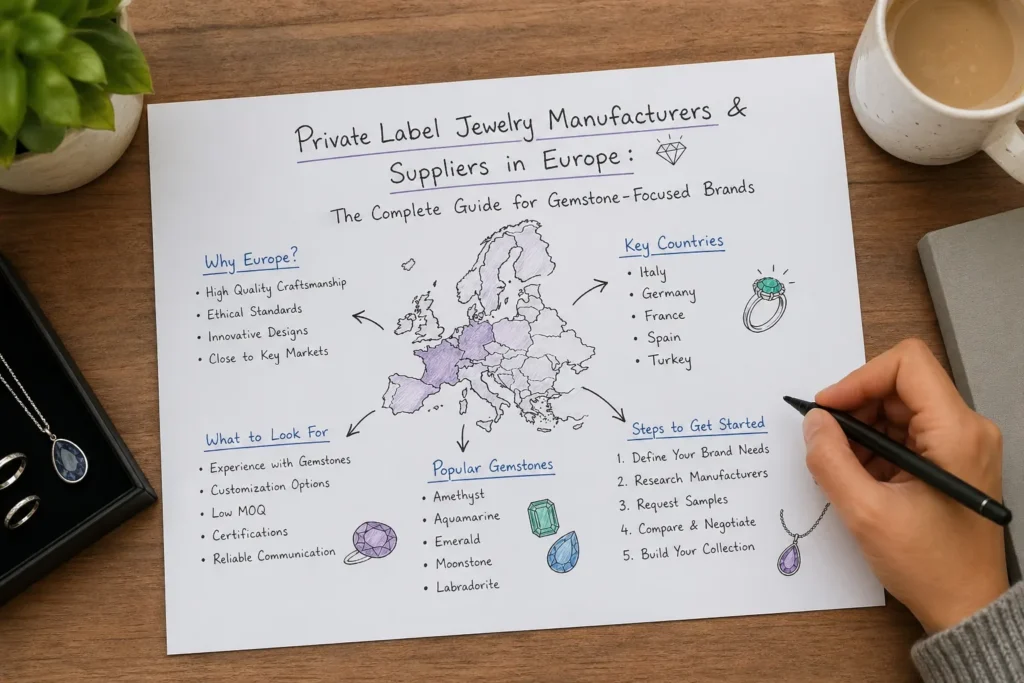
Introduction: Why Finding the Right Private Label Jewelry Partner in Europe Is Harder Than It Looks
The European private label jewelry market is booming. Driven by a new generation of boutique retailers, independent designers, and online jewellery brands across Germany, France, the UK, Italy, the Netherlands, and Scandinavia, the demand for exclusive, customised jewellery collections has never been greater. According to Statista, the European jewellery market is projected to surpass €28 billion by 2026, with private label and custom jewellery segments growing fastest of all.
Yet for European brands searching for the right manufacturing partner, the journey is riddled with frustration. A quick search for “private label jewelry manufacturers Europe” returns a confusing mix of Indian wholesale catalogues dressed up with European flags, generic B2B directories with no real supplier vetting, and marketplace platforms that treat gemstones as an afterthought. As one buyer candidly noted on Reddit’s r/ecommerce: “There are plenty of Asian websites that look European until you check the contact info.”
At Gemstones Universe, we understand this challenge better than most. With decades of deep expertise in natural gemstone sourcing, grading, and jewellery manufacturing, we have built long-standing partnerships with European brands, designers, and retailers who demand something the wider market simply cannot offer: jewellery where the gemstone is the centrepiece, not an afterthought.
This guide is your complete resource for navigating the world of private label gemstone jewellery manufacturing and supply in Europe. Whether you are launching your first collection, scaling an established brand, or sourcing exclusively for the European luxury market, what follows will save you months of costly trial and error.
What Is Private Label Jewellery Manufacturing, and Why Does It Matter for European Brands?
Private label jewellery manufacturing refers to the model where a manufacturer produces jewellery pieces to a brand’s exact specifications design, materials, gemstones, metalwork, and packaging which the brand then sells exclusively under its own name. It is distinct from wholesale purchasing (where brands buy pre-made stock from a shared catalogue) and white label (where generic products are simply rebranded).
For European brands, the private label model offers several decisive advantages:
Complete design exclusivity
Your sapphire pendant collection belongs only to you. No competitor can order the same piece from the same supplier.
Control over gemstone quality
European luxury consumers are increasingly educated about gemstone treatments, country of origin, and ethical sourcing. Private label partnerships allow you to specify exactly which stones you source and how they are graded.
Higher profit margins
working directly with a manufacturer rather than through multiple distribution layers, brands retain significantly more margin often 40 to 60 per cent more than traditional wholesale models.
Brand storytelling
The most successful jewellery brands in Europe today from emerging Scandinavian designers to established French maisons sell a story as much as a product. A private label partnership with a gemstone-specialist manufacturer gives you rich, authentic content: the origin of your rubies, the treatment-free nature of your sapphires, the ethical sourcing protocols behind your emeralds.
Speed to market
Working with an experienced manufacturer who already has gemstone sourcing networks and production infrastructure cuts development timelines dramatically, often from nine months to as few as six to ten weeks for initial sample collections.
It is also important to understand the difference between OEM (Original Equipment Manufacturer, where you provide the design) and ODM (Original Design Manufacturer, where the manufacturer designs to your brief). Both models are available through quality private label partners, and the best manufacturers offer both seamlessly.
The European Private Label Gemstone Jewellery Market: Key Trends for 2025–2026
Understanding what European consumers and buyers want is the foundation of any successful private label strategy. The market has shifted significantly in recent years, and brands that align with these trends are growing fastest.
The Rise of Gemstone-Led Collections
Across Europe, consumer appetite for natural gemstone jewellery has surged. Post-pandemic, buyers at all price points are gravitating toward pieces with inherent meaning and natural gemstones provide exactly that narrative. Amethyst, moonstone, tourmaline, and labradorite are performing strongly in the accessible luxury segment (€80 to €400 retail), while treatment-free sapphires, rubies, and paraiba tourmalines command premium prices in the fine jewellery tier.
European jewellery buyers, particularly in Germany, the Netherlands, and Scandinavia, are notably sophisticated about gemstone quality. Requests for gemological certificates, country of origin disclosure, and treatment declarations are now routine in B2B purchasing conversations.
Ethical and Sustainable Sourcing Is Non-Negotiable
The EU’s Corporate Sustainability Reporting Directive (CSRD) and the growing influence of frameworks like the Responsible Jewellery Council (RJC) have made ethical sourcing a commercial requirement, not merely a marketing angle. European retailers stocking your private label collection will increasingly ask for evidence of responsible gemstone sourcing particularly regarding conflict minerals, child labour policies, and environmental impact.
Manufacturers who can provide REACH-compliant products (free of harmful chemical substances regulated by EU legislation), RJC membership or certification, and traceable gemstone supply chains offer enormous value to European brand partners.
The “Buy European” Movement
There is a rapidly growing consumer and retailer preference across Europe for products manufactured within the EU or by manufacturers with genuine, verifiable European presence and partnerships. As one r/BuyFromEU Reddit thread with 67 upvotes showed, consumers are actively seeking European-made jewellery brands. While this does not mean all manufacturing must happen in Europe, it does mean European brands need to work with partners who understand EU standards, can ship efficiently within the EU, and hold relevant international certifications.
Demi-Fine Gemstone Jewellery Is the Fastest-Growing Segment
Between costume fashion jewellery and fine jewellery lies the demi-fine segment typically sterling silver or vermeil settings with genuine, semi-precious gemstones. This segment has exploded across European markets, bridging the gap between accessibility and authenticity. It is also the ideal entry point for private label brands: lower capital outlay than fine jewellery, dramatically higher perceived value than fashion jewellery, and enormous scope for gemstone-led storytelling.
The Most In-Demand Gemstones for Private Label Collections in Europe
One of the most critical and most overlooked aspects of private label jewellery manufacturing for European markets is gemstone selection. No competitor currently ranking on page one of Google for this keyword provides meaningful guidance on which gemstones resonate with European buyers. We are changing that now.
Sapphire
Blue sapphire remains the single most requested coloured gemstone in European fine and demi-fine private label collections. The British royal connection (Princess Diana’s and Kate Middleton’s engagement rings) has made blue sapphire a perennial bestseller across the UK and Northern Europe. For private label collections, the most commercially successful approach is offering a range across price tiers: heated Sri Lankan sapphires at accessible price points, and treatment-free Ceylon or Kashmir sapphires at premium positioning. European buyers are increasingly requesting AGL, GRS, or Gübelin certificates for top-tier stones.
Ruby
Natural ruby commands extraordinary prices in the European fine jewellery sector, but the private label opportunity lies in genuine, commercial-grade rubies in sterling silver settings a combination that delivers authentic gemstone value at accessible retail price points between €120 and €350. Mozambique rubies have become commercially significant for the segment, offering vivid colour at more approachable price points than Burmese material.
Emerald
Colombian and Zambian emeralds are the dominant choices for European private label collections. European buyers in the luxury segment are particularly attentive to clarity and treatment status heavily oiled emeralds are increasingly undesirable at premium price points. Minor oiling with industry-standard resins is accepted when disclosed. For private label purposes, Zambian emeralds offer excellent colour saturation and value positioning, particularly in 925 silver settings.
Moonstone
Rainbow moonstone and peach moonstone have become signature stones for European boutique and designer jewellery brands, particularly in the UK, Germany, and the Nordic countries. The ethereal adularescence the internal glow photographs beautifully for social media, making moonstone a strategic choice for brands building visual identity. Moonstone is highly accessible for private label programmes, with no significant treatment concerns, and pairs elegantly with both yellow gold vermeil and oxidised silver settings.
Tourmaline
Paraiba tourmaline from Brazil and Mozambique has become one of the most coveted gemstones in the European luxury market, while more accessible tourmaline varieties pink, green, bi-colour, and watermelon are performing strongly in the accessible luxury segment. Tourmaline’s extraordinary colour range makes it ideal for private label collections requiring distinctive visual identity.
Labradorite, Amazonite, and Chalcedony
For brands targeting the accessible and bohemian luxury segments strong in the UK, Germany, France, and the Netherlands these opaque and translucent stones offer exceptional visual impact at very favourable cost positions. They are ideal for demi-fine private label programmes with retail price points between €45 and €180.
Tanzanite
Found exclusively in Tanzania, tanzanite is experiencing growing demand in European markets, particularly among buyers who seek distinctive, story-driven gemstones. Its trichroic nature displaying blue, violet, and burgundy simultaneously provides compelling retail narrative. For private label collections targeting premium positioning, tanzanite in white gold or platinum settings commands excellent retail margins.
How to Choose the Right Private Label Gemstone Jewellery Manufacturer for Your European Brand?
This is where most guides fail completely by simply listing manufacturers without giving European brands a rigorous vetting framework. Here is the criteria you must apply.
Criterion 1: Genuine Gemstone Expertise, Not Just Gemstone Mentioning
There is a critical difference between a manufacturer who uses gemstones and one who understands gemstones. Ask any prospective manufacturing partner the following questions:
- Can you specify the origin of the gemstones used in my collection?
- What gemstone treatment disclosures do you provide?
- Do you work with certified gemologists on your quality control team?
- Can you source treatment-free stones for premium collection tiers?
- Which gemological laboratories (GIA, AGL, GRS, Gübelin, IGI) do you work with for certification?
A manufacturer who cannot answer these questions with confidence and specificity is not equipped to build a gemstone-led private label collection.
Criterion 2: Verifiable European Credentials, Not Just European Flags on the Website
The Reddit r/ecommerce buyer identified this problem precisely: many websites targeting European buyers are India or China-based operations with European domain extensions and stock photos of European cities. Verify the following before any commitment:
- Request a video call to verify the actual manufacturing facility
- Ask for evidence of EU compliance (REACH regulations, CE marking where relevant, Nickel Directive compliance for metal components)
- Verify whether the company has genuine European client references not just claimed European shipping destinations
- Check whether the company has participated in verifiable European trade shows (Vicenzaoro, Inhorgenta Munich, Bijorhca Paris, IJL London)
Criterion 3: EU REACH Compliance and Chemical Safety
The EU’s REACH regulation (Registration, Evaluation, Authorisation and Restriction of Chemicals) applies directly to jewellery products sold in European markets. Key requirements include restrictions on nickel release from items in contact with skin, limits on cadmium in silver-soldered jewellery, and restrictions on certain hazardous substances in plating processes. Any private label jewellery partner serving European brands must be able to demonstrate REACH compliance through relevant testing documentation.
Criterion 4: Minimum Order Quantities That Match Your Business Stage
The private label jewellery market in Europe spans emerging designers testing their first 50-piece collection to established brands ordering 10,000 units per style. Your manufacturing partner’s MOQ structure should match your business stage. Be cautious of manufacturers who set artificially high MOQs to increase order values, particularly in the gemstone category where individual stone costs already represent significant investment.
Criterion 5: Transparent Pricing and Gemstone Traceability
A quality private label gemstone jewellery partner provides full cost breakdowns: metal costs, gemstone costs (with origin and treatment notes), labour, finishing, certification, and packaging. Hidden gemstone substitution where specified stones are swapped for lower-grade material after sample approval is an industry problem. Demand transparent documentation throughout production.
Criterion 6: Quality Control Systems and Sample Protocols
Before committing to production runs, always request a full sample. Evaluate the sample against the following specific gemstone criteria:
- Colour consistency across a batch of the same stone type
- Absence of visible inclusions that were not disclosed in the specification
- Setting security (stones should withstand gentle pressure tests without movement)
- Accurate stone dimensions matching specified parameters
- Appropriate surface polish and finish
Criterion 7: Shipping, Logistics, and EU Customs Expertise
For European brands importing from outside the EU, customs classification, duty rates, and import VAT are significant operational considerations. Jewellery containing precious metals and gemstones falls under specific customs codes, and a manufacturing partner experienced with European importers should be able to provide accurate HS codes, proper customs valuation documentation, and DDP (Delivered Duty Paid) shipping options to remove customs complexity from your operations.
Leading Private Label Jewelry Manufacturers & Suppliers Serving Europe: An Honest Overview
The European and Europe-serving private label jewellery market spans a spectrum from genuinely European manufacturers to Asia-based specialists with strong European credentials. Here is an honest, category-based overview of the landscape.
Genuinely European Manufacturers
Portugal
has emerged as a significant jewellery manufacturing hub, benefiting from centuries of goldsmith tradition, EU membership (enabling seamless intra-EU trade), and competitive production costs relative to France, Italy, and the UK. Portuguese manufacturers offer genuine filigree craftsmanship, strong sustainability credentials, and fast EU shipping typically three to five business days across continental Europe.
Italy
remains the world’s reference point for luxury jewellery manufacturing, with clusters in Vicenza, Arezzo, and Valenza. Italian manufacturers are ideal for fine jewellery and luxury private label collections where provenance and “Made in Italy” carry genuine commercial premium. However, minimum order quantities and pricing reflect the cost structure of European manufacturing, making Italian partners better suited to established brands than emerging designers.
Germany
jewellery manufacturing base, centred around Pforzheim (historically known as the “Golden City”), specialises in precision technical jewellery and has strong expertise in regulatory compliance and quality certification important considerations for European market access.
India-Based Manufacturers with Genuine European Expertise
Jaipur, India, has become one of the world’s most significant jewellery manufacturing centres, and for good reason. The combination of access to natural gemstones (Jaipur is the world’s premier gemstone trading and cutting centre), skilled master craftsmen, modern CAD and casting facilities, and significantly lower production costs than European manufacturing makes Jaipur an attractive option for European brands seeking quality gemstone jewellery at competitive price points.
The critical distinction, however, is between Jaipur manufacturers who genuinely understand the European market its quality expectations, ethical sourcing requirements, certification standards, and consumer sophistication and those who simply claim European expertise through website localisation. Gemstones Universe, based in Jaipur with deep European client relationships, sits firmly in the former category.
B2B Marketplace Platforms
Platforms like Wonnda (Berlin-based), Ensun (Germany-based), and similar aggregators offer convenience but not gemstone expertise. They are best used as starting-point directories for discovering manufacturers, but the vetting process described in this guide must still be applied to any supplier discovered through these platforms. Notably, none of the major B2B marketplace platforms currently serving European jewellery brands have meaningful gemstone expertise embedded in their supplier vetting processes.
The Private Label Gemstone Jewellery Manufacturing Process: From Brief to Finished Collection
Understanding the manufacturing process gives European brands a significant advantage in managing timelines, expectations, and quality outcomes. Here is what a well-managed private label gemstone jewellery programme looks like end to end.
Stage 1: Design Brief and Gemstone Strategy (Weeks 1–2)
The process begins not with design software but with a gemstone strategy conversation. For a gemstone-led private label collection, decisions about stone selection, colour palette, treatment policy, certification requirements, and price positioning must be made before design begins, because they fundamentally determine what is possible within budget.
At this stage, you should receive from your manufacturing partner: a gemstone availability report for your specified stones, indicative pricing across quality tiers, initial opinions on setting styles that showcase your chosen gemstones optimally, and a clear statement of the manufacturer’s ethical sourcing protocols.
Stage 2: CAD Design and Digital Prototyping (Weeks 2–4)
Experienced CAD designers translate your brief into precise three-dimensional models. For gemstone jewellery specifically, CAD must accurately represent prong configurations, bezel dimensions, and stone seat angles to ensure the actual gemstones will be held securely and displayed optimally in the final piece. Request photorealistic renders showing the actual gemstone colour (not generic placeholder colours) before approving CAD files.
Stage 3: Gemstone Procurement and Grading (Weeks 3–5, parallel to CAD)
Parallel to the design process, your manufacturing partner should be sourcing and grading the gemstones for your collection. This is where the distinction between a true gemstone specialist and a generic manufacturer becomes most apparent. Gemstone procurement for a premium private label collection involves: selecting stones from multiple parcels to ensure colour consistency across your production run, applying your specified quality parameters (clarity grade, colour intensity, treatment status), and arranging any required third-party gemological certification.
Stage 4: Physical Sample Production (Weeks 5–8)
Physical samples incorporate the actual gemstones specified for your collection not substitute stones. This is critically important: some manufacturers produce samples with premium gemstones but substitute lower-grade material in production runs. Establish a formal sample approval document that specifies exact stone parameters, and require production samples to be matched against this document before any full production run is authorised.
Stage 5: Sample Review and Refinement (Weeks 8–10)
Review physical samples systematically against your gemstone quality parameters and design specifications. Professional photography of samples under standardised lighting conditions is recommended for documentation purposes. Refinements at this stage prong repositioning, stone seat adjustment, finish changes are normal and should be accommodated by your manufacturing partner without additional design charges.
Stage 6: Production Run and Quality Control (Weeks 10–16)
Full production of a gemstone private label collection involves multiple quality checkpoints: incoming gemstone inspection against approved specifications, mid-production checks for setting security and consistency, and final pre-shipment inspection covering finish quality, dimensional accuracy, and packaging compliance.
Stage 7: Certification, Hallmarking, and Documentation (Weeks 15–17)
For European markets, ensuring appropriate hallmarking for precious metal content, preparing customs documentation accurately describing gemstone content and values, and arranging any required gemological certificates for individual pieces should be coordinated at this stage. Your manufacturing partner should manage this process with experience and precision.
Stage 8: Logistics and EU Delivery (Weeks 17–18)
For Europe-bound shipments, your manufacturing partner should provide: accurate HS codes for customs classification, detailed commercial invoices with per-piece gemstone descriptions, fully insured shipping appropriate to the declared value, and either DDU or DDP Incoterms depending on your preference for handling customs clearance.
EU Regulations Every European Jewellery Brand Must Understand
REACH Compliance
The EU’s REACH regulation restricts certain chemical substances in products sold within the European Economic Area. For jewellery brands, the key provisions concern nickel release rates from items in prolonged skin contact, cadmium content limits (particularly relevant for soldered sterling silver), and restrictions on certain dyes and surface treatment chemicals. Any jewellery imported into the EU for sale must comply with REACH, and responsibility ultimately rests with the brand placing the product on the EU market. Require your manufacturing partner to provide REACH compliance testing certificates for your product lines.
Hallmarking Requirements
Hallmarking requirements vary by country within Europe. The UK, Ireland, Sweden, Finland, Denmark, the Netherlands, Austria, Cyprus, Czech Republic, Hungary, Israel, Latvia, Lithuania, Norway, Poland, Portugal, Sweden, and Switzerland are signatories to the International Hallmarking Convention, which provides mutual recognition of hallmarks. Other EU countries have their own national requirements. Understand the hallmarking requirements of each European market you sell into and ensure your manufacturing partner can accommodate the relevant standards.
Consumer Information Regulations
The EU Consumer Rights Directive and individual national consumer protection laws require clear disclosure of material composition for jewellery products. For gemstone jewellery specifically, this means accurately describing gemstone types (using correct mineralogical names rather than trade names), disclosing treatments (heat treatment, oiling, irradiation, etc.), and not misrepresenting laboratory-created gemstones as natural stones.
Import Duties and VAT
Jewellery imported into the EU from non-EU countries is subject to import duties (typically 2.5% for most precious metal jewellery and 4% for some categories) and import VAT at the destination country’s applicable rate. Understanding the landed cost of your private label collection including duties and VAT is essential for accurate margin calculation. Work with a manufacturing partner experienced in EU importation, or engage a specialist customs broker.
Why Gemstones Universe Is the Ideal Private Label Gemstone Jewellery Partner for European Brands?
At Gemstones Universe, our positioning in the private label jewellery market is fundamentally different from every other manufacturer or supplier you will encounter during your search and that difference is built on one word: gemstones.
We Are Gemstone Experts First, Jewellery Manufacturers Second
Our foundation is decades of deep expertise in natural gemstone sourcing, grading, and gemology. While other manufacturers treat gemstones as a component a box to tick in the specification sheet we treat each gemstone as the soul of the jewellery piece it inhabits. This means:
We source directly from origin markets Sri Lanka for sapphires, Colombia and Zambia for emeralds, Mozambique and Burma for rubies, Tanzania for tanzanite, Brazil for paraiba tourmaline giving our European private label partners access to gemstones at the source, with full provenance documentation.
We apply rigorous, internationally recognised grading standards to every stone that enters our private label programmes. Our gemological team evaluates colour, clarity, cut, carat weight, and treatment status for every parcel we acquire.
We provide complete treatment transparency not as a compliance exercise, but because European luxury consumers deserve to know exactly what they are buying. Our private label documentation includes stone-by-stone treatment disclosure as standard.
Our European Market Understanding Is Built on Real Relationships
Gemstones Universe has served European jewellery designers, retailers, and brands across the UK, Germany, France, the Netherlands, Italy, Scandinavia, and beyond. We understand the quality expectations of a German fine jewellery retailer, the design sensibility of a French boutique brand, the ethical sourcing demands of a British online jewellery business, and the value positioning required for the competitive Nordic market.
Our Private Label Programme Is Designed for European Brands
Our European private label programme is structured to deliver what page-one competitors simply cannot:
Gemstone-specific collection development:
We begin every private label engagement with a gemstone strategy session advising on stone selection, quality tiers, treatment policies, and certification requirements appropriate for your target market and price positioning.
Flexible MOQ with no compromise on gemstone quality:
We work with brands at all stages, from initial collections of 30 to 50 pieces per design to high-volume production programmes. Our MOQ flexibility never comes at the cost of gemstone quality standards.
EU REACH-compliant production:
All metalwork in our private label collections is produced to EU REACH standards, with testing documentation available on request.
EU-experienced logistics:
We ship exclusively insured, with complete customs documentation including accurate gemstone descriptions, HS codes, and declared values to facilitate smooth EU customs clearance.
Full collection storytelling support:
We provide our private label partners with gemstone origin information, treatment documentation, and gemstone educational content that can be used directly in your product descriptions, social media, and marketing materials giving your brand the gemstone authority that European luxury consumers increasingly expect.
Certifications on request:
For premium collection tiers, we coordinate IGI, GIA, and AGL certification for individual gemstones and finished pieces, providing your European customers with the third-party validation that supports premium pricing.
Frequently Asked Questions: Private Label Gemstone Jewellery for European Brands
Q1: How do I know if a manufacturer claiming to be European actually is?
Ans1: Request a video call tour of the actual production facility. Ask for verifiable trade show attendance records at European events (Vicenzaoro, Inhorgenta, IJL). Request references from European client brands you can contact directly. Check the company’s VAT registration a genuine EU business will have an EU VAT number.
Q2: What is the typical lead time for a private label gemstone jewellery collection?
Ans2: For a first collection including design development, gemstone sourcing, sampling, and production, allow 12 to 18 weeks from brief to delivery. Established collections with approved designs can turn around in 6 to 8 weeks. Rush programmes are possible but carry quality risk do not compromise gemstone sourcing timelines.
Q3: What minimum order quantities should I expect for gemstone jewellery private label?
Ans3: MOQs vary significantly by manufacturer and gemstone type. For natural gemstone jewellery in sterling silver, MOQs of 25 to 50 pieces per design are realistic from specialist manufacturers. For fine jewellery with certified sapphires, rubies, or emeralds, MOQs may be set per-stone-weight rather than per-piece. Avoid manufacturers who insist on very high MOQs (500+ pieces) for initial gemstone collections this suggests a factory model not designed for private label partnership.
Q4: Do I need gemological certificates for every piece in my private label collection?
Ans4: For consumer-facing retail in Europe, full certificates for every piece are not always necessary or commercially viable. However, treatment disclosure documentation (confirming heat treatment status, oiling, irradiation, etc.) should accompany every batch, and individual GIA, AGL, or equivalent certificates are recommended for stones above approximately 0.50 carats in fine jewellery collections. For demi-fine collections with smaller semi-precious stones, a batch quality report from a reputable gemologist is an appropriate and commercially practical alternative.
Q5: How does EU REACH compliance work for imported jewellery?
Ans5: Any brand placing jewellery on the EU market whether manufactured in Europe or imported is responsible for ensuring REACH compliance. The most relevant provisions concern nickel release rates (maximum 0.5μg/cm²/week for items in prolonged skin contact), cadmium limits, and restrictions on certain other substances. Work with a manufacturing partner who can provide current REACH compliance test reports for the specific alloys and plating solutions used in your collection, and ensure you retain these documents as the entity placing goods on the EU market.
Q6: Can I request treatment-free gemstones for my premium private label collection?
Ans6: Yes, and you should for genuinely premium positioning. Treatment-free sapphires, rubies, and emeralds command significant price premiums and provide compelling retail narratives for European luxury consumers. Your manufacturing partner must have direct access to treatment-free parcel sourcing this requires established relationships with origin market suppliers, not just access to wholesale trading markets. At Gemstones Universe, treatment-free sourcing is a standard capability, not an exception.
Q7: What is the difference between private label, white label, and OEM/ODM for jewellery?
Ans7: Private label means the manufacturer produces to your exact design specifications, exclusively for your brand. White label means the manufacturer’s existing designs are sold under your brand name you have less design control but faster time to market. OEM (Original Equipment Manufacturer) describes production to your supplied design, while ODM (Original Design Manufacturer) means the manufacturer creates the design to your brief. Most sophisticated private label jewellery partners, including Gemstones Universe, offer all four models depending on the client’s needs and business stage.
Q8: How should I present gemstone quality to my European customers?
Ans8: European jewellery consumers are increasingly educated about gemstones and respond positively to transparent, specific quality information. Rather than vague language like “high-quality gemstones,” provide specific details: “Natural, heat-treated blue sapphire, 1.2ct, Vivid Blue, VS clarity, Sri Lanka origin” or “Treatment-free Mozambique ruby, 0.8ct, Pigeon Blood colour range, minor silk inclusions.” This level of specificity builds consumer trust and supports premium pricing. Gemstones Universe provides exactly this documentation with every private label collection.
Building a Gemstone-Led Private Label Brand for the European Market: A Strategic Checklist
Before you approach any private label manufacturing partner, work through this checklist to sharpen your brief and strengthen your negotiating position.
Brand positioning:
Define your target price point, target consumer (boutique retailer, online DTC, department store buyer), and the gemstone story you want to tell. The more specific your brief, the more effective your manufacturing partnership will be.
Gemstone selection:
Choose two to four hero gemstones for your launch collection based on European market demand trends, your price positioning, and the visual identity you want to build. Avoid spreading too thin across stone types in an initial collection.
Treatment policy:
Decide your treatment policy before approaching manufacturers. For premium positioning: treatment-free or minor heat treatment only, with full disclosure. For accessible positioning: industry-standard treatments disclosed transparently.
Certification strategy:
Determine which pieces in your collection warrant individual gemological certificates, and which will be supported by batch quality documentation.
Compliance readiness:
Understand the REACH requirements, hallmarking standards, and consumer disclosure obligations for each European market you plan to sell into.
Packaging and branding:
European luxury consumers value packaging as part of the product experience. Define your unboxing experience materials, sustainability credentials, brand storytelling inserts as part of your manufacturing brief.
Photography and content:
Plan your gemstone photography approach from the outset. Natural gemstones photograph differently from synthetics and require specific lighting setups to capture adularescence, asterism, and pleochroism accurately.
Conclusion: The European Private Label Gemstone Jewellery Opportunity Is Yours to Take
The European private label jewellery market is crowded with suppliers claiming expertise they do not have, manufacturers with European website addresses and Asian production facilities, and marketplace platforms that treat gemstones as a generic category. The result is a profound content and expertise vacuum and a significant commercial opportunity for brands willing to invest in genuine gemstone knowledge and authentic supply chain relationships.
The brands winning in the European jewellery market in 2025 and 2026 are those who have built their private label collections on a foundation of gemstone authenticity, transparent quality standards, ethical sourcing, and compelling storytelling. These brands are not competing on price they are competing on meaning, and they are winning.
Gemstones Universe is built to support exactly these brands. With our unmatched expertise in natural gemstone sourcing and grading, our deep understanding of European market requirements, our EU REACH-compliant production processes, and our commitment to full treatment transparency and provenance documentation, we offer European private label jewellery brands what no other manufacturer on this page can: genuine gemstone authority.
Ready to build a private label gemstone jewellery collection that European consumers will love and retailers will demand?
Contact Gemstones Universe today to begin your private label consultation. Share your brief, your gemstone vision, and your European market ambitions and let our gemstone experts help you create something extraordinary.
About Gemstones Universe
Gemstones Universe is a world-leading company in natural gemstone sourcing, grading, and gemstone jewellery. With decades of expertise spanning planetary gemstones, astrological gemstones, natural sapphires, rubies, emeralds, and hundreds of rare and precious stone varieties, Gemstones Universe serves jewellery brands, designers, retailers, and private collectors across Europe, the United States, Australia, and beyond. Our private label jewellery programme combines unrivalled gemstone expertise with precision manufacturing, ethical sourcing protocols, and the transparency standards that European luxury consumers demand.