


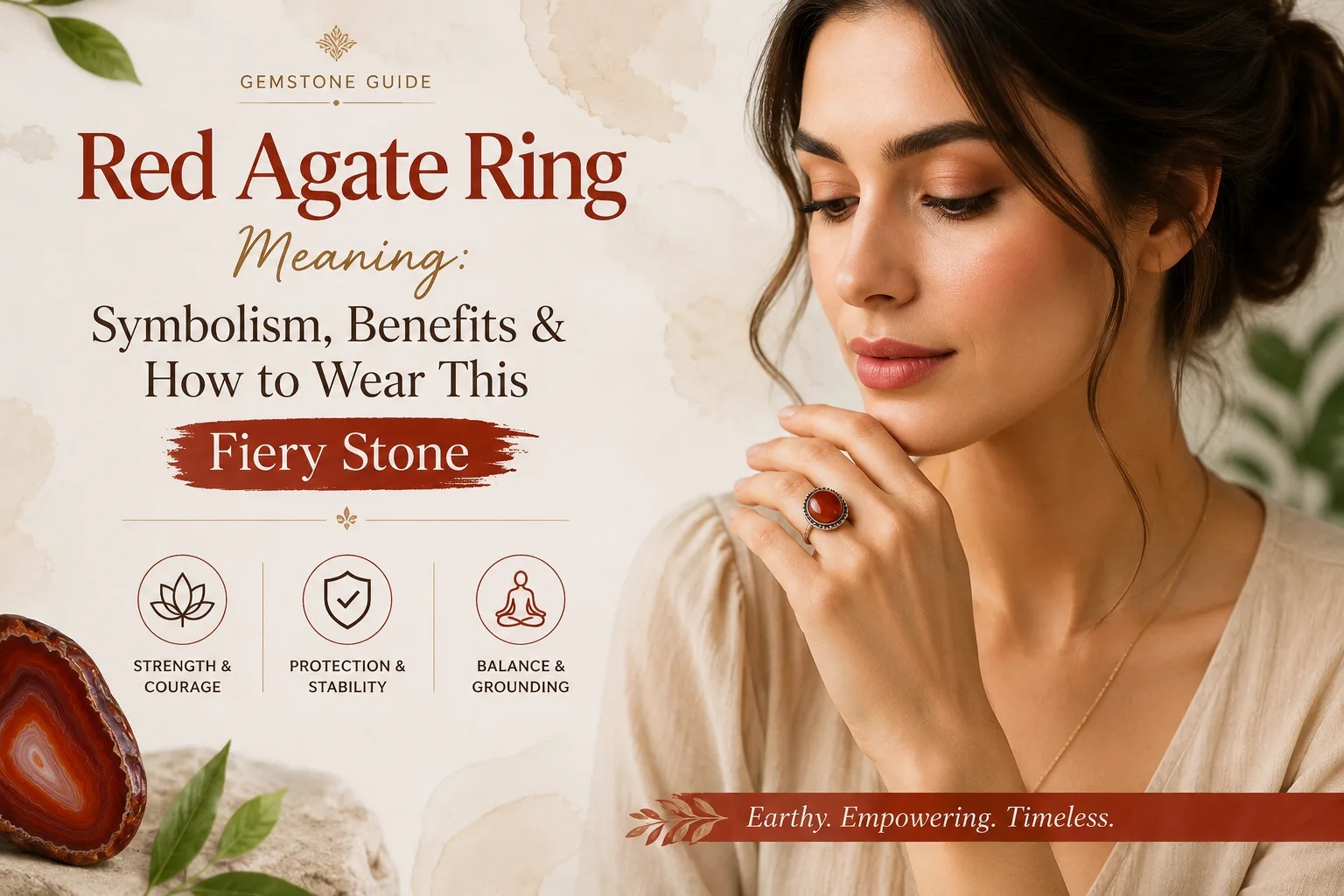
Red Agate Ring Meaning: Symbolism, Benefits & How to Wear This Fiery Stone
There’s a reason red agate has been set into rings for more than 3,000 years. Babylonian merchants pressed it into seals. Egyptian warriors carried it into battle. Roman senators wore it carved into signets, and to this day, brides in parts of Asia receive red agate as a blessing for a long and passionate marriage. Few gemstones have traveled through so many civilizations while keeping their meaning so remarkably intact: courage, protection, vitality, and grounded strength.
If you’ve recently bought a red agate ring, inherited one, or simply found yourself drawn to that deep, fiery crimson in a jewelry case, you’re probably wondering what this stone actually represents and whether there’s any substance behind the centuries of lore.
This complete guide covers everything: the meaning and symbolism of a red agate ring, its history across cultures, its spiritual and healing associations, which finger and hand to wear it on, its zodiac connections, how to tell genuine red agate from dyed imitations, and how to care for your ring so it lasts a lifetime. By the end, you’ll understand exactly why this “Warrior’s Stone” has never gone out of style and how to choose a piece that’s right for you.
Red Agate Ring Meaning at a Glance
Short on time? Here’s the quick answer:
A red agate ring symbolizes courage, inner strength, protection, vitality, and emotional stability. Known as the “Warrior’s Stone,” red agate is believed to ground its wearer during stressful times, shield against negative energy, ignite passion and motivation, and build the quiet confidence needed to face challenges head-on. Worn as a ring, the stone stays in constant contact with your skin and within your line of sight a continuous, personal reminder of your own resilience.
| Attribute | Meaning |
| Core symbolism | Courage, strength, protection, passion, vitality |
| Emotional meaning | Stability, security, confidence, calm under pressure |
| Spiritual association | Root chakra (grounding) and sacral chakra (passion) |
| Element | Fire and Earth |
| Zodiac signs | Capricorn, Scorpio, Taurus, Aries |
| Nicknames | Warrior’s Stone, Red Eye Agate, Nanhong (China), Aqeeq (Middle East) |
| Mohs hardness | 6.5–7 (durable enough for daily wear) |
| Best fingers | Index (leadership), middle (balance), ring finger (relationships) |
Now let’s go deeper starting with what red agate actually is.
What Is Red Agate? The Stone Behind the Ring
Before we explore meaning, it helps to understand the gemstone itself, because red agate’s physical nature is woven directly into its symbolism.
Red agate is a variety of chalcedony, a microcrystalline form of quartz composed primarily of silicon dioxide. What gives the stone its signature color is iron oxide the same mineral compound that colors desert canyons and red clay earth. Depending on iron concentration and how the stone formed, red agate ranges from bright scarlet and orange-red to deep brick, oxblood, and earthy maroon. Many specimens display the banding agate is famous for: concentric rings and ribbons of color laid down layer by layer as mineral-rich water seeped into volcanic cavities over millions of years.
That formation story matters. Each band in a red agate represents a slow, patient deposit of silica sometimes spanning tens of thousands of years per stone. Ancient cultures didn’t know the geology, but they sensed it intuitively: agate has always been read as a stone of patience, endurance, and strength built gradually rather than granted suddenly. When you wear a red agate ring, you’re literally wearing time made visible.
A few practical facts about the stone:
- Hardness: Red agate measures 6.5 to 7 on the Mohs scale, which makes it harder than glass and durable enough for rings worn every day a genuine advantage over softer “meaning stones” like malachite or opal.
- Sources: Significant deposits come from Brazil, Uruguay, India, Madagascar, Botswana, Mexico, and China’s Yunnan province (home of the prized nanhong or “southern red” agate).
- Finish: Most ring stones are cut as smooth cabochons to showcase color and banding, though faceted red agate and carved signet styles are increasingly popular in American fine jewelry.
- Related names: You may see red agate sold as red eye agate, fire agate (technically a different variety), carnelian agate, or aqeeq/akik in Middle Eastern and South Asian jewelry traditions.
One important distinction for shoppers in the USA: red agate and carnelian are close cousins, not identical twins. Both are chalcedony colored by iron, but carnelian is typically translucent and evenly colored, while true red agate shows visible banding or layered patterns. We’ll compare them in detail later in this guide.
The Symbolism of a Red Agate Ring: What It Really Means
Across nearly every culture that has worked with this stone, four core meanings repeat again and again. Together, they explain why red agate became and remains one of the most worn talismanic ring stones in the world.
1. Courage and Inner Strength
Red agate’s most enduring title is the Warrior’s Stone. The association began on actual battlefields: ancient Egyptians and later Roman soldiers set red agate into armor, shields, and rings in the belief that it granted bravery and protected the wearer from harm. Over the centuries, the battlefield became metaphorical. Today, a red agate ring is worn for modern acts of courage the job interview, the difficult conversation, the presentation, the fresh start after loss. It symbolizes the resolve to face what’s in front of you rather than retreat from it.
2. Protection and Security
Long before it meant courage, agate meant protection. Babylonians carved it into amulets and cylinder seals. Persian magi believed it could turn away storms. In Middle Eastern tradition, the aqeeq (agate) ring is still considered a guard against the evil eye and negative intentions. A red agate ring carries this protective lineage on your hand many wearers describe it as a kind of personal perimeter, a reminder that they are safe, grounded, and shielded as they move through the world.
3. Passion, Vitality, and Life Force
Red is the color of blood, fire, and the life force itself, and red agate has always absorbed that symbolism. The stone is associated with passion in every sense romantic love, creative drive, physical energy, and enthusiasm for life. In Chinese tradition, red agate (nanhong) is a stone of joy and celebration, historically gifted at weddings to bless the couple with lasting warmth and devotion. If darker agates are about endurance, red agate is about aliveness: the spark that gets you out of bed and into your purpose.
4. Emotional Balance and Grounding
Here’s the paradox that makes red agate special: despite its fiery color, it is fundamentally a calming, stabilizing stone. Unlike high-intensity red gems such as ruby or garnet, agate’s energy is traditionally described as slow, steady, and grounding. It’s believed to soothe anger, quiet anxiety, and help the wearer respond to stress with composure instead of reactivity. Think of it as fire contained in earth passion with a foundation. That’s why red agate rings are so often recommended for people navigating high-pressure careers, major life transitions, or emotionally turbulent seasons.
What a Red Agate Ring Says About the Wearer?
Because rings are the most visible and personal form of jewelry, the format adds its own layer of meaning. A ring encircles the finger an ancient symbol of continuity, commitment, and unbroken energy. Wearing red agate as a ring (rather than a pendant or bracelet) is traditionally understood as a declaration: I carry my strength with me, and I’m not hiding it. In modern style terms, a red agate ring signals bold, grounded confidence someone who appreciates natural beauty with history behind it, rather than mass-produced sparkle.
A 3,000-Year History: Red Agate Across Cultures
Part of what makes the red agate ring meaning so rich is that it wasn’t invented by one culture it was discovered independently, again and again, by civilizations that often never met. Here’s the journey of this stone through human history.
Ancient Mesopotamia and Babylon
Some of the earliest worked agates come from Mesopotamia, where Babylonians carved the stone into cylinder seals, beads, and amulets as early as the third millennium BCE. Agate’s hardness made it ideal for engraving, and its banded patterns were believed to hold protective power. A red agate seal wasn’t just a signature it was a guardian.
Ancient Egypt
Egyptians prized red and brown agates for amulets, scarabs, and burial jewelry, associating the red stone with the protective blood of Isis. Warriors reportedly wore agate into battle to steady the heart and shield the body. The connection between red stones and protection in conflict the root of the “Warrior’s Stone” title begins here.
Greece and Rome
The very word agate comes from the Achates River in Sicily (modern Dirillo), where the Greek philosopher Theophrastus described the stone around the 4th century BCE. Greeks and Romans carved agate into cameos, intaglios, and signet rings some of the finest glyptic art in history. Romans believed agate rings brought favor from the gods, victory in legal disputes, and even better harvests. A carved red agate signet on a Roman hand communicated status, eloquence, and divine protection all at once.
China: Nanhong, the “Southern Red”
In China, red agate nanhong (南红), meaning “southern red” has been treasured since at least the Warring States period. Mined historically in Yunnan and Sichuan, nanhong agate was carved into court beads, snuff bottles, and ceremonial jewelry, and at times was reserved for nobility. In Chinese symbolism, red is the color of luck, joy, and prosperity, so red agate became a stone of good fortune, harmony, and marital happiness, often carved with blessing motifs and gifted at weddings and births. Fine nanhong remains one of the most collected agates in the world today.
The Islamic World: The Aqeeq Ring
Perhaps no tradition holds the agate ring in higher esteem than the Islamic world, where the stone is known as aqeeq (also spelled akik or aqiq). It is widely narrated that the Prophet Muhammad wore an aqeeq ring on his right hand, and agate rings remain deeply meaningful in Muslim communities worldwide including millions of wearers across the United States. The aqeeq ring is associated with blessings, protection, and answered prayers, traditionally worn on the right hand’s ring or little finger. Red and orange-red aqeeq from Yemen is especially prized.
India: The Sulemani Tradition
In India, agate is known as hakik, and a famous dark variety is called sulemani. Indian lapidary centers particularly Khambhat in Gujarat, and Jaipur in Rajasthan, the gemstone-cutting capital of the world have been cutting and polishing agate for centuries. In Vedic tradition, red agate is linked to the energy of Mars: courage, action, and vitality. India remains one of the world’s most important sources of finished agate jewelry, and many of the red agate rings sold in the USA today are handcrafted by Indian artisans whose techniques have been passed down through generations.
Medieval and Renaissance Europe
European lapidaries of the Middle Ages credited agate with everything from curing insomnia to detecting poison. Red agate specifically was believed to calm tempers, stop nosebleeds (a classic medieval prescription for red stones), and grant eloquence to speakers. By the Victorian era, banded agates from Germany’s Idar-Oberstein cutting houses were set into mourning jewelry, signets, and sentimental rings across Europe and America.
What This History Means for You
When meanings repeat across unconnected civilizations courage in Egypt, protection in Babylon, fortune in China, blessing in Arabia, vitality in India the symbolism stops feeling arbitrary and starts feeling archetypal. A red agate ring connects you to one of humanity’s oldest continuous jewelry traditions. That’s a kind of meaning no lab-created trend stone can offer.
The Spiritual Meaning of a Red Agate Ring
For readers drawn to crystal healing, energy work, and metaphysical traditions, red agate occupies a specific and well-defined place. (And if you’re a skeptic, feel free to read this section as cultural symbolism the beauty of red agate is that it rewards both perspectives.)
Red Agate and the Root Chakra
In chakra systems, red agate is most strongly connected to the root chakra (Muladhara) the energy center at the base of the spine governing safety, security, survival, and our sense of being grounded in the physical world. A balanced root chakra is said to feel like standing on solid earth: stable finances, secure relationships, a calm nervous system, and trust in life’s foundation.
Red agate is considered one of the gentlest, steadiest root chakra stones. Where some red crystals are described as intense or activating, red agate is believed to ground slowly and durably making it a favorite for people who feel scattered, anxious, uprooted, or “in their head” too much. Some practitioners also associate brighter orange-red agate with the sacral chakra (Svadhisthana), the center of creativity, pleasure, and passion.
Red Agate in Feng Shui
In feng shui, red agate carries strong fire and earth energy. Practitioners use it to:
- Activate the fame and reputation area (the south sector of the bagua), supporting recognition and confidence
- Energize the wealth corner to invite abundance and financial stability
- Anchor the center of the home, grounding the energy of the entire household
- Welcome positive energy near entryways and workspaces
A red agate ring, in this framework, becomes wearable feng shui a small, mobile source of warm, grounding fire energy that travels with you from your home into the world.
Red Agate for Meditation and Intention-Setting
Many wearers in the USA use their red agate ring as an anchor for daily intention. The practice is simple: when you put the ring on each morning, pause and name the quality you want to carry that day courage before a hard meeting, patience with your kids, steadiness through uncertainty. Through the day, every glance at the stone re-triggers the intention. Psychologists would call this a commitment device or mindfulness cue; energy practitioners would call it programming the crystal. Either way, it works the same on your hand.
Benefits of Wearing a Red Agate Ring
What do people actually report and what do the traditions claim about wearing red agate daily? Here are the benefits most commonly attributed to this stone, organized by category.
A quick note for our readers: the healing properties below come from traditional belief systems and modern crystal practice. They are shared for cultural and informational purposes and are not medical advice. Gemstones are a beautiful complement to wellbeing never a replacement for professional healthcare.
Emotional Benefits
- Calm under pressure. Red agate is traditionally used to soothe anger, frustration, and anxiety, helping the wearer respond rather than react. Many people choose it specifically for high-stress jobs and seasons of upheaval.
- Confidence and self-acceptance. The stone is believed to quiet self-doubt and harsh inner criticism, replacing them with grounded self-assurance confidence built on stability rather than bravado.
- Emotional security. Linked to the root chakra, red agate is associated with feeling safe, supported, and at home in your own life.
- Courage through grief and change. Because of its warrior lineage, red agate is a traditional companion stone for loss, divorce, relocation, and reinvention moments that ask for both softness and strength.
Mental and Professional Benefits
- Focus and follow-through. Red agate’s steady energy is said to sharpen concentration and help turn intention into consistent action the reason it’s sometimes called an “achiever’s stone” for entrepreneurs, students, and creatives.
- Motivation without burnout. Unlike stimulating stones that spike energy, red agate is described as a slow-burning fuel: sustainable drive, paced ambition, projects actually finished.
- Decisiveness. Grounding stones are traditionally used to cut through overthinking. Wearers often describe red agate as helping them trust their judgment and commit.
Relationship and Passion Benefits
- Rekindled passion. As a stone of fire and the life force, red agate is associated with reigniting romance, sensuality, and emotional warmth in long-term relationships.
- Loyalty and commitment. In Chinese wedding tradition, red agate blesses unions with devotion and longevity one reason red agate rings make meaningful anniversary and engagement-adjacent gifts.
- Self-love first. Modern practitioners emphasize that red agate’s love energy starts inward: acceptance of yourself as the foundation for healthy connection with others.
Traditional Physical Associations
In historical and folk traditions, red agate has been associated with healthy blood circulation, vitality, stamina, digestive comfort, and reproductive health associations that follow naturally from its blood-red color and iron content. Medieval Europeans prescribed it for fevers and restless sleep; Chinese tradition links nanhong to vigor and longevity. Again, these are cultural beliefs rather than clinical claims, but they’re a fascinating window into how deeply humans have connected this stone to the body’s life force.
The Benefit Everyone Agrees On
Strip away every metaphysical layer and one benefit remains beyond dispute: a red agate ring is a daily, tangible symbol. Humans think with objects. A wedding band changes how you move through the world; so does a watch inherited from a grandfather. A red agate ring worn with intention becomes a private emblem of your own courage and stability and symbols, as any psychologist will tell you, genuinely shape behavior.
Which Finger Should You Wear a Red Agate Ring On?
This is one of the most-asked questions about red agate rings and the answer depends on which tradition you follow and what you want the stone to support. Here’s a complete guide to finger and hand placement.
The Quick Recommendation
For most wearers, the index finger of the right hand is the classic choice. In multiple traditions, the index finger governs leadership, authority, and ambition a natural match for a courage stone and the right hand is considered the “giving” or projective hand, sending the stone’s energy outward into your actions.
Finger-by-Finger Meaning
- Index finger leadership and confidence. Wear red agate here when you want to step into authority: leading a team, launching a business, speaking up. Historically, signet rings (including Roman agate signets) were worn on the index finger as a mark of power.
- Middle finger balance and responsibility. The middle finger is associated with Saturn: structure, discipline, and stability. Red agate here supports grounded responsibility and is also simply the most visually balanced placement for a statement stone.
- Ring finger love and commitment. Traditionally connected to the heart, the ring finger suits red agate worn for passion, devotion, and vitality in relationships. A red agate ring on this finger of the right hand makes a beautiful symbol of commitment without imitating a wedding set.
- Little finger (pinky) communication and tradition. In Islamic tradition, the aqeeq ring is often worn on the right pinky or ring finger. Pinky placement also carries old associations with eloquence and persuasion and it’s a sharp modern style statement.
- Thumb willpower. Less traditional, increasingly fashionable. A red agate thumb ring is read as independence and strong personal will.
Left Hand or Right Hand?
In many energy traditions, the left hand receives energy and the right hand projects it. Practically:
- Wear red agate on the left hand if your goal is internal absorbing calm, grounding anxiety, building inner security.
- Wear it on the right hand if your goal is external projecting confidence, courage in action, leadership.
In Vedic practice, red stones linked to Mars energy are typically worn on the right hand. In Islamic tradition, the right hand is sunnah for aqeeq. And in plain American style terms? There is no wrong hand. The best placement is the one that feels natural, fits your daily routine, and keeps the stone where you’ll see it. Meaning follows attention.
Red Agate Zodiac Signs and Birthstone Connections
Red agate isn’t a modern birthstone in the official American Gem Trade Association list (agate was actually the historicalJune birthstone before pearl and alexandrite took over), but in astrological tradition it resonates strongly with several signs:
- Capricorn (Dec 22 – Jan 19). Many traditions name red agate a primary Capricorn stone. It complements Capricorn’s discipline with warmth and vitality, guarding against the burnout this hardworking sign is famous for.
- Scorpio (Oct 23 – Nov 21). Red agate’s grounding energy is said to steady Scorpio’s emotional intensity, channeling passion into focus rather than turbulence.
- Taurus (Apr 20 – May 20). An earth sign with a love of beauty and stability, Taurus pairs naturally with agate’s slow, steady, sensual energy.
- Aries (Mar 21 – Apr 19). Ruled by Mars, Aries shares red agate’s fire. The stone is believed to give the ram’s boldness more endurance and less impulsiveness.
- Gemini (May 21 – Jun 20). Through agate’s historical role as the June birthstone, Geminis can rightfully claim red agate as a traditional birthstone alternative a wonderful fact for June-birthday gift shoppers.
Red Agate vs. Carnelian vs. Garnet vs. Ruby: Know Your Red Stones
American shoppers searching for red gemstone rings often compare these four. Here’s how they differ in look, meaning, durability, and price.
| Red Agate | Carnelian | Garnet | Ruby | |
| Mineral family | Chalcedony (quartz) | Chalcedony (quartz) | Garnet group | Corundum |
| Appearance | Opaque to translucent, often banded | Translucent, evenly colored orange-red | Transparent, deep wine red | Transparent, vivid red |
| Hardness (Mohs) | 6.5–7 | 6.5–7 | 6.5–7.5 | 9 |
| Core meaning | Courage, protection, grounding, stability | Creativity, motivation, confidence | Passion, devotion, regeneration | Love, power, prosperity |
| Energy style | Steady, calming, slow-burning | Activating, energizing | Intense, devotional | Regal, intense |
| Typical price | Affordable | Affordable | Moderate | Premium to very high |
| Best for | Daily talisman, grounding, meaningful everyday rings | Creative spark, new projects | Romantic gifts, January birthdays | Heirlooms, July birthdays |
How to tell red agate from carnelian: look for banding. True agate shows layered rings, ribbons, or zones of color; carnelian is typically uniform and more translucent. (In practice, much commercial “carnelian” is actually heat-treated banded agate the trade lines blur, which is one more reason to buy from a transparent, reputable jeweler.)
The takeaway: if you want a red stone whose meaning centers on stability and quiet strength rather than pure romance or status and one durable and affordable enough to wear every single day red agate is the clear choice.
How to Tell If Your Red Agate Ring Is Real?
The popularity of red agate means the market includes dyed, glass, and plastic imitations. Here’s how to evaluate a stone before (and after) you buy.
1. The Temperature Test
Genuine agate is dense crystalline quartz and feels cool to the touch, warming slowly against your skin. Plastic and resin imitations feel room-temperature immediately and warm fast.
2. The Weight Test
Real agate has noticeable heft for its size. Glass comes close, but plastic feels conspicuously light.
3. Examine the Banding
Natural agate banding is slightly irregular organic curves, varied band widths, tiny inconsistencies. Imitation “banding” in glass or dyed howlite tends to look too uniform, too repetitive, or painted-on. Under a loupe, glass may also show telltale swirl marks and round gas bubbles, which natural agate never has.
4. The Hardness Test (Use Caution)
At 6.5–7 Mohs, agate scratches glass and cannot be scratched by a steel knife. Test only on an inconspicuous spot of a loose stone never on a finished ring.
5. Understand Dye and Why It Isn’t Always a Dealbreaker
Here’s an honest industry fact most blogs skip: a great deal of vividly colored agate on the market is treated or dyed, a practice the trade has used since ancient Rome. Uniform, intensely saturated, almost neon red with sharp color concentrated in surface cracks suggests dye. Natural red agate (colored by iron oxide) tends toward warmer, more varied brick-to-crimson tones. Stable, well-done color enhancement on genuine agate is considered acceptable in the trade when disclosed the problem is sellers who hide it. Always buy from a jeweler who tells you exactly what you’re getting.
6. Buy From a Source With Provenance
The single most reliable authenticity test is a transparent supply chain. Reputable manufacturers can tell you where their stones come from, how they’re cut, and whether any treatment was applied and will stand behind the piece with certification or guarantees.
How to Choose the Perfect Red Agate Ring?
Once you know the stone is genuine, choosing well comes down to four decisions.
Setting Metal
- Sterling silver (925): The most popular pairing in the USA. Cool silver makes red agate’s warmth pop, suits both minimalist and bohemian styles, and keeps the piece accessible. In energy traditions, silver is a calming, lunar metal that balances agate’s fire.
- Gold and gold vermeil: Yellow gold deepens red agate into something regal and vintage the classic look of Roman and Victorian agate rings. Gold is traditionally a solar, vitality-amplifying metal.
- Rose gold: A modern favorite that harmonizes tone-on-tone with the stone’s warmth romantic and contemporary.
Cut and Style
- Cabochon: The traditional smooth dome, best for displaying banding and depth. Timeless.
- Signet and carved styles: Echo the stone’s 2,000-year engraving heritage; outstanding for men’s rings.
- Faceted and geometric cuts: Give red agate a fashion-forward edge for stacking and statement looks.
- Statement vs. everyday: Bold oval and rectangular stones suit index/middle finger placement; smaller rounds and east-west ovals stack beautifully on the ring finger or pinky.
Men’s Red Agate Rings
Red agate is one of the few “meaning stones” with an unbroken masculine tradition from Roman signets to the aqeeq rings worn by men across the Middle East and South Asia today. Wide silver bands with deep oxblood cabochons remain among the most popular men’s gemstone rings in the USA, reading as grounded and classic rather than trendy.
Fit and Daily-Wear Practicality
At 6.5–7 hardness, red agate handles daily wear well, but bezel settings (a metal rim fully surrounding the stone) protect edges better than high prong settings for an everyday ring. If you work with your hands, choose a low-profile bezel-set cabochon it will still look beautiful in twenty years.
How to Cleanse, Charge, and Care for Your Red Agate Ring?
A red agate ring can genuinely last generations with simple care. Here’s how to maintain both the stone’s physical beauty and for those who practice its energetic clarity.
Physical Care
- Clean monthly with lukewarm water, a drop of mild soap, and a soft cloth or soft brush. Rinse and pat dry never air-dry silver settings.
- Avoid harsh chemicals. Remove your ring before swimming pools (chlorine), cleaning with bleach or ammonia, and applying perfume or hairspray directly over it.
- Skip ultrasonic and steam cleaners if your stone is dyed or has visible fractures; gentle hand-washing is always safe.
- Store separately in a soft pouch or lined box. Agate is hard enough to scratch softer gems and hard stones like sapphire can scratch it back.
- Mind the heat. Prolonged intense heat or sunlight can fade some agates (especially treated ones), so don’t leave your ring on a sunny windowsill or dashboard.
Energetic Cleansing and Charging
If you follow crystal practice, red agate is wonderfully low-maintenance:
- Cleanse under cool running water for thirty seconds about once a month, or whenever the stone has “absorbed” a heavy period. (Agate is water-safe one of its practical advantages.)
- Smoke cleansing with sage, palo santo, or incense is a water-free alternative.
- Charge in morning sunlight for an hour (fire stone, solar energy) or overnight under a full moon for gentler renewal. Placing the ring on a piece of selenite or in the earth overnight are also traditional methods.
- Set intention when you put it back on: hold the ring, breathe, and name what you want it to anchor.
Skeptic or believer, the monthly ritual has a universal benefit: you’ll inspect your ring regularly, catch loose settings early, and keep it gleaming.
A Red Agate Ring as a Gift: Occasions and Meaning
Because its symbolism is so layered, a red agate ring is one of the most versatile meaningful gifts you can give in the USA:
- 12th wedding anniversary. Agate is the traditional 12th-anniversary gemstone a red agate ring is the textbook-perfect gift for this milestone, symbolizing a love that has built strength layer by layer.
- New beginnings. Graduations, new jobs, new businesses, sobriety milestones, fresh starts after hardship the Warrior’s Stone says you have the courage for this chapter.
- June birthdays. As the historical June birthstone, agate offers a characterful alternative to pearl.
- Capricorn, Scorpio, Taurus, and Aries loved ones. A zodiac-aligned gift with a story behind it.
- Love and commitment. In the spirit of the Chinese wedding tradition, a red agate ring makes a warm promise gift, anniversary gift, or “just because” token of devotion.
When you give red agate, include the meaning a small card explaining courage, protection, and grounding turns a beautiful ring into an unforgettable one.
Why Choose Gemstones Universe for Your Red Agate Ring?
At Gemstones Universe, red agate isn’t a trend we stock it’s part of a craft heritage we live. Our jewelry is handcrafted in Jaipur, India, the gemstone capital of the world, where agate has been cut, carved, and set by master artisans for centuries. Every red agate ring we create carries that lineage forward:
- Genuine, hand-selected gemstones. We source natural red agate and disclose exactly what you’re buying no mystery stones, no hidden treatments.
- Handcrafted in 925 sterling silver and gold. Each piece is made by skilled artisans, not stamped out by machines, so the banding, setting, and finish get individual attention.
- Custom and wholesale capability. From a single bespoke design to full collections for U.S. jewelry brands and retailers, we manufacture made-to-order pieces that meet international quality standards.
- Honest pricing, direct from the source. As manufacturers, we remove the layers of markup between Jaipur’s workshops and your hand.
Frequently Asked Questions About Red Agate Ring Meaning
What does a red agate ring symbolize?
A red agate ring symbolizes courage, protection, vitality, passion, and emotional grounding. Known as the Warrior’s Stone, it has been worn for over 3,000 years as a talisman of inner strength and security, and as a ring it serves as a constant, visible reminder of the wearer’s resilience.
What are the benefits of wearing a red agate ring?
Traditionally attributed benefits include calm under stress, increased confidence and motivation, protection from negativity, emotional stability, enhanced passion and vitality, and support for focus and follow-through. Historically it was also associated with healthy circulation and physical vigor. These are traditional beliefs rather than medical claims.
Which finger should I wear my red agate ring on?
The right-hand index finger is the classic choice for confidence and leadership. The ring finger suits love and commitment, the middle finger suits balance and responsibility, and the right pinky follows the Middle Eastern aqeeq tradition. Ultimately, wear it wherever it fits comfortably and stays visible to you.
Can I wear a red agate ring every day?
Yes. At 6.5–7 on the Mohs hardness scale, red agate is harder than glass and well suited to daily wear, especially in a protective bezel setting. Just remove it for heavy manual work, pools, and harsh chemicals.
Is red agate the same as carnelian?
No, though they’re closely related. Both are chalcedony quartz colored by iron, but red agate typically shows banding or layered patterns, while carnelian is more translucent with uniform color. Their meanings differ too: agate is grounding and stabilizing, carnelian is energizing and activating.
What zodiac signs should wear red agate?
Red agate resonates most strongly with Capricorn, Scorpio, Taurus, and Aries. It’s also a meaningful choice for Gemini, since agate was the traditional June birthstone. That said, anyone seeking courage or grounding can wear it regardless of sign.
How do I know if my red agate is real?
Genuine red agate feels cool and substantial, shows slightly irregular natural banding, scratches glass, and contains no air bubbles. Extremely uniform neon color or dye concentrated in cracks suggests treatment. The most reliable safeguard is buying from a reputable jeweler that discloses sourcing and treatments.
What chakra is red agate associated with?
Primarily the root chakra, governing safety, stability, and grounding. Brighter orange-red agate is also linked to the sacral chakra of creativity and passion.
How should I cleanse and charge a red agate ring?
Rinse under cool running water monthly (agate is water-safe), or smoke-cleanse with sage or incense. Charge it in morning sunlight for about an hour or under a full moon overnight, then set your intention as you put it back on.
Is red agate expensive?
Red agate is one of the most accessible meaningful gemstones. Quality natural stones set in sterling silver are affordable for everyday luxury, while exceptional specimens like fine Chinese nanhong or intricately carved antique pieces can command collector prices. You don’t need a large budget to own a genuine, beautiful red agate ring.
Can men wear red agate rings?
Absolutely red agate has one of the strongest masculine traditions of any gemstone, from Roman signet rings to the aqeeq rings worn by men across the Middle East and South Asia today. Wide silver bands with deep red cabochons are a classic men’s style in the USA.
What does it mean if someone gives you a red agate ring?
It’s traditionally a wish for your strength, protection, and happiness. Depending on context it can signify devotion (echoing Chinese wedding customs), encouragement through a challenge, or celebration of a 12th wedding anniversary, for which agate is the traditional gemstone.
Final Thoughts: A Small Stone With a Mighty Meaning
The meaning of a red agate ring comes down to a beautiful paradox: fire, grounded. It is passion with patience, courage with calm, strength built layer by layer over millennia both in the stone itself and in the person who wears it.
From Babylonian seals to Roman signets, from Chinese wedding gifts to the aqeeq on a believer’s hand, humans across every age have reached for this crimson stone when they needed to feel brave, protected, and alive. When you slide a red agate ring onto your finger, you join that lineage and you carry a 3,000-year-old promise of resilience into your own modern battles, whatever they may be.
Ready to find yours? Explore Gemstones Universe handcrafted red agate rings in sterling silver and gold genuine stones, Jaipur artisanship, and meaning you can wear every day.