


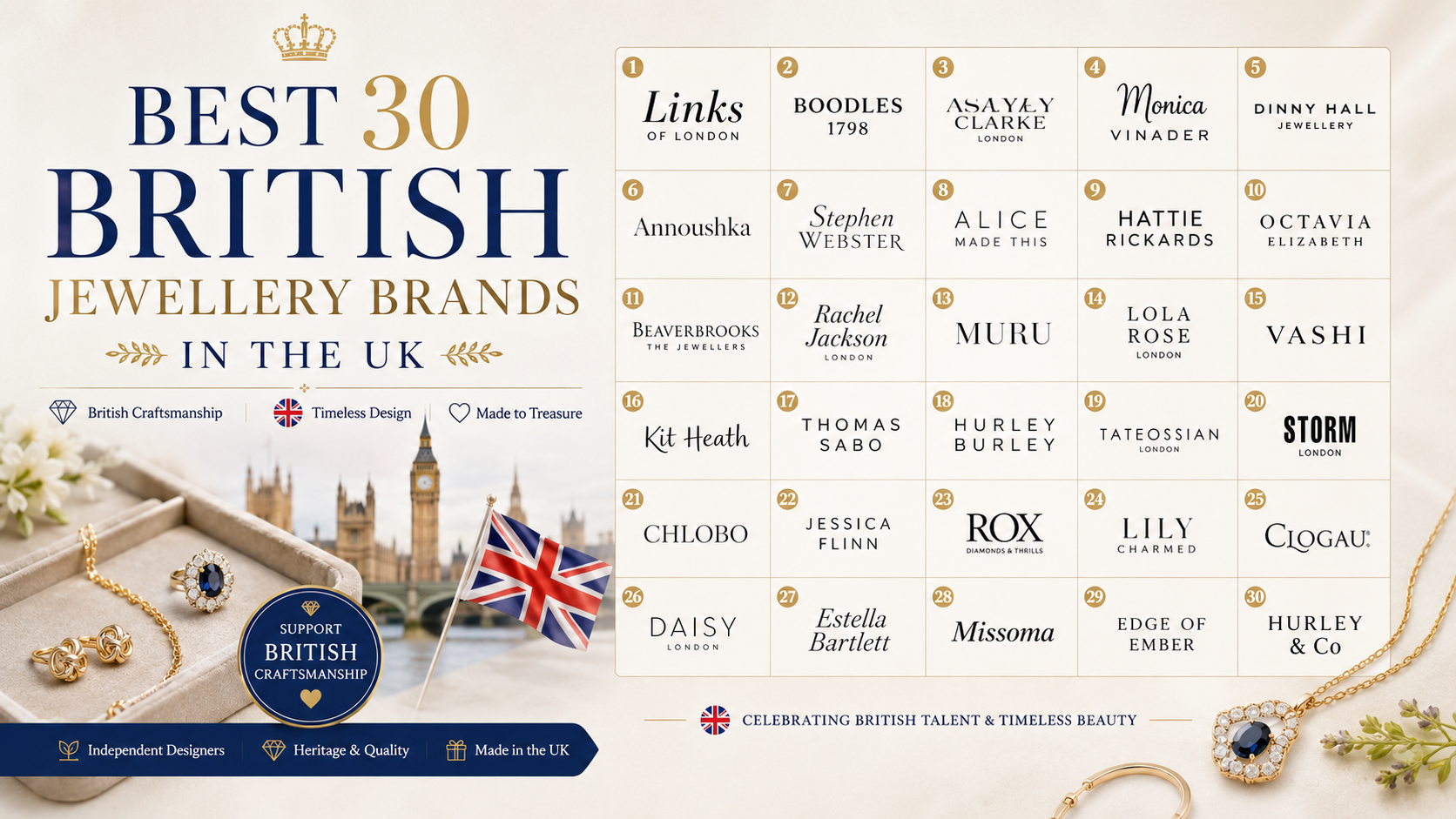
Best 30 British Jewellery Brands in the UK
Quick answer: The best British jewellery brands span four tiers. For heritage and high jewellery, look to Garrard, Asprey, Boodles and Mappin & Webb. For designer fine pieces, Theo Fennell, Stephen Webster, Shaun Leane and Annoushka lead. For everyday demi-fine, Monica Vinader, Missoma and Astley Clarke dominate. For ethical and lab-grown bridal, Fenton and Lylie stand out.
British jewellery is having a moment. The UK jewellery and watch market is worth roughly £6.4 billion and is growing at around 3–4% a year, driven by record gold prices, the rise of lab-grown diamonds, and a generation of buyers who treat fine pieces as “wearable wealth.” Yet most “best of” lists stop at 8 or 12 names and skip the things that actually protect your money: hallmarks, materials, and provenance.
This guide is different. We have curated 30 British jewellery brands across every price point, then added the buyer’s knowledge competitors leave out, including how to read a UK hallmark, what “demi-fine” really means, and how to match a brand to your budget and occasion.
Who wrote this: This guide is produced by the team at GemstonesUniverse (GU), specialists in natural, certified coloured gemstones. Because we work daily with people choosing stones for bespoke commissions and engagement pieces, our lens here is craftsmanship, stone quality, hallmarking and provenance, not just brand prestige.
How we chose these 30 brands?
We assessed every brand against five practical criteria rather than marketing reach alone:
- Heritage and craft — depth of goldsmithing tradition and whether pieces are made or finished in the UK (Hatton Garden, Birmingham’s Jewellery Quarter, or in-house ateliers).
- Material integrity — solid gold, gold vermeil, sterling silver or platinum, and whether pieces carry a proper UK hallmark.
- Design signature — a recognisable house style rather than interchangeable trend pieces.
- Provenance and ethics — recycled metals, traceable or lab-grown stones, and credible certification.
- Value for money — what you actually get at each price, from £50 stacking rings to five-figure high jewellery.
Prices below are approximate retail ranges drawn from typical listings in early 2026. They move with collection, metal weight, gold price and bespoke work, so treat them as a guide, not a quote.
At a glance: the four tiers of British jewellery
| Tier | What it means | Typical price | Brands in this guide |
| Heritage & royal warrant | Centuries-old houses, high jewellery, Crown connections | £1,500 – £50,000+ | Garrard, Asprey, Mappin & Webb, Boodles, Graff, David Morris, Bentley & Skinner, Pragnell |
| Designer & bespoke fine | Named designers, sculptural fine jewellery, commissions | £150 – £10,000+ | Theo Fennell, Stephen Webster, Shaun Leane, Annoushka, Jessica McCormack, Alex Monroe, Solange Azagury-Partridge, Pippa Small, Cassandra Goad, Wright & Teague |
| Demi-fine & everyday | Vermeil, sterling silver and 9ct gold, designed for stacking | £50 – £800 | Monica Vinader, Missoma, Astley Clarke, Otiumberg, Dinny Hall, Daisy London, Astrid & Miyu, Edge of Ember, Tateossian, Maya Magal |
| Sustainable & lab-grown | Recycled gold, lab-grown diamonds, modern bridal | £150 – £5,000+ | Lylie, Fenton |
Heritage & royal warrant houses
These are the institutions: houses with deep archives, Bond Street and Mayfair flagships, and, in several cases, a formal connection to the Crown.
| Brand | Founded | Known for | Approx. price |
| Garrard | 1735 | First Crown Jeweller; Diana’s sapphire ring; coloured stones | £2,000 – £50,000+ |
| Asprey | 1781 | Royal warrants; the bespoke Asprey Cut diamond | £2,000 – £50,000+ |
| Mappin & Webb | 1775 | Current Crown Jeweller (since 2017); warrants from several monarchs | £1,500 – £30,000+ |
| Boodles | Liverpool roots; family-owned | The Raindance collection; nature-led diamond design | £2,000 – £50,000+ |
| Graff | 1960 | High-value diamonds and statement high jewellery | £5,000 – £1m+ |
| David Morris | 1962 | Family-run high jewellery; dramatic coloured stones | £3,000 – £100,000+ |
| Bentley & Skinner | Piccadilly | Antique jewels, Fabergé and tiaras; royal warrant | £1,500 – £100,000+ |
| Pragnell | Stratford-upon-Avon | UK-made fine and high jewellery; bespoke engagement | £1,500 – £50,000+ |
Garrard is the oldest name on this list and held the role of Crown Jeweller from 1843 to 2007, creating pieces for the British royal family and maintaining the Crown Jewels. It is also the house behind the sapphire-and-diamond cluster engagement ring now worn by the Princess of Wales. Today it focuses on coloured gemstone fine jewellery and still holds a royal warrant.
Asprey, founded in 1781, built its reputation on luxury goods before becoming a jeweller, and accumulated royal warrants across multiple reigns. It even has its own hand-cut diamond, the Asprey Cut. Mappin & Webb carries the current title of Crown Jeweller, appointed in 2017, with a heritage stretching to 1775.
Boodles is the outlier with the best story: a family business with Liverpool origins, still run by the founding Wainwright family, and best known for its sparkling, nature-inspired Raindance collection. It is a reminder that British fine jewellery is not only a London affair, and several of the country’s most respected houses, including Stratford-upon-Avon’s Pragnell, manufacture outside the capital.
Designer & bespoke fine jewellers
This is where British jewellery gets its personality. These designers have a signature you can spot across a room, and most offer bespoke commissions.
| Brand | Based | Signature | Approx. price |
| Theo Fennell | London | Sculptural, witty, intricately carved fine jewellery | £300 – £30,000+ |
| Stephen Webster | London | Rock-and-roll luxury; bold gem-set pieces | £250 – £25,000+ |
| Shaun Leane | London | Architectural design; the Alexander McQueen collaborator | £150 – £20,000+ |
| Annoushka | London | Charms, chains and wearable fine jewellery | £150 – £10,000+ |
| Jessica McCormack | Mayfair | Modern, characterful diamond jewellery | £1,000 – £50,000+ |
| Alex Monroe | London (Suffolk-born) | Hand-made botanical and nature-inspired pieces | £100 – £2,000 |
| Solange Azagury-Partridge | London | Bold, colourful, avant-garde fine jewellery | £500 – £30,000+ |
| Pippa Small | London | Ethically sourced gemstones; organic, hand-made forms | £200 – £10,000+ |
| Cassandra Goad | London | Globally inspired, collectable fine jewellery | £200 – £15,000+ |
| Wright & Teague | London | Talismanic gold and silver; meaningful motifs | £100 – £5,000+ |
Shaun Leane trained in Hatton Garden and made his name with sculptural, sometimes radical pieces, including his celebrated collaborations with Alexander McQueen. Theo Fennell is the master of the intricate and the unexpected, known for richly carved, story-led designs. Stephen Webster brings an edgier, rock-influenced aesthetic and once served as creative director of Garrard, a neat illustration of how interconnected the British scene is.
For nature lovers, Alex Monroe hand-makes botanical pieces in his London studio; his bee and feather designs have become modern British classics at an accessible fine-jewellery price. And for ethically minded buyers, Pippa Small has built a respected practice around hand-cut gemstones and fair-trade gold, blending fine jewellery with genuine humanitarian work.
Demi-fine & everyday brands
Demi-fine is the fastest-growing slice of the UK market. It sits between costume and fine jewellery: real gold vermeil, sterling silver or 9ct–14ct gold, designed to be layered and worn daily, usually for £50 to £800.
A quick materials note, because the words are not interchangeable:
- Gold-plated — a thin gold layer over any base metal. Lowest cost, least durable.
- Gold vermeil — gold over sterling silver, at a minimum thickness of 2.5 microns. The demi-fine standard.
- Solid gold — gold throughout (9ct, 14ct or 18ct). Highest cost, best long-term value.
| Brand | Founded | Known for | Approx. price |
| Monica Vinader | 2008 | Demi-fine pioneer; recycled silver and gold; the Siren collection | £75 – £2,500 |
| Missoma | 2008 | Gold vermeil and 14ct gold; one of the UK’s fastest-growing brands | £75 – £400 |
| Astley Clarke | 2007 | Ethical gemstones; the Orbit and moonstone pieces | £150 – £800 |
| Otiumberg | 2016 | B-Corp; recycled metals; the Love Link bracelet | £60 – £1,000 |
| Dinny Hall | 1985 | Clean, minimal London design; a demi-fine veteran | £60 – £1,500 |
| Daisy London | — | 100% recycled silver and gold plating; layering staples | £50 – £300 |
| Astrid & Miyu | London | Earscaping, piercing studios and trend-led demi-fine | £50 – £400 |
| Edge of Ember | London | Lab-grown diamonds and ethical demi-fine | £75 – £1,500 |
| Tateossian | London | Men’s jewellery, cufflinks and accessories | £80 – £2,000 |
| Maya Magal | London | Hand-finished contemporary pieces in a London studio | £50 – £600 |
Monica Vinader more or less defined British demi-fine, reviving Victorian gold vermeil in 2008 and building a brand on recycled metals, traceable gemstones and engravable, stackable design. Missoma is the growth story of the category, expanding from a small label into one of the UK’s best-known names with its vermeil and 14ct gold pieces. Otiumberg, founded by sisters Rosanna and Christie Wollenberg, has earned B-Corp status for its responsible manufacturing, while Astley Clarke anchors its identity in ethically sourced gemstones.
For something more specific, Astrid & Miyu has reframed buying jewellery as an experience through its piercing and earscaping studios, and Tateossian is the go-to British name for men’s pieces and cufflinks.
Sustainable, lab-grown & modern bridal
Ethics and traceability are now mainstream, not niche. New G7 rules introduced in 2025 require diamonds above 0.50 carats entering the UK to be certified for origin, which has pushed the whole industry toward transparency and made lab-grown stones more appealing to value- and ethics-led buyers.
| Brand | Focus | Known for | Approx. price |
| Lylie | Reclaimed and recycled gold | Bespoke pieces from reclaimed metals; circular sourcing | £150 – £5,000+ |
| Fenton | Lab-grown and traceable stones | Modern engagement rings; transparent, build-your-own pricing | £600 – £5,000+ |
Fenton has become one of the most talked-about modern bridal names in Britain, offering lab-grown and traceably mined stones with clear, itemised pricing, an antidote to the opacity that surrounds a lot of engagement-ring buying. Lylie takes the circular approach, crafting fine jewellery from reclaimed gold, including metal recovered from electronic waste, for buyers who want provenance they can trace.
If a lab-grown diamond is on your shortlist, it is worth knowing why the category has exploded: lab-grown stones are chemically and visually identical to mined diamonds, typically cost a fraction of the price, and are forecast to make up around half of all diamond jewellery unit sales by 2030.
The UK jewellery market in 2026: a quick snapshot
A little context helps you buy well:
- Market size: The UK jewellery and watch market is valued at roughly £6.4 billion and growing at about 3–4% a year.
- Spend per head: UK shoppers spend around £77 per person on jewellery a year.
- Gold rules: Gold is the dominant metal, accounting for roughly half of the market by value, and record gold prices in 2025 pushed many buyers toward jewellery as an asset.
- Online is the engine: E-commerce now accounts for roughly a third of UK jewellery sales and is growing faster than physical retail.
- Lab-grown is rising fast: Lab-grown diamonds passed a fifth of the diamond market by 2025 and continue to climb.
The takeaway: there has never been more choice, but also more reason to check what you are actually buying.
How to read a UK hallmark (the buyer protection most lists skip)
This is the single most useful thing a British jewellery buyer can learn, and almost no “best brands” article explains it.
Under the Hallmarking Act 1973, it is a criminal offence to describe an item as gold, silver, platinum or palladium and sell it in the UK without an official hallmark, unless it falls below a small weight threshold (currently around 1g for gold, 7.78g for silver, 0.5g for platinum and 1g for palladium). A UK hallmark is applied by an independent Assay Office after the metal is scientifically tested, which makes it one of the most trustworthy guarantees of purity anywhere in the world.
A complete modern hallmark has three compulsory marks (plus an optional date letter):
| Mark | What it tells you |
| Sponsor’s (maker’s) mark | Who submitted the piece — the brand, maker or importer |
| Fineness mark | The metal and its purity in parts per thousand (e.g. 750 = 18ct gold, 585 = 14ct, 375 = 9ct, 925 = sterling silver, 950 = platinum) |
| Assay Office mark | Which of the four UK offices tested it |
| Date letter (optional since 1999) | The year it was hallmarked |
There are four UK Assay Offices, each with its own symbol:
- London — leopard’s head
- Birmingham — anchor (the busiest assay office in the world)
- Sheffield — rose
- Edinburgh — castle
Practical tip: Before you buy any solid precious-metal piece in the UK, check for the hallmark. Its presence is a legal guarantee of metal content and underpins resale value. Its absence on a qualifying item is a red flag.
How to choose the right British jewellery brand?
Match the brand to the moment and the budget:
- Engagement or once-in-a-lifetime: Heritage houses (Garrard, Boodles, Pragnell) for prestige and bespoke fine work; Fenton or a Hatton Garden bespoke jeweller for a modern, transparent, often lab-grown route.
- Milestone gift (£500–£5,000): Designer fine jewellers such as Annoushka, Alex Monroe or Shaun Leane for a piece with a recognisable signature.
- Everyday luxury and gifting (£50–£800): Monica Vinader, Missoma, Astley Clarke and Otiumberg for solid value and stackable design.
- Ethics first: Pippa Small, Lylie, Otiumberg (B-Corp) and Monica Vinader (recycled metals, traceable stones).
- Men’s pieces: Tateossian, Stephen Webster and Shaun Leane.
- A statement gemstone: Coloured-stone specialists such as Garrard and David Morris, or commission a piece around a certified loose gemstone (see below).
A simple rule of thumb on longevity: for daily wear you will keep for years, solid 9ct–18ct gold outlasts vermeil, and vermeil outlasts plating. Pay for the metal, not just the marketing.
A note on coloured gemstones and certification
If a coloured stone is the heart of your piece, whether a sapphire engagement ring or an emerald pendant, the gem itself matters more than the setting. Three things protect you:
- Independent certification of the stone (species, origin where possible, and any treatments).
- Disclosure of treatments such as heating, which is common and legitimate but should be stated.
- Clear provenance, increasingly expected after the 2025 G7 traceability rules for diamonds.
This is the area we know best. At GemstonesUniverse, we supply natural, certified coloured gemstones for buyers who want to commission a bespoke British piece around a specific stone, or simply understand exactly what they are paying for. Whether you buy from one of the brands above or source the stone first and have it set by a goldsmith, insist on certification and written disclosure before money changes hands.
Frequently asked questions
What is the most prestigious British jewellery brand?
Garrard is widely regarded as the most prestigious, as the world’s first Crown Jeweller (a role it held from 1843 to 2007) and the maker of many of the British Crown Jewels. Asprey, Mappin & Webb and Graff are close peers in the heritage and high-jewellery space.
Which British jewellery brands hold a royal warrant?
Several British houses have held royal warrants, including Garrard, Asprey and Bentley & Skinner. A royal warrant means a brand has supplied the royal household for at least five consecutive years; it signals provenance and trust, though it is not a quality grade on its own.
What is the best affordable British jewellery brand?
For affordable, well-made everyday pieces, Daisy London, Astrid & Miyu, Otiumberg and Missoma offer real materials (recycled silver, gold vermeil and some solid gold) from around £50–£200. They are ideal for layering, gifting and building a collection over time.
What does “demi-fine” jewellery mean?
Demi-fine sits between costume and fine jewellery. It uses real precious materials, usually gold vermeil, sterling silver or 9ct–14ct gold, at a more accessible price than solid-gold fine jewellery. Monica Vinader, Missoma and Astley Clarke are leading British demi-fine brands.
Is gold vermeil real gold?
Yes. Gold vermeil is genuine gold (commonly 18ct) layered over sterling silver at a minimum thickness of 2.5 microns. It is more durable and valuable than standard gold plating, but it is not solid gold, so it will eventually wear with heavy use.
Are lab-grown diamonds worth buying?
For many UK buyers, yes. Lab-grown diamonds are chemically and visually identical to mined diamonds and typically cost far less, which is why brands such as Fenton and Edge of Ember have grown quickly. Natural diamonds tend to hold resale value better, so the choice depends on whether you prioritise budget and ethics or long-term value.
Where is British jewellery made?
The UK’s main jewellery-making centres are London’s Hatton Garden, Birmingham’s Jewellery Quarter and a network of independent ateliers. Brands such as Pragnell, Alex Monroe and David Morris manufacture in the UK, while some demi-fine brands are designed in Britain but produced elsewhere, so check whether a piece is “made in the UK” or “designed in the UK.”
How do I know jewellery is real gold or silver in the UK?
Look for a UK hallmark. Under the Hallmarking Act 1973, qualifying precious-metal items must carry a fineness mark (e.g. 750 for 18ct gold) and an Assay Office mark applied by London, Birmingham, Sheffield or Edinburgh. An independent hallmark is a legal guarantee of metal purity.