


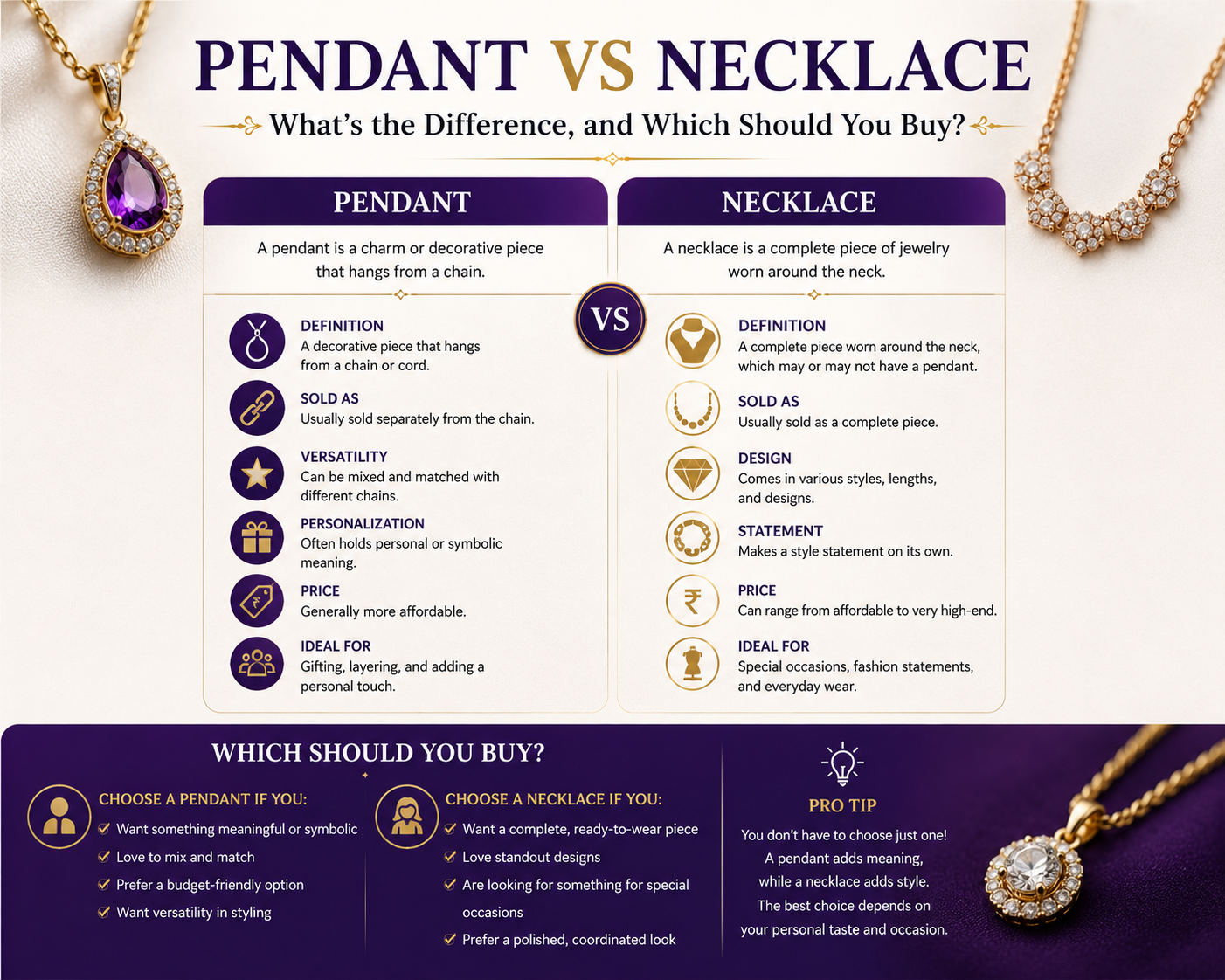
Pendant vs Necklace: What’s the Difference, and Which Should You Buy?
A necklace is the complete piece of jewelry worn around the neck the chain or strand itself. A pendant is a single decorative ornament that hangs from a chain and can’t be worn on its own. Put the two together and you have a pendant necklace. Knowing this difference is what stops you from buying a beautiful pendant that arrives with no chain.
People use these two words as if they’re the same, and most of the time it doesn’t matter until you’re at checkout. That’s when the distinction decides whether your package contains a ready-to-wear piece or a single ornament you still can’t put on. This guide settles the terms, then takes you all the way to a confident buying decision: what’s included when you order, whether your pendant will actually fit your chain, what each costs in the US right now, and how to choose a fine gemstone pendant that’s built to last.
Pendant vs Necklace at a Glance
| Term | What it is | Wearable alone? | Where you’ll see it |
| Necklace | The complete piece around the neck (chain or strand) | Yes | Plain chain, tennis necklace, pearl strand, station necklace |
| Pendant | A single ornament that hangs from a chain | No | Gemstone drop, initial, cross, solitaire |
| Pendant necklace | A pendant already paired with a chain | Yes | Most “necklaces” sold with a hanging centerpiece |
| Charm | A small ornament, usually collected and worn in groups | No | Charm bracelets, charm necklaces |
| Locket | A pendant that opens to hold a photo or keepsake | No (needs a chain) | Memorial and sentimental pieces |
| Medallion | A larger, coin- or disc-shaped pendant | No (needs a chain) | Religious medals, statement gold pieces |
What Is a Necklace?
A necklace is any piece of jewelry designed to be worn around the neck as a finished object. The defining feature is that it’s complete on its own the design lives in the chain or strand, and nothing has to hang from it.
A plain 14K gold chain is a necklace. So is a diamond tennis necklace, a strand of pearls, or a station necklace where gemstones are set into the chain at intervals. In every case, you can take it out of the box and wear it.
Common Types of Necklaces
- Chain necklaces cable, box, rope, curb, Figaro, Cuban link, in gold, platinum, or sterling silver.
- Chokers short chains or bands that sit snugly at the base of the neck.
- Station necklaces gemstones or diamonds fixed along the chain (the décor is part of the chain, not hanging from it).
- Tennis necklaces a continuous line of matched diamonds or gemstones.
- Pearl and beaded strands classic graduated or uniform strands.
- Opera and rope necklaces long single strands ideal for layering.
A useful test: if the decoration is built into the chain and can’t slide off or be swapped, you’re looking at a necklace, not a pendant on a chain.
What Is a Pendant?
A pendant is a single ornamental piece a gemstone, a motif, an initial, a religious symbol made to hang from a chain or cord. On its own, it isn’t wearable around the neck. It becomes wearable only once it’s threaded onto a compatible chain.
The small loop at the top of a pendant is the bail (sometimes a simple jump ring). The chain passes through the bail, and that’s what lets the pendant rest at the center of the chest and, in many designs, slide freely along the chain.
The reason people love pendants is interchangeability. One pendant can move between several chains, giving you a different look without buying a whole new piece. A pendant is also where personal meaning usually lives a birthstone, a milestone, an initial, or, in GU’s world, a planetary gemstone chosen for a specific purpose.
Pendant, Charm, Locket, and Medallion Cleared Up
These four get tangled constantly:
- Pendant a single, usually larger focal ornament that hangs as the centerpiece.
- Charm smaller and typically collected; charms are worn in groups on a bracelet or charm necklace. A large charm worn solo on a chain effectively becomes a pendant.
- Locket a pendant with a hinge that opens to hold a small photo or keepsake. Every locket is a pendant; not every pendant is a locket.
- Medallion a larger coin- or disc-shaped pendant, often religious or a bold gold statement piece.
All of them still need a chain to be worn around the neck.
What Is a “Pendant Necklace”?
A pendant necklace is exactly what it sounds like: a pendant already paired with a chain, sold as one ready-to-wear piece. This is one of the most common forms of jewelry on the market when most shoppers say “necklace,” they’re often picturing a pendant necklace.
The term isn’t wrong; it’s precise. It tells you the piece has both components. The distinction only becomes a problem when a listing says “pendant” but you assume it means “pendant necklace.”
The One Difference That Actually Changes Your Purchase
Forget the dictionary for a second. The difference that costs people money is this:
A pendant may be sold without a chain. A necklace is, by definition, complete.
Whether a chain is included is entirely up to the seller and how the item is marketed. Some pendants ship as standalone pieces so you can choose your own chain; others come as a set. Before you buy, read the title and description for the exact wording:
- “Pendant only” or “pendant, chain sold separately” → you’ll need a chain.
- “Pendant necklace” or “pendant with chain” → ready to wear.
- For custom or gemstone orders, state explicitly whether you want the chain, the pendant, or both this prevents the most common ordering mistake of all.
This single check is the practical heart of the whole pendant-vs-necklace question.
Will Any Pendant Fit Any Chain? Bails, Jump Rings, and Weight
Usually yes but not always, and “usually” is what trips people up. Two things decide compatibility: the bail openingand the chain’s strength.
Matching Bail Size to Chain Width
The chain has to physically pass through the bail, so the bail’s interior opening must be larger than the chain’s width. A rough, reliable guide:
| Chain width | Minimum bail interior opening |
| 1 mm | ~2 mm |
| 2 mm | ~3 mm |
| 3 mm | ~4 mm |
| 4 mm | ~5 mm |
If the bail is too small, the chain simply won’t thread through. If it’s far too large, a small pendant can look unbalanced or flip forward. Note too that some necklaces aren’t built to carry a pendant at all a pearl strand or a tennis necklace is designed as a finished piece and shouldn’t have a pendant forced onto it.
Heavier Gemstone Pendants Need Sturdier Chains
Weight matters as much as fit. A delicate cable chain that’s perfect for a small initial pendant can stretch, kink, or snap under a heavy gemstone drop. The rule of thumb:
- Light pendants (a thin initial, a small diamond) pair happily with fine 1–1.5 mm chains.
- Heavier pendants a multi-carat gemstone set in gold, a medallion, a locket want a thicker, stronger chain (commonly 1.5–2 mm+ in a solid alloy) so the chain carries the weight without distorting.
- Balance the two. A heavy pendant on a too-thin chain not only risks breakage, it tangles more and sits poorly.
For certified gemstone pendants GU’s specialty this is a real engineering consideration, not a styling footnote, because the gemstone’s carat weight directly drives the bail and chain you need.
Pendant vs Necklace: US Price Ranges (2026)
“Is a pendant cheaper than a necklace?” The honest answer: it depends on materials, not on the category. Buying a pendant alone means buying one component, which is often cheaper than a complete necklace of similar quality but a fine diamond or natural gemstone pendant can easily cost more than a plain gold chain.
For context, in 2026 gold has traded in roughly the $55–$65 per gram range, and 14K gold is 58.3% pure (the “585 / 14K” stamp under US FTC marking rules). Retailers typically price finished gold pieces at a meaningful markup over raw metal value to cover craftsmanship. Ballpark US ranges:
| Piece | Typical US range (2026) |
| Sterling silver pendant (no chain) | $20–$120 |
| Gold-vermeil / gold-filled pendant | $40–$200 |
| 14K gold pendant (small, plain or small diamond) | $150–$900 |
| Diamond solitaire pendant (≈0.25–1 ct, no chain) | $300–$3,000+ |
| Certified natural gemstone pendant (set in gold) | $200–$5,000+ (varies by gem, quality, carat) |
| Sterling silver chain | $20–$80 |
| Plain 14K gold chain (16–20″) | $200–$700 (by weight) |
| Pearl strand necklace | $100–$2,000+ |
| Diamond tennis necklace (complete) | $1,500–$15,000+ |
Ranges are indicative; design complexity, gemstone rarity, and live metal prices move them. Always compare the per-gram gold price and, for colored stones, the certified quality rather than brand prestige alone.
Which Should You Buy? A Simple Decision Guide
Buy a Complete Necklace If…
- You want one piece that’s ready to wear out of the box.
- You’re after a clean, classic look a slim chain, a station necklace, a pearl strand with no centerpiece.
- You value simplicity and the easiest gift: nothing to assemble, nothing to match.
Buy a Pendant (and Pair It) If…
- You want meaning a birthstone, an initial, a milestone, or a planetary gemstone chosen for a purpose.
- You already own chains and want versatility: swap one pendant across several looks.
- You’re building a collection where one pendant earns its keep over many outfits.
- Just confirm the bail-and-chain fit before you commit (see above).
Buying a Gift? The Safe Choice
When you’re unsure of someone’s style, a complete pendant necklace is the lowest-risk option the recipient can wear it immediately, with nothing to match or buy separately. If you know they already collect chains, a standout pendantalone can be the more personal, more flexible gift. An 18-inch chain is the safest length for most adults.
Chain Length Guide for Pendants (US Sizing)
Where a pendant sits depends on chain length. US naming and typical placement:
| Length | Name | Where it sits | Best for |
| 14″ | Collar | Tight at the base of the neck | High necklines, layering base |
| 16″ | Choker | At the collarbone | Petite frames; pendant sits high |
| 18″ | Princess | Just below the collarbone | Most versatile best all-rounder |
| 20″ | Matinee | On the upper chest | Wearing over tops; many men |
| 22″ | Top of the bust | Larger pendants, men | |
| 24″+ | Opera / rope | Mid-chest and lower | Layering, statement pendants, men |
If you’re buying one length for everyday wear, 18 inches flatters the widest range of people and lets most pendants rest in their intended spot. Men generally wear 20–24 inches.
Choosing a Gemstone or Astrological Pendant
This is where the pendant-vs-necklace question gets serious and where GemstonesUniverse’s craft matters. A gemstone pendant isn’t just décor; for many wearers it’s a Jyotish (astrological) talisman chosen on the principles of planetary gem therapy. A few things separate a meaningful, durable gemstone pendant from a disappointing one:
Certification and quality
A genuine Jyotish gemstone is natural and untreated, with quality verified by laboratory certification. Synthetic or heavily treated stones don’t carry the same value and in the astrological view, are considered inert. Always buy a pendant whose central gemstone is certified.
The right gemstone for the purpose
In Vedic gemology, each gem corresponds to a planet for example, ruby (Manik) for the Sun, yellow sapphire (Pukhraj) for Jupiter, blue sapphire (Neelam) for Saturn, emerald (Panna) for Mercury, red coral (Moonga) for Mars, and pearl (Moti) for the Moon. A Navaratna pendant combines all nine planetary gems in one piece.
Metal and karat
Traditional Jyotish settings often use high-purity 22K gold, while US fine jewelry favors 14K or 18K for everyday durability. Both are valid 22K maximizes purity, 14K/18K maximizes hardness. Choose based on how the pendant will be worn and your tradition.
Carat weight drives the build
A heavier gemstone needs a sturdier bail and a stronger chain. This is exactly why a quality gemstone pendant should be matched to an appropriate chain rather than hung on whatever’s nearest.
Skin contact
Some wearers prefer settings that let the gemstone touch the skin, a traditional preference in gem therapy. That’s a setting choice to raise with your jeweler up front.
A gemstone pendant pairs the flexibility of a pendant with the intrinsic value of a certified natural stone in gold which is why, for the right buyer, it can be the most rewarding piece in the box.
Care and Maintenance: Where Pendants and Necklaces Differ
A plain chain and a hanging gemstone pendant don’t age the same way, so they don’t get cleaned the same way.
- Chains mostly need detangling, gentle cleaning, and a check of the clasp and links for wear.
- Pendants add two stress points: the bail (which can thin over years of movement) and the setting holding the gemstone. Inspect prongs and the bail periodically.
- Match cleaning to the gemstone. Hard stones like sapphire and ruby tolerate routine cleaning well; softer or more delicate stones (and pearls, coral, emeralds) need gentler care and should avoid harsh solutions and ultrasonic cleaning unless a jeweler approves.
- Store separately. Keep chains and pendants flat and apart so a heavier pendant doesn’t scratch or tangle a finer chain.
Common Mistakes Shoppers Make
- Assuming “pendant” includes a chain. It often doesn’t. Read for “pendant only” vs “pendant necklace.”
- Mismatched bail and chain. The chain won’t thread through a too-small bail check the bail opening against the chain width.
- Heavy gemstone on a too-thin chain. Risks stretching, tangling, and breakage. Match weight to chain strength.
- Forcing a pendant onto the wrong necklace. Pearl strands and tennis necklaces aren’t built to carry pendants.
- Buying a gemstone pendant without certification. For value and for astrological purpose insist on a natural, certified stone.
- Wrong chain length. When in doubt, 18″ for adults; 20–24″ for men.
Frequently Asked Questions
Can a pendant be worn without a chain?
No. A pendant is designed to hang from a chain or cord. Without one, it can’t be worn around the neck though some people repurpose pendants as bracelet charms, zipper pulls, or keychain ornaments.
What exactly is a pendant necklace?
A pendant necklace is a pendant already paired with a chain and sold as one ready-to-wear piece. It’s the most common everyday format and what most people mean when they say “necklace.”
Is a pendant the same as a charm?
Not quite. A pendant is usually a single, larger focal ornament. A charm is smaller and typically collected worn in groups on a bracelet or charm necklace. A large charm worn alone on a chain effectively functions as a pendant.
Can you put any pendant on any chain?
Most of the time, as long as the bail opening is wide enough for the chain and the chain is strong enough for the pendant’s weight. Match a heavy pendant to a sturdier chain, and avoid hanging pendants on pearl strands or tennis necklaces.
Does a pendant come with a chain?
Sometimes. It depends entirely on the seller. Check the listing for “pendant only” versus “pendant necklace,” and for custom or gemstone orders, state clearly whether you want the chain included.
Is a pendant cheaper than a necklace?
It can be, because you’re buying one component but not always. A fine diamond or certified natural gemstone pendant can cost more than a plain gold chain. Compare materials and certification, not the label.
What’s the difference between a pendant and a locket?
A locket is a type of pendant that opens to hold a photo or small keepsake. Every locket is a pendant; not every pendant is a locket. Both need a chain to wear.
Which is better a pendant or a necklace?
Neither is universally better. Choose a complete necklace for a ready-to-wear, classic look; choose a pendant for meaning and the flexibility to swap it across chains. For a gift when you’re unsure, a complete pendant necklace is safest.
What chain length should I get for a pendant?
For most adults, 18 inches lets a pendant sit just below the collarbone the most versatile choice. Petite frames may prefer 16″; men typically wear 20–24″.