


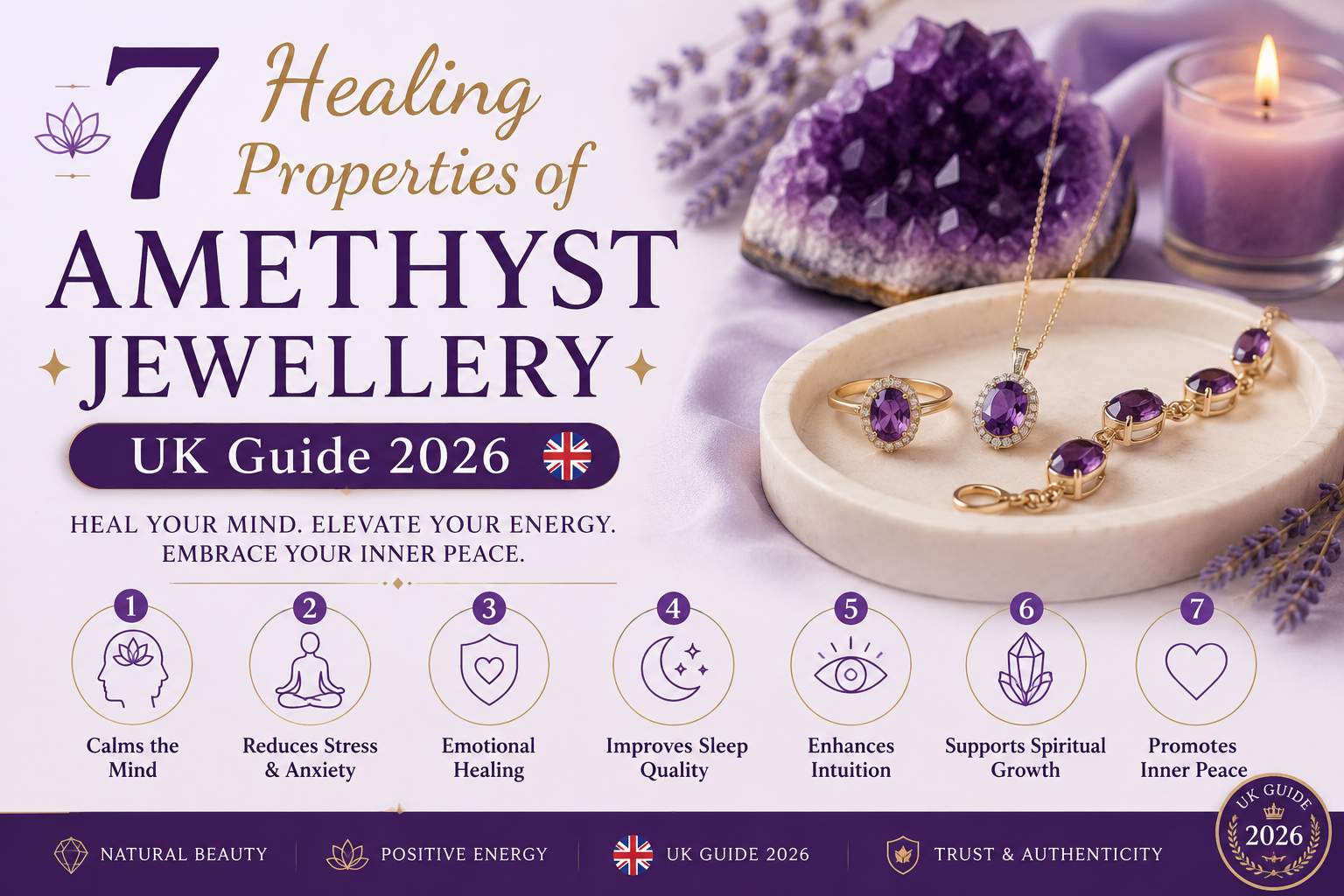
7 Healing Properties of Amethyst Jewellery: UK Guide 2026
Amethyst is the purple face of quartz and for thousands of years people across Britain and beyond have worn it not only for its colour, but for how it makes them feel. If you’re researching amethyst jewellery in 2026, you’ve probably seen wildly different claims, from gentle “calming” language to bold promises about curing ailments. This guide separates the tradition from the truth, then shows you how to wear, care for and confidently buy authentic amethyst in the UK.
Quick answer: In crystal-healing tradition, amethyst jewellery is believed to encourage calm and stress relief, restful sleep, emotional balance, mental clarity, energetic protection, deeper intuition, and moderation. These are spiritual and metaphysical associations, not medically proven effects amethyst should complement, never replace, professional healthcare or mental-health support.
Why trust this guide? This article is written by the team at Gemstones Universe, [a UK-based gemstone and jewellery specialist with 5 years’ experience sourcing and selling coloured stones jewelry]. Our buyers handle natural and lab-created amethyst daily, work only with gold and silver, and gemmological qualifications such as the FGA (Gem-A). Where we describe traditional or spiritual meanings, we say so plainly and where the science is unsettled, we tell you that too. Replace the bracketed details with your real, verifiable credentials before publishing never invent them.
What is amethyst? A quick gemmologist’s primer
Before the meanings, the material. Knowing what amethyst actually is helps you judge quality and avoid fakes later.
- Mineral: Amethyst is the violet-to-purple variety of quartz (silicon dioxide, SiO₂). Its colour comes from traces of iron combined with natural irradiation deep in the earth.
- Hardness: 7 on the Mohs scale hard and durable enough for everyday rings, pendants and bracelets, though not indestructible.
- Look: A glassy (vitreous) lustre and shades ranging from soft lilac to deep “grape” purple. The most prized stones show rich, even, deep purple with subtle red or blue flashes.
- Birthstone & zodiac: The traditional birthstone for February, and commonly associated with Pisces and Aquarius.
- Name: From the ancient Greek amethystos, meaning “not intoxicated.” The Greeks and Romans believed amethyst guarded against drunkenness and kept the mind clear a lovely detail that shapes its symbolism to this day.
- Where it’s from: Major sources include Brazil, Uruguay, Zambia and Madagascar, with fine material also coming from several other regions worldwide.
That clear lineage abundant, durable, historically tied to clarity and sobriety is the foundation for everything that follows.
The 7 healing properties of amethyst jewellery
A note before the list, because it matters: the properties below are traditional, spiritual and metaphysical associationsdrawn from crystal-healing practice and centuries of folklore. They describe how amethyst is used and experienced by many people not clinically proven medical effects. Wearing a crystal can be a meaningful ritual that supports calm and mindfulness; it is not a treatment for illness.
Here are the seven properties most often attributed to amethyst jewellery.
| # | Traditional property | Associated with | Common way to wear it |
| 1 | Calm & stress relief | Soothing nerves, easing tension | Bracelet on the wrist; pendant near the heart |
| 2 | Restful sleep | Quieting the mind, easing nightmares | Pendant worn in the evening; stone by the bedside |
| 3 | Emotional balance | Lifting low mood, steadying feelings | Ring or bracelet for daily wear |
| 4 | Mental clarity & focus | Clear thinking, decision-making | Earrings or pendant during work/study |
| 5 | Energetic protection | A “shield” against negative energy | Pendant worn over the chest |
| 6 | Intuition & meditation | Third-eye & crown chakra, spiritual insight | Pendant or held stone during meditation |
| 7 | Moderation | Self-control, breaking unhelpful habits | Ring as a daily, visible reminder |
1. Calm and stress relief
This is amethyst’s signature association. It’s widely described as a soothing, grounding stone that helps wearers feel more settled and less frazzled. Practically, a smooth amethyst bracelet or a pendant you can touch becomes a small anchor for mindfulness a physical prompt to slow your breathing and reset during a stressful moment. Many people find that ritual calming in itself, which is a perfectly real benefit even where the “energy” is a matter of belief.
2. Support for restful sleep
Closely tied to calm, amethyst is traditionally linked with quieter sleep and easing nightmares. Wearers often keep an amethyst pendant on in the evening or place a tumbled stone on the nightstand as part of a wind-down routine. Think of it as one cue among several dimmed lights, less screen time, a consistent bedtime rather than a remedy on its own.
3. Emotional balance and lifting low mood
Amethyst is said to help steady the emotions softening anger, frustration and spiralling negative thoughts, and encouraging a more even keel. It’s a popular everyday stone for exactly this reason: a ring or bracelet worn daily becomes a gentle, recurring reminder to pause and reframe.
4. Mental clarity and focus
True to its “not intoxicated” roots, amethyst carries a long association with a clear, sober mind. In modern practice it’s reached for to support concentration and level-headed decision-making which is why people like to wear it during work, study or anything that needs a clear head.
5. A sense of energetic protection
In crystal lore, amethyst forms a protective “shield” that transmutes negative energy into something more positive, helping the wearer stay centred. A pendant worn over the chest is the classic choice for those who want that sense of personal “buffer” through a demanding day.
6. Intuition, meditation and spiritual connection
Amethyst is one of the most popular meditation stones, strongly linked to the third-eye and crown chakras the energy centres associated with insight, intuition and higher awareness. Holding a stone or wearing a pendant during meditation is thought to deepen focus and spiritual connection. Even setting aside the metaphysics, a dedicated object can genuinely help anchor a meditation habit.
7. Moderation and breaking unhelpful habits
The oldest association of all. Because amethyst’s very name means “not intoxicated,” it has long been a stone of moderation and self-mastery traditionally worn as a talisman to resist overindulgence and unhelpful patterns. Today many people choose an amethyst ring as a visible daily reminder of an intention they’ve set for themselves. (If you’re working to change a serious habit or dependency, please pair any ritual with real support see below.)
What does the evidence actually say?
We’ll be straight with you, because honesty is part of trust.
There is no scientific evidence that amethyst or any crystal produces physical or medical healing effects. Reputable health sources are clear that crystal-healing claims aren’t backed by research. That doesn’t make amethyst worthless: a beautiful object you wear with intention can support mindfulness, ritual and a sense of calm, and those psychological and emotional benefits are real to the people who feel them.
What we deliberately won’t tell you is that amethyst treats, cures or prevents any illness because it doesn’t, and in the UK such claims are also tightly regulated. Under the CAP Code enforced by the Advertising Standards Authority (ASA), only licensed medicines may carry medicinal claims; unproven health claims for ordinary products are prohibited and increasingly enforced. We think that’s the right standard for shoppers, too.
So treat amethyst the way you might treat a favourite candle, a calming playlist, or a morning walk: a supportive part of your wellbeing toolkit, not a substitute for it. If you’re struggling with your physical or mental health, please speak to a GP or a qualified professional. In the UK you can find support through the NHS and, in a crisis, services such as Samaritans (116 123). Crystals can sit alongside that care never in place of it.
How to wear and use amethyst jewellery?
There’s no single “correct” way the best piece is the one you’ll actually wear. A few practical pointers:
- Pendant or necklace: Worn near the heart or throat; the traditional choice for “protection” and for keeping the stone in your eyeline as a daily reminder.
- Bracelet: Sits against the skin and is easy to touch through the day ideal if you like a tactile cue for calm.
- Ring: Highly visible, great as a reminder of an intention (focus, moderation, patience).
- Earrings: Subtle and elegant; popular for focus during work and study.
Make it a ritual
When you put the piece on, take one slow breath and silently set a simple intention for the day. The object’s job is to remind you the calm comes from the habit.
Pair it with intention
Amethyst is often combined with rose quartz (compassion), clear quartz (clarity/amplifying), or citrine and amethyst and citrine grown together form the beautiful bi-colour stone ametrine, prized for balancing energies.
Cleansing and recharging your amethyst
In crystal practice, stones are “cleansed” periodically. Choose methods that are also kind to the material:
- ✅ Moonlight: Leave it out overnight (e.g. on a windowsill). Gentle and popular.
- ✅ Sound or smoke: A singing bowl, or smudging with herbs, are non-abrasive options.
- ✅ On a clear-quartz cluster or a bed of selenite easy and damage-free.
- ⚠️ Water: Brief rinsing of solid, untreated amethyst is generally fine (it’s hard quartz), but avoid soaking fracture-filled, dyed or glued/costume pieces, as water can loosen settings and adhesives.
- ❌ Avoid prolonged direct sunlight. This is the big one: extended UV exposure can fade amethyst’s purple colour over time. Don’t “charge” it on a sunny windowsill for days.
Buying amethyst jewellery in the UK (2026)
This is where most online guides go quiet and where you can shop smartest. Amethyst is abundant and therefore affordable, which is wonderful for buyers but also means quality varies hugely and fakes exist.
What drives amethyst quality and price
| Factor | What to look for | Why it matters |
| Colour | Deep, even, saturated purple (“grape”), ideally with red/blue flashes the top grade is often called “Siberian” | Colour is the single biggest value driver; pale or zoned stones are cheaper |
| Clarity | “Eye-clean” with no obvious inclusions | Amethyst is usually fairly clean; visible flaws lower value |
| Cut | Even, well-proportioned faceting with good sparkle | A good cut makes colour and brilliance sing |
| Carat (size) | Larger stones cost more, but colour beats size | A small, deep-purple stone can outvalue a large pale one |
| Natural vs treated vs lab | Ask whether it’s natural, heat-treated, or lab-created | All are sold legitimately, but should be disclosed and priced accordingly |
A quick note on heat treatment: amethyst is commonly heat-treated to deepen or alter colour, and heating can even turn some amethyst into citrine. Treated stones are normal and acceptable you just deserve to know.
Indicative UK prices in 2026
Broad, real-world ranges to set expectations. These are indicative only actual prices swing with colour, clarity, size, metal, brand and whether the stone is natural or lab-created.
| Piece | Typical UK range (2026, indicative) |
| Sterling silver amethyst studs / small pendant | £20 – £60 |
| Sterling silver amethyst ring (good colour) | £35 – £120 |
| 9ct gold amethyst pendant or ring | £90 – £350 |
| 18ct gold / fine deep-colour amethyst piece | £300 – £1,000+ |
| Loose faceted amethyst (good quality) | roughly £8 – £40 per carat |
| Designer, statement or antique pieces | £500+ |
If a “deep Siberian amethyst, 18ct gold” piece is priced like costume jewellery, be sceptical it’s likely pale material, lab-created, or not solid gold.
Hallmarks, metals and authenticity
This is the UK buyer’s superpower. Precious-metal jewellery sold in Britain must be independently tested and stamped under the Hallmarking Act 1973 one of the world’s oldest consumer protections.
- What a UK hallmark guarantees: that the metal content matches what’s claimed. A maker simply stamping “925” is a claim; a piece that’s passed through an assay office carries a legally guaranteed mark.
- The four UK assay offices and their symbols:
- London leopard’s head
- Birmingham anchor
- Sheffield rose
- Edinburgh castle
- Sterling silver: shown as 925 (and/or the lion passant). Hallmarking is required for silver items over 7.78g; below that, sellers can’t legally describe them as “sterling silver” without a hallmark or exempt-weight labelling.
- A trust check for shops: UK jewellery retailers must, by law, display a Dealer’s Notice (in-store and online) explaining hallmarks. Its presence is a quick sign you’re dealing with a compliant seller.
How to spot a fake or misrepresented amethyst:
- Glass imitations: Look for tiny round bubbles, a “too perfect” colour, or warmth (glass warms in the hand faster than quartz). Glass also scratches more easily than quartz’s Mohs 7.
- Lab-created (synthetic) amethyst: It’s real quartz chemically and perfectly legitimate just typically flawless, very even in colour, and much cheaper. It should be disclosed as lab-created/synthetic.
- Dyed quartz: Suspiciously vivid colour at a bargain price; sometimes colour concentrates in cracks.
- Best protection: Buy from a reputable UK seller, ask directly “is this natural, treated or lab-created?”, request the metal hallmark details, and check the returns policy before you pay.
Natural, lab-created and ethical sourcing
You don’t have to choose “natural” to choose well you just want transparency:
- Natural amethyst is mined and may be heat-treated; fine deep colour commands a premium.
- Lab-created amethyst is identical quartz grown in controlled conditions: consistent, lower-cost, lower-impact, and a smart budget choice when disclosed.
- Ethical sourcing is an increasingly common question. Ask your seller about provenance and any treatments; a confident, specific answer is a good sign.
Caring for your amethyst jewellery
A few habits will keep your piece looking its best for decades:
- Cleaning: Warm water, a little mild soap and a soft brush, then pat dry. That’s all most pieces need.
- Protect the colour: Keep it out of prolonged sunlight and high heat, which can fade amethyst’s purple over time. Don’t leave it on a sunny sill or wear it sunbathing.
- Avoid harsh chemicals: Remove amethyst before cleaning products, perfume, hairspray, swimming pools (chlorine) and the gym.
- Mind the Mohs: At hardness 7, amethyst can scratch softer stones and be scratched by harder ones (and by everyday grit). Store pieces separately, ideally in soft pouches or a lined box.
- Ultrasonic & steam caution: Generally avoid these for amethyst that’s fracture-filled, dyed, or set with adhesive, as they can damage treatments and loosen stones. If unsure, clean by hand.
Frequently asked questions
Is amethyst safe to wear every day?
Yes. At Mohs 7 it’s durable enough for daily rings, pendants and bracelets. Just remove it for heavy manual work, harsh chemicals and the gym, and store it separately so harder stones don’t scratch it.
Can amethyst get wet or go in water?
Brief contact with water is generally fine for solid, untreated amethyst. Avoid soaking dyed, fracture-filled or costume/glued pieces, and take jewellery off before swimming chlorine and salt water can damage settings and metals over time.
Does amethyst fade in sunlight?
It can. Extended UV exposure may gradually lighten amethyst’s purple, so don’t “charge” or store it in direct sun for long periods. Moonlight, a quartz cluster, or simple indoor storage are kinder alternatives.
Where should you wear amethyst for its benefits?
There’s no rule, but traditionally a pendant is worn near the heart or throat for calm and “protection,” a bracelet sits against the skin for an easy tactile cue, and a ring works as a visible daily reminder of an intention.
How can I tell if my amethyst is real?
Real natural amethyst usually shows slight colour zoning and minor natural inclusions, stays cool to the touch, and resists scratching (Mohs 7). Watch for round bubbles (glass), flawless ultra-even colour at a low price (often lab-created), or colour pooling in cracks (dyed). For valuable pieces, ask the seller to confirm whether it’s natural, treated or lab-created, and consider an independent gemmological opinion.
Who is amethyst best suited to?
It’s the February birthstone and is traditionally linked with Pisces and Aquarius but anyone can wear it. There’s no genuine reason a particular person “shouldn’t” wear amethyst; choose it because you love the colour and the meaning resonates with you.
What’s the difference between amethyst and citrine and what is ametrine?
Both are quartz: amethyst is purple (from iron and irradiation), citrine is yellow-to-orange. Heating amethyst can produce citrine-like colour. When the two occur naturally together in one crystal, the bi-colour stone is called ametrine purple and gold in a single gem.
Can amethyst really help with anxiety or sleep?
Not as a medical treatment there’s no scientific evidence for that. What can help is the ritual: wearing a piece you touch to prompt slow breathing, or using it as a cue in a calming bedtime routine. If anxiety or sleep problems are affecting your life, please speak to a GP or a qualified professional.