


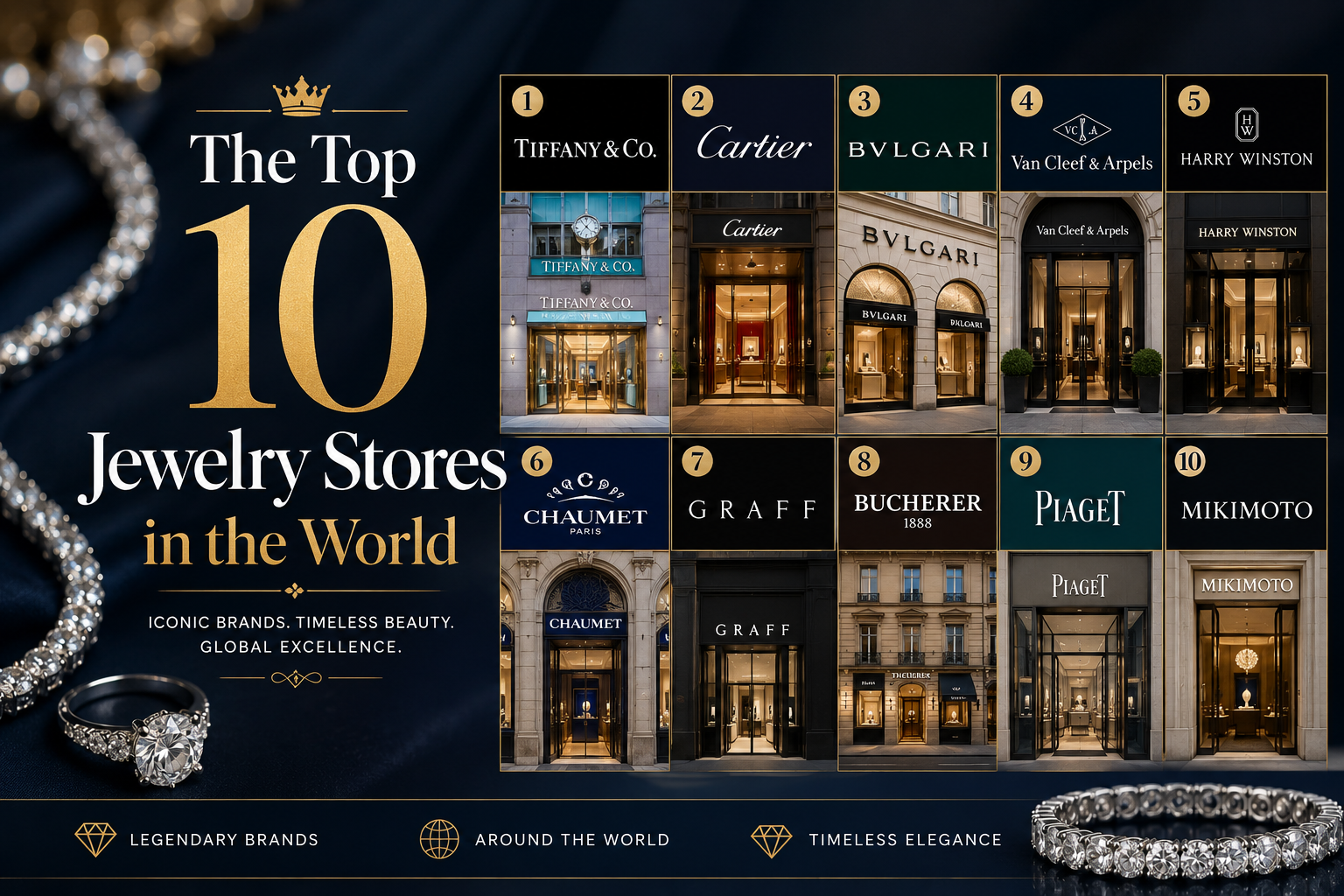
The Top 10 Jewelry Stores in the World
For nearly two centuries, a handful of jewelry houses have defined what the word luxury actually means. They have crowned royalty, set the diamonds that walk down red carpets, and turned a single shade of blue or a four-leaf clover into a symbol recognised on every continent. If you have ever searched for the top 10 jewelry stores in the world, you were really asking a deeper question: which names have earned their place at the very top, and what makes each one worth knowing?
This guide answers that. At GemstonesUniverse, our world revolves around the heart of every great jewel the stone itself so we have looked at these houses the way a gemmologist would: by heritage, by the quality and rarity of the stones they work with, by the signature designs that hold their value, and by the experience of walking through their doors. Here are the ten that consistently rise above the rest.
How we chose these jewelry houses?
There is no single “best” jewelry store for everyone, so we ranked these legendary names against criteria that genuinely matter to a serious buyer or collector:
- Heritage and authority decades (often a century or more) of unbroken craftsmanship.
- Quality and rarity of stones the calibre of diamonds, pearls, and coloured gemstones each house is known for.
- Iconic, value-retaining collections designs that are instantly recognisable and hold their worth on the resale market.
- Craftsmanship and innovation techniques and patents that other jewelers cannot easily replicate.
- Global reach and cultural impact flagship boutiques and a presence that shapes the wider luxury market.
A quick note on the word stores: at this level, the “store” and the “brand” are the same thing. Each of these names is a maison a house that designs, crafts, and sells its own jewelry through its own flagship boutiques. So this is, in effect, a list of the greatest jewelry brands in the world and the legendary stores they operate.
1. Cartier The Jeweler of Kings
Founded in Paris in 1847 by Louis-François Cartier, Cartier earned the title “the jeweler of kings and the king of jewelers” by serving European royalty and shaping modern jewelry itself. The house helped popularise platinum settings and pioneered the clean geometry of the Art Deco era.
Today, owned by the Richemont group, Cartier is the highest-grossing fine jeweler in the world. Its instantly recognisable collections the Love bracelet (born in the 1970s and still a bestseller), Juste un Clou, Panthère, and Trinity are treated by many buyers as long-term investments. With landmark boutiques such as the historic address on Rue de la Paix in Paris, Cartier remains the benchmark every other house is measured against.
Best for: timeless status pieces, high jewelry, and designs that hold their value.
2. Tiffany & Co. American Icon
No name is more woven into the popular idea of fine jewelry than Tiffany & Co. Founded in New York in 1837, the house gave the world its famous robin’s-egg blue box a colour so distinctive it carries its own trademark and revolutionised the engagement ring in 1886 with the six-prong Tiffany Setting, which lifts a diamond above the band to release its maximum brilliance.
Now part of the LVMH group, Tiffany blends heritage collections with modern lines and celebrated designer collaborations. Its restored flagship on New York’s Fifth Avenue is a destination in its own right.
Best for: engagement rings, classic diamond jewelry, and an unmistakable brand experience.
3. Van Cleef & Arpels The Poet of High Jewelry
Since opening at 22 Place Vendôme in Paris in 1906, Van Cleef & Arpels has owned the dreamier, more poetic side of high jewelry. The house is famous for two things above all: the Alhambra four-leaf-clover motif, a symbol of luck that has shown extraordinary value retention, and the patented Mystery Setting, in which stones are placed so precisely that no metal is visible between them.
Also part of the Richemont group, Van Cleef & Arpels turns nature, dance, and fairy tales into wearable art the kind of pieces collectors hold onto for generations.
Best for: whimsical, nature-inspired designs and the iconic Alhambra collection.
4. Harry Winston The King of Diamonds
Established in New York in 1932, Harry Winston is where the rarest and largest diamonds find a home and where celebrities turn before the Oscars. Founder Harry Winston was nicknamed the “King of Diamonds” for his love of acquiring the world’s most exceptional stones, and the house’s history is tied to legendary gems including the Hope Diamond.
Its signature Winston Cluster setting minimises metal so the stones themselves take centre stage. This is high jewelry at its most exclusive, where pieces are viewed as genuine financial assets.
Best for: exceptional diamonds, red-carpet glamour, and serious collectors.
5. Bvlgari Roman Boldness and Colour
Founded in Rome in 1884 by Greek silversmith Sotirio Bulgari, Bvlgari brings unmistakable Italian exuberance to high jewelry. While French houses tend toward delicacy, Bvlgari embraces bold proportions, ancient Roman motifs, and audacious combinations of colour it was a pioneer of cabochon-cut coloured gemstones when rivals focused only on diamonds.
Its Serpenti coiled-snake designs and the architectural B.zero1 collection are among the most recognisable in the world. The house rose to global fame in the La Dolce Vita era, famously adored by Elizabeth Taylor, and is now part of the LVMH group.
Best for: bold, colourful statement pieces with a distinctive Italian character.
6. Graff The Home of the Rarest Diamonds
Founded in London in 1960 by Laurence Graff, Graff is the definitive name for the world’s most significant and rarest diamonds. Privately owned and vertically integrated, the house controls every step sourcing rough stones, then cutting, polishing, and setting them which lets it work with gems other jewelers never see.
When the 1,109-carat Lesedi La Rona, one of the largest rough diamonds ever found, came to market in 2015, it was Graff that acquired it. From its flagship on New Bond Street, Graff caters to a clientele for whom only the most extraordinary stone will do.
Best for: record-setting diamonds and the absolute pinnacle of stone quality.
7. Chopard Swiss Craftsmanship Meets the Red Carpet
Founded in Switzerland in 1860 by Louis-Ulysse Chopard and led by the Scheufele family since 1963, Chopard bridges two luxury worlds fine watchmaking and high jewelry with equal brilliance. Its signature Happy Diamonds collection features loose diamonds that dance freely between two panes of sapphire crystal, a charming technical innovation, alongside the playful Happy Hearts and geometric Ice Cube lines.
As the long-standing partner of the Cannes Film Festival, Chopard is a fixture on the red carpet. It is also a leader in responsible luxury, crafting its jewelry from 100% ethically sourced gold.
Best for: joyful everyday luxury, ethical sourcing, and jewelry-and-watch lovers.
8. Buccellati Italian Old-World Artistry
Founded in Milan in 1919 by master goldsmith Mario Buccellati, this house is the pinnacle of Italian “old-world” prestige. Inspired by Renaissance art and Venetian lace, Buccellati is revered for hand-engraving techniques such as the silky parallel lines of rigato and the openwork honeycomb of tulle that make solid gold look as light and textured as fabric.
Each piece can require hundreds of hours of work using methods barely changed in centuries. Now part of the Richemont group, Buccellati remains a quiet favourite of connoisseurs who prize craftsmanship over logos.
Best for: distinctive textured goldwork and collectors who value rare craft.
9. Boucheron The Pioneer of Place Vendôme
Founded in Paris in 1858 by Frédéric Boucheron, this maison made history in 1893 as the first jeweler to open on Place Vendôme the address that would become the global epicentre of high jewelry. (Legend says Boucheron chose number 26 because it caught the most sunlight, so the diamonds in the window would sparkle brightest.)
Known for daring, nature-inspired designs and a fearless use of coloured stones, Boucheron’s signature Quatre ring stacks four contrasting bands into a single modern classic, while the Serpent Bohème line keeps its beloved snake motif alive. The house is part of the Kering group today.
Best for: Parisian artistry, modular designs, and a true sense of jewelry history.
10. Mikimoto The King of Pearls
Founded in Japan in 1893 by Kokichi Mikimoto, this house changed the jewelry world forever: Mikimoto created the first cultured pearl, making the once-impossibly-rare gem accessible to far more people. More than a century later, Mikimoto is still regarded as the global leader in luxury pearl jewelry.
From classic strands of Akoya pearls to elaborate high jewelry set with rare South Sea pearls and diamonds, Mikimoto pieces are defined by exacting quality. With flagship boutiques in Tokyo, Paris, New York, and London, it is the undisputed authority for anyone who loves pearls.
Best for: the finest cultured pearls and timeless, elegant pearl jewelry.
Quick comparison: the world’s top 10 jewelry houses
| # | House | Founded | Origin | Famous for |
| 1 | Cartier | 1847 | Paris, France | Love bracelet, Panthère, royal heritage |
| 2 | Tiffany & Co. | 1837 | New York, USA | Tiffany Setting, the blue box |
| 3 | Van Cleef & Arpels | 1906 | Paris, France | Alhambra motif, Mystery Setting |
| 4 | Harry Winston | 1932 | New York, USA | Rare diamonds, red-carpet glamour |
| 5 | Bvlgari | 1884 | Rome, Italy | Serpenti, bold coloured gemstones |
| 6 | Graff | 1960 | London, UK | The rarest and largest diamonds |
| 7 | Chopard | 1860 | Switzerland | Happy Diamonds, ethical gold |
| 8 | Buccellati | 1919 | Milan, Italy | Renaissance-style hand-engraving |
| 9 | Boucheron | 1858 | Paris, France | First on Place Vendôme, Quatre ring |
| 10 | Mikimoto | 1893 | Japan | The original cultured pearls |
Beyond the icons: other ways to read “the best”
“Top jewelry stores” can mean different things depending on what you are looking for, so it is worth knowing the other leaders in the field:
- Largest jewelry companies by scale. If you measure by sheer size, conglomerates dominate: the LVMH and Richemont groups own many of the houses above, while Chow Tai Fook of Hong Kong operates thousands of stores across Asia. These are the giants behind the global jewelry market.
- Best for value engagement rings. A new generation of digital-first retailers has changed how people buy diamonds, offering strong transparency and value for engagement rings and loose stones a smart route when the stone matters more than the name on the box.
- The heritage maisons above remain the choice when you want iconic design, prestige, and the best resale value.
What these legendary houses can teach you about buying jewelry?
Here is the secret that ties all ten of these names together: the design and the name add prestige, but the true value of any fine jewel lives in the stone. A house like Graff is celebrated for its diamonds; Mikimoto for its pearls; Bvlgari and Boucheron for their rare coloured gemstones. The maison is the frame the gemstone is the masterpiece.
That is exactly why, before you fall for a setting, it pays to understand what you are really buying:
- For diamonds, learn the 4Cs cut, colour, clarity, and carat weight and always insist on independent certification.
- For coloured gemstones such as rubies, emeralds, sapphires, and other precious stones, origin, natural (untreated) quality, and clarity make an enormous difference to both beauty and value.
- For pearls, lustre, surface, shape, and size separate the ordinary from the exceptional.
Whether you choose a piece from a Place Vendôme maison or commission your own design, a well-chosen, high-quality natural gemstone is what turns jewelry into a treasure worth passing down. At GemstonesUniverse, that is our entire craft sourcing fine natural gemstones so the heart of your jewel is as remarkable as the name beside it.
Frequently asked questions
Which is the most famous jewelry store in the world?
Cartier and Tiffany & Co. are widely considered the most famous jewelry houses in the world. Cartier is the highest-grossing fine jeweler and is known as “the jeweler of kings,” while Tiffany & Co. is the most recognisable name in popular culture thanks to its iconic blue box and Fifth Avenue flagship.
What is the most expensive jewelry brand?
For ultra-high jewelry, Graff and Harry Winston sit at the top, because they specialise in the rarest, largest, and finest diamonds, where individual pieces can reach extraordinary prices. Among the major heritage houses, Cartier and Van Cleef & Arpels also command premium prices for their signature collections.
Which jewelry store is best for engagement rings?
Tiffany & Co. and Cartier are the classic luxury choices for engagement rings and offer iconic, value-retaining settings. If value and stone quality are your priority over the brand name, dedicated online diamond retailers often provide excellent transparency and pricing for the same quality of stone.
What is the oldest luxury jewelry house?
Among the houses on this list, Tiffany & Co. (1837) is the oldest, followed closely by Cartier (1847), Boucheron (1858), and Chopard (1860). Several of the world’s greatest jewelers have been crafting fine pieces continuously for well over 150 years.
Is luxury jewelry a good investment?
Certain pieces from these houses have historically held or increased their value, particularly iconic, instantly recognisable designs and jewelry set with exceptional natural stones. As with any investment, condition, rarity, certification, and the quality of the gemstone are what drive long-term value which is why understanding the stone matters as much as the brand.
What is the largest jewelry company in the world?
By revenue, the largest players are the luxury conglomerates LVMH and Richemont, which own many of the houses on this list. By retail footprint, Chow Tai Fook is among the biggest, with thousands of stores concentrated across Asia.