


Zultanite Gemstone Benefits: The Complete Guide to Meaning, Healing Properties, and Value
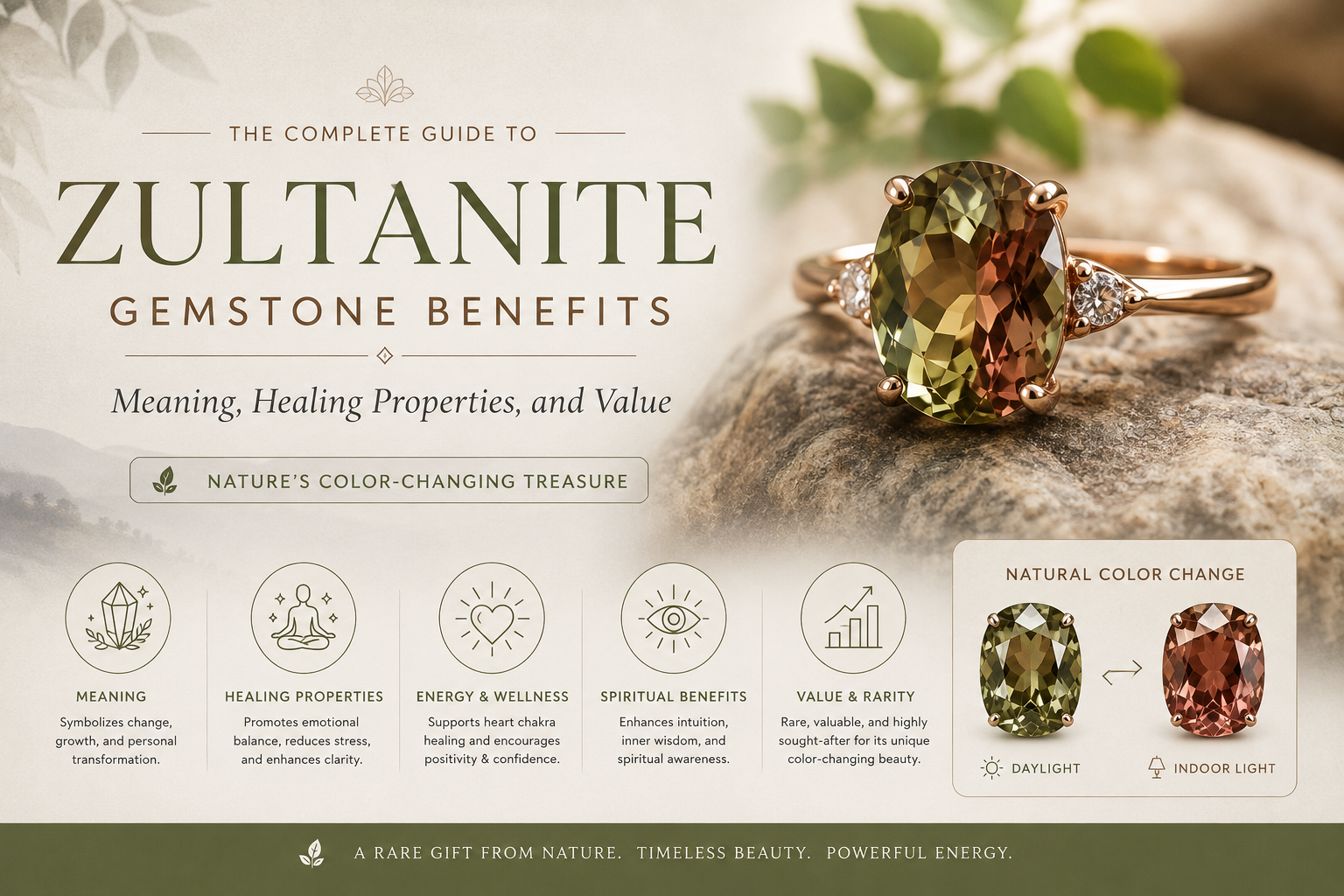
Few stones reward a second look quite like zultanite. Tilt it toward a window and it glows a soft kiwi green; carry it indoors under a lamp and it warms to champagne; hold it near candlelight and it blushes a rich raspberry pink. That living, shifting colour is the headline act but the zultanite gemstone benefits that keep collectors, crystal enthusiasts, and jewellery lovers fascinated run much deeper than looks alone.
This guide pulls everything together in one place. You’ll learn what zultanite actually is, the spiritual and emotional meanings people attach to it, its connections to the chakras and the zodiac, the wellness beliefs surrounding it (and what the science really says), and the practical advantages durability, rarity, traceable sourcing that make it a genuinely smart addition to a collection. We’ve written it for a Canadian audience, with pricing context in Canadian dollars and tips for buying with confidence, whether you’re shopping at a GU showcase or browsing online.
Let’s start with the basics, because understanding what zultanite is makes every one of its benefits easier to appreciate.
What Is Zultanite? A Quick Answer
Zultanite is the trademarked trade name for gem-quality, colour-changing diaspore mined from a single deposit in the Anatolian Mountains of southwestern Turkey. Its standout trait is a natural colour shift from green in daylight to pink, champagne, and raspberry under warmer light and unlike most coloured gemstones on the market, it is never heated, irradiated, or otherwise treated. What you see is 100% natural.
That short definition packs in three things worth slowing down on: the mineral, the brand name, and the rarity.
The mineral itself is diaspore, a hydrous aluminium oxide with the chemical formula AlO(OH). Diaspore was first identified back in 1801 and turns up in bauxite deposits in several countries, but the gem-quality, strongly colour-changing material that the jewellery world prizes comes essentially from one place: the Milas district of Muğla province in Turkey, mined at altitude in remote mountain terrain.
Zultanite is a brand. When the Turkish gem-quality diaspore was introduced to the international jewellery trade in the mid-2000s, it was given a marketable name “Zultanite,” a nod to the sultans who once ruled the region. A second trademark, Csarite, was introduced around 2012 (referencing the Russian czars), and you may also see the term Ottomanite. All three are marketing names for the same mineral: top-grade Turkish diaspore. Diaspore from any other location cannot legally be called zultanite or csarite. Think of it the way a sparkling wine from one specific region earns a protected name while the same style made elsewhere cannot use it.
The rarity is not marketing fluff. Cutting diaspore is notoriously difficult because the crystal has perfect cleavage it can split cleanly along one plane and it must be oriented precisely to reveal its colour change. The result is brutal yields: only about half of mined material is even suitable for faceting, and as much as 98% of a rough crystal can be lost during cutting. Stones above five carats are genuinely scarce. That scarcity is one of the gemstone’s most tangible benefits as a collectible, and we’ll return to it later.
Zultanite at a Glance: Gemological Properties
For readers who like the technical picture, here are the verified properties of zultanite (colour-change diaspore). These numbers also matter for two real benefits we’ll discuss durability and authenticity.
| Property | Detail |
| Mineral name | Diaspore |
| Trade names | Zultanite, Csarite, Ottomanite |
| Chemistry | AlO(OH) hydrous aluminium oxide |
| Crystal system | Orthorhombic |
| Mohs hardness | 6.5 – 7 |
| Refractive index | ~1.68 – 1.75 |
| Birefringence | ~0.048 |
| Specific gravity | ~3.30 – 3.39 |
| Cleavage | Perfect on one plane (cutting challenge) |
| Lustre | Vitreous to pearly |
| Pleochroism | Strong (multiple colours by viewing angle) |
| Clarity type | GIA Type II (some inclusions typical in rough) |
| Phenomenon | Colour change; occasionally a cat’s-eye effect |
| Treatments | None never enhanced |
| Source | Anatolian Mountains, Muğla, Turkey (single deposit) |
A hardness of 6.5 to 7 puts zultanite roughly on par with peridot and just below quartz hard enough for everyday jewellery, though its perfect cleavage means it needs a little more care than a sapphire. More on care toward the end.
The Colour-Change Phenomenon and Why It’s the First Benefit
The most immediate zultanite gemstone benefit is purely experiential: you are buying several gemstones in one. Where most stones present a single fixed hue, zultanite is a chameleon.
Under cool daylight (around 6,500 K), it reads as sage or kiwi green, often with flashes of canary yellow. Move to ordinary indoor lighting (incandescent or warm LED, around 3,000 K), and it transitions through cognac and rich champagne tones. Bring it close to candlelight (around 1,850 K), and the warmest, most dramatic raspberry-pink and purplish hues appear. The same stone can even show two colours at once at the boundary between light sources.
This is the same optical family as the celebrated “alexandrite effect,” but zultanite has a wider range. Alexandrite essentially toggles between two colours green to red. Zultanite moves across a broader palette, which is why people describe owning one as endlessly engaging. From a styling perspective, that versatility is a practical perk: a single zultanite pendant or ring quietly coordinates with a daytime outfit and an evening one, shifting its personality as your surroundings change.
It is also worth noting why the colour changes, because the explanation feeds the stone’s symbolism. The shift happens because of how trace elements in the crystal absorb and transmit different wavelengths of light depending on the light source. Nothing about the stone itself is changing only the light around it and yet its appearance transforms completely. That single physical fact is the seed of nearly every spiritual meaning attached to zultanite, which we’ll explore next.
Zultanite Gemstone Benefits: The Overview
Before we go deep, here’s the quick-reference list many readers come for. In crystal and gemstone traditions, zultanite is associated with:
- Transformation and adaptability embracing change with grace
- Emotional balance steadying mood swings and easing overwhelm
- Mental clarity and focus supporting concentration, memory, and study
- Stress and anxiety relief encouraging calm and centred decision-making
- Spiritual growth and intuition opening higher awareness and insight
- Self-discovery and confidence aligning beliefs with action
- Heart-centred qualities compassion, self-love, and acceptance
Alongside these metaphysical associations sit several practical, real-world benefits: exceptional rarity and collectibility, all-natural untreated quality, single-source traceability, everyday durability, and remarkable styling versatility.
A clear distinction matters here, and it’s one most competing articles skip. The metaphysical and emotional associations belong to belief systems and personal practice they are not medically proven. The practical benefits, by contrast, are factual and verifiable. We’ll treat each honestly. Let’s begin with the meanings people cherish most.
The Spiritual and Metaphysical Meaning of Zultanite
A Stone of Transformation and Change
If zultanite has a single defining theme, it’s transformation. The reason is poetic but intuitive: a stone that changes its colour depending on its surroundings becomes a natural emblem for adapting to life’s shifting conditions. Practitioners reach for zultanite during transitions a new job, a move, the end of a relationship, a creative reinvention using it as a tactile reminder that change can be navigated with elegance rather than resisted.
The symbolism cuts deeper than novelty. Because the stone’s essence never changes even as its appearance transforms, it’s often read as a lesson in staying grounded in who you are while the circumstances around you move. For anyone going through upheaval, that’s a quietly reassuring message to carry in a pocket or on a finger.
Emotional Balance and Calm
The second meaning most often attributed to zultanite is emotional equilibrium. Its ever-shifting yet stable colour play is said to mirror the natural rise and fall of human emotion feelings move and change, but the self underneath can remain centred.
In practice, people who keep zultanite nearby during stressful periods describe using it as an anchor: a moment to pause, breathe, and respond from a calmer place rather than react in the heat of a moment. Whether you understand that as the stone’s energy or simply as the genuine psychological value of a grounding ritual and a beautiful object to focus on, the calming effect many users report is real to them. For those prone to mood swings or feeling emotionally overwhelmed, zultanite is a popular companion stone.
Mental Clarity, Focus, and Memory
Among crystal enthusiasts, zultanite has a particular reputation as a “clear thinking” stone. It’s frequently recommended to students during exam season and to anyone wrestling with brain fog, forgetfulness, or scattered attention. The association is with sharper recall, steadier concentration, and a mind less cluttered by stress.
It bears repeating that these are traditional beliefs rather than clinical findings there’s no scientific evidence that a gemstone improves memory or cognition. That said, the placebo of intention is not nothing: choosing a beautiful object to represent your focus and keeping it on your desk during study can genuinely support a productive mindset and routine. Many people find that meaningful.
Stress Relief and Resilience
Closely tied to clarity is zultanite’s reputation for easing stress and building resilience. The idea is that a calmer, clearer mind handles pressure better so the stone is used as a small daily reset and a symbol of bouncing back. People who feel they’ve grown more easily discouraged over time sometimes adopt zultanite specifically as a “resilience” token.
Spiritual Awakening, Intuition, and Self-Discovery
On the spiritual side, zultanite is linked to higher awareness, intuition, and the search for meaning and purpose. Because its colours span the spectrum, it’s associated with more than one energy centre (more on chakras below) and is used in meditation to encourage insight, inner wisdom, and a sense of direction. Some practitioners also associate it with self-discovery using the stone’s “many faces” as a prompt to explore different sides of themselves and a smaller number connect it with past-life recall and deeper meditative states.
However you relate to these ideas, the common thread is gentle: zultanite is treated as a stone of growth, reflection, and becoming.
Zultanite and the Chakras
In chakra-based practice, zultanite’s multiple colours give it an unusually broad reach across the body’s energy centres. Different shades are mapped to different chakras, which is part of why the stone is considered so versatile in energy work.
- Heart chakra (green tones). The kiwi-green daylight colour links zultanite to the heart centre, associated with love, compassion, self-acceptance, and emotional balance. This is the most commonly cited connection.
- Solar plexus chakra (yellow/champagne tones). The warm golden hues tie it to the solar plexus, the centre of personal power, confidence, and willpower supporting self-assurance and motivation.
- Third eye chakra (insight). Zultanite is used to stimulate the third eye, associated with intuition, perception, and inner clarity.
- Crown chakra (higher awareness). It’s also linked to the crown chakra, connected with spiritual insight, higher consciousness, and one’s sense of meaning and purpose.
- Throat chakra (where bluish flashes appear). Some stones show cooler bluish flashes, and these are occasionally associated with the throat chakra communication and authentic self-expression.
A common way to work with the stone is simple: choose the chakra you want to focus on, select or position the zultanite to match, and hold or wear it during quiet meditation while you visualise the quality you’re cultivating. There’s no single “correct” technique comfort and consistency matter more than ritual precision.
Zultanite and Astrology: Zodiac Connections
As a variety of diaspore, zultanite is frequently described as a beneficial stone for several zodiac signs. You’ll see slightly different lists across sources, but the most commonly cited are:
- Libra drawn to the stone’s themes of balance and harmony.
- Leo supported in confidence and warmth (echoing the solar-plexus association).
- Pisces aligned with its intuitive, emotionally attuned qualities.
- Gemini matched to the stone’s adaptable, curious, “many-sided” nature.
Some traditions also associate the green-toned stone with the planet Mercury the planet of intellect and communication which dovetails with the mental-clarity reputation described earlier. In Vedic-influenced systems, zultanite is sometimes discussed alongside emerald (Panna) for that Mercury connection, though it is a distinct gemstone with no formal place in classical birthstone charts.
Speaking of which: because of its colour-change kinship with alexandrite (a June birthstone), zultanite is often suggested as a beautiful and more affordable June birthstone alternative. For a Canadian shopper looking for a June birthday gift with a story, that’s a lovely angle.
Physical and Wellness Beliefs With an Honest Disclaimer
This is the section where responsible writing matters most, because much of the internet repeats dramatic health claims about zultanite without context. Here is the balanced truth.
Important: The wellness associations below come from crystal-healing folklore and personal belief. They are not scientifically proven, and zultanite is not a medical treatment. No gemstone can cure, treat, or prevent any disease. If you have a health concern, please consult a qualified healthcare professional. Crystals can be a meaningful complement to wellbeing practices, but they should never replace medical care.
With that firmly established, here are the physical benefits traditionally attributed to zultanite in crystal-healing circles. We present them as beliefs, not facts:
- Mental sharpness and focus the most consistent claim, framed as support for memory and concentration.
- Stress reduction and better sleep used by some for relaxation, dream recall, and easing insomnia.
- Metabolism and weight goals sometimes kept as a supportive token during a wellness routine.
- Vitality and detoxification described as energising or supportive of the body’s natural balance.
- General comfort during illness kept nearby for reassurance and calm.
You will find sources online claiming zultanite helps with serious conditions such as Alzheimer’s, dementia, or Parkinson’s. There is no evidence for this, and we’d urge readers to treat such claims with healthy scepticism. The legitimate, defensible value of zultanite in a wellness context is as a calming, intention-focusing, beautiful object that supports mindful habits not as a substitute for medicine.
The Practical Benefits of Zultanite (These Are Real)
Set the metaphysics aside for a moment, because zultanite offers concrete, verifiable advantages that stand on their own. For many buyers, these are the most compelling reasons to own one.
1. Genuine Rarity and Collectibility
Zultanite comes from a single deposit on Earth, mined by hand in difficult terrain, with cutting yields so low that most rough is lost in the process. Fine stones above a few carats are scarce. In a market full of mass-produced and heavily treated gems, that authentic scarcity gives zultanite real collector appeal and the kind of conversation-starting backstory that mainstream gemstones can’t match.
2. 100% Natural, Never Treated
The vast majority of coloured gemstones you encounter from sapphires to topaz are routinely heated, irradiated, oil-filled, or otherwise enhanced. Zultanite is one of the rare exceptions that is never treated. Its colour, brilliance, and colour change are entirely natural. For buyers who value authenticity and disclosure, that’s a meaningful benefit.
3. Single-Source Traceability and Ethical Sourcing
Because authentic zultanite can be traced to one mine and is sold through authorised channels, its provenance is unusually clear. You know where it came from. For increasingly conscientious Canadian consumers who care about origin and responsible sourcing, traceability is a genuine plus provided you buy certified material from a reputable seller.
4. Everyday Durability
At 6.5 to 7 on the Mohs scale, zultanite is hard enough for rings, pendants, and earrings worn regularly. It isn’t as tough as corundum (sapphire and ruby) because of its cleavage, so it warrants sensible care, but it’s far from a fragile “display only” stone.
5. Unmatched Styling Versatility
As covered above, the colour change effectively gives you several looks in one piece. A zultanite ring reads green and fresh by day and pink and romantic by candlelight a practical wardrobe advantage no single-colour stone can offer.
6. A More Accessible Alternative to Alexandrite
Natural alexandrite is one of the most expensive gemstones in the world. Zultanite delivers a comparable colour-change “wow” at a fraction of the price often cited at roughly 5–20% of alexandrite’s cost with a wider palette of hues to boot. That brings the magic of colour change within reach of far more buyers.
Zultanite vs Alexandrite vs Other Colour-Change Stones
Because shoppers almost always compare these stones, here’s a clear breakdown.
| Feature | Zultanite (Diaspore) | Alexandrite | Colour-Change Sapphire |
| Colour change | Green → champagne → raspberry-pink (wide range) | Green → red (two main colours) | Blue → purple/green (varies) |
| Mohs hardness | 6.5 – 7 | 8.5 | 9 |
| Typical treatment | None (natural) | Usually untreated; synthetics common | Often heated |
| Rarity | Very rare; one source | Extremely rare (natural) | Rare |
| Relative price | More accessible | Very high | High |
| Source | Turkey (single deposit) | Russia, Brazil, Sri Lanka, others | Sri Lanka, Tanzania, others |
The short version: alexandrite is harder and historically the most prestigious colour-change gem, but its natural form is eye-wateringly expensive. Colour-change sapphire is the most durable option. Zultanite wins on breadth of colour shift, all-natural quality, and value at the cost of needing slightly more careful handling. For most Canadian buyers who love the colour-change effect but don’t want alexandrite’s price tag, zultanite is the sweet spot.
Zultanite Value and Price in Canada
So, what does zultanite cost? Prices vary widely with quality, and they shift with currency and market conditions, so treat the following as general guidance and always confirm current pricing with your seller.
What drives the price:
- Colour-change quality. The more vivid and complete the shift between green and pink, the higher the value. A strong, obvious change commands a premium over a subtle one.
- Carat weight. Because large rough is so often lost in cutting, stones grow disproportionately more expensive with size. Anything above 3–5 carats is rare and priced accordingly.
- Clarity. Although zultanite is a Type II stone (some inclusions are normal in rough), most cut and sold stones are eye-clean. Cleaner stones with better transparency are worth more.
- Cut quality. Skilled faceting that maximises the colour change and brilliance significantly raises value. Fancy and precision cuts command the highest prices.
- Authenticity and certification. Certified natural zultanite is worth far more than untreated lab-created “zultanite-type” diaspore or imitations.
Approximate ranges (verify locally): Smaller, commercial-quality natural zultanite often starts in the low hundreds of Canadian dollars per carat. Finer one-to-two-carat stones with strong colour change typically climb into the several-hundred-to-over-a-thousand CAD per carat range, and exceptional large, vivid stones go well beyond that. By contrast, a simple sterling-silver ring set with lab-created colour-change diaspore (sold as costume or fashion jewellery, not genuine zultanite) may cost well under CAD $150. Those two things are not the same product, which leads neatly to authenticity.
How to Identify Genuine Zultanite and Avoid Fakes?
Because zultanite is valuable and trademark-protected, the market includes both honest lab-created diaspore (legitimately sold as a fashion alternative) and outright misrepresentation. Protect yourself with these steps:
Ask directly whether it’s natural or lab-created
A reputable seller will tell you plainly. Lab-grown colour-change diaspore is real and attractive, but it is not “zultanite” and shouldn’t be priced as such.
Insist on certification
Genuine zultanite is typically accompanied by documentation tracing it to the authorised source, often including an authenticity card. For anything sold at a significant price, a report from a recognised gemmological lab is reassuring.
Be wary of “too cheap to be true”
Authentic natural zultanite is rare and priced like it. A bargain that seems impossible usually is it’s likely synthetic or glass.
Mind the colour change
Genuine zultanite shows a real shift between cool daylight and warm indoor or candlelight. Ask to view the stone under different light sources before buying.
Buy from established sellers
Whether in a Canadian showroom or online, choose vendors with transparent sourcing, clear return policies, and verifiable reputations like GU rather than unfamiliar bazaar stalls or anonymous marketplace listings.
None of this means lab-created diaspore is “bad” it’s a perfectly nice, affordable way to enjoy the colour-change look. The key is honest disclosure so you know exactly what you’re paying for.
Zultanite Jewellery: Rings, Pendants, Earrings, and More
Zultanite’s drama makes it a showpiece in fine jewellery, and its versatility suits a range of designs.
- Rings. A zultanite ring is a true conversation piece green by day, pink by candlelight. It works beautifully as a statement cocktail ring and, for the adventurous, even as a distinctive alternative engagement ring (with the caveat that its cleavage means protective settings and mindful wear are wise).
- Pendants and necklaces. A pendant frames the colour change perfectly against the skin and is one of the most protected ways to wear the stone, since it’s less exposed to knocks than a ring.
- Earrings. Studs or drops catch shifting light as you move, showing off the colour play to anyone you’re speaking with.
- Bracelets. From delicate chains to bolder cuffs, a zultanite bracelet adds shifting colour at the wrist.
The stone flatters both yellow and white metals: warm gold settings amplify its champagne and pink tones, while white gold or platinum emphasise the cool green. It suits people who love individuality and a piece with a story and it makes a memorable gift for milestones, especially June birthdays.
How to Use Zultanite for Its Benefits?
If you’re drawn to zultanite’s metaphysical side, here are common ways people incorporate it into daily life. Take what resonates and leave the rest.
- Wear it. The simplest approach a ring, pendant, or earrings keeps the stone with you, its shifting colour a gentle prompt toward calm and adaptability throughout the day.
- Meditate with it. Hold the stone in your hand or rest it over the chakra you’re focusing on. Breathe slowly and visualise the quality you want to cultivate balance, clarity, confidence. There’s no wrong way to do it.
- Keep it at your desk. Many students and professionals place zultanite where they work as a focus anchor during demanding tasks.
- Carry it through transitions. During a move, a career change, or any big shift, keep it in a pocket as a tactile reminder to adapt with grace.
- Set an intention. When you first acquire the stone, take a quiet moment to associate it with what you’re working toward. The ritual of intention is where much of the personal value lives.
Caring for Your Zultanite
Zultanite is durable enough for regular wear, but its perfect cleavage means it deserves a little respect. Follow these guidelines to keep yours beautiful for a lifetime.
- Avoid hard knocks. A sharp blow aligned with the cleavage plane can split the stone. Remove rings during sports, gardening, heavy lifting, or rough work.
- Clean gently. Warm water, mild dish soap, and a soft brush or cloth are all you need. Avoid harsh chemicals, bleach, and prolonged chemical exposure.
- Skip ultrasonic and steam cleaners. Because of the cleavage, mechanical cleaning systems carry unnecessary risk. Hand-cleaning is safest.
- Store separately. Keep zultanite away from harder gems (diamonds, sapphires) that could scratch it. A soft pouch or a lined compartment in a jewellery box is ideal.
- Put jewellery on last. Apply perfume, lotion, and hairspray before your zultanite goes on, and take it off before showering or swimming.
A little routine care preserves both the colour change and the polish for generations.
Who Should Consider Zultanite?
Zultanite is an especially good fit if you:
- Love the magic of colour-change gems but find natural alexandrite out of reach.
- Value authenticity and want an untreated, naturally beautiful stone.
- Care about traceable, responsibly sourced provenance.
- Enjoy owning something genuinely rare with a story to tell.
- Want one piece of jewellery that adapts from day to evening.
- Are drawn to the stone’s themes of transformation, balance, and growth.
- Need a distinctive June birthstone alternative or a meaningful milestone gift.
If your priority is maximum scratch-resistance for daily abuse without any care, a colour-change sapphire might suit you better. But for sheer character, value, and that mesmerising shift of colour, zultanite is hard to beat.
Frequently Asked Questions About Zultanite
Is zultanite a real gemstone?
Yes. Zultanite is a genuine, naturally occurring gemstone the gem-quality, colour-changing variety of the mineral diaspore, mined in Turkey. “Zultanite” is a trademarked trade name for that material; the mineral itself is diaspore.
What are the main benefits of zultanite?
On the metaphysical side, zultanite is associated with transformation, emotional balance, mental clarity, stress relief, and spiritual growth. On the practical side, its real benefits are rarity and collectibility, all-natural untreated quality, traceable sourcing, everyday durability, and exceptional styling versatility thanks to its colour change.
Does zultanite really have healing powers?
The emotional and spiritual associations are part of crystal-healing belief, not scientific fact. Zultanite is not a medical treatment and cannot cure or prevent any illness. Its legitimate value in wellbeing is as a calming, intention-focusing object that supports mindful habits always alongside, never instead of, proper medical care.
What is the difference between zultanite, csarite, and diaspore?
Diaspore is the mineral’s gemological name. Zultanite and Csarite are two trademarked brand names for top-grade Turkish diaspore. The stone is the same; the names reflect different branding (and historically, different distributors). Diaspore from outside Turkey cannot be sold as zultanite or csarite.
Why is zultanite so expensive and rare?
It comes from a single deposit in Turkey, is mined by hand in remote terrain, and is extremely difficult to cut because of its perfect cleavage. Only about half of mined material is suitable for faceting, and up to 98% of a rough crystal can be lost during cutting. Large, vivid stones are especially scarce.
Zultanite vs alexandrite which is better?
It depends on your priorities. Alexandrite is harder (8.5 Mohs) and the most prestigious colour-change gem, but natural alexandrite is dramatically more expensive. Zultanite offers a wider range of colours, all-natural quality, and far better value, at the cost of needing slightly more careful handling. For most buyers, zultanite is the more accessible choice.
Is zultanite treated or enhanced?
No. Zultanite is one of the few gemstones that is never heated, irradiated, or otherwise treated. Its colour and colour change are completely natural.
What chakras and zodiac signs is zultanite associated with?
In chakra practice it’s linked to the heart, solar plexus, third eye, and crown chakras (and occasionally the throat). Astrologically it’s most often associated with Libra, Leo, Pisces, and Gemini, and sometimes with the planet Mercury.
Can I wear zultanite every day?
Yes, with sensible care. Its 6.5–7 hardness suits regular wear, but its cleavage means you should avoid hard impacts, remove it for rough activities, and clean it gently by hand rather than with ultrasonic machines.
How can I tell if my zultanite is genuine?
Ask the seller directly whether it’s natural or lab-created, request certification and provenance documentation, view the stone under different light sources to confirm a real colour change, be sceptical of prices that seem too low, and buy only from reputable, transparent sellers.
Is zultanite a good investment?
Its genuine rarity, all-natural quality, and limited single source give it real collector appeal, and fine stones hold their interest in the market. As with any gemstone, value depends heavily on quality and on buying authenticated material at a fair price so prioritise certification and a trusted seller over a bargain.
What colours does zultanite change between?
Cool daylight brings out sage or kiwi green with yellow flashes; warm indoor light shifts it toward champagne and cognac; candlelight reveals raspberry-pink and purplish hues. A single stone can even show two colours at the transition between light sources.
Final Thoughts: Why Zultanite Earns Its Place
The lasting appeal of zultanite is that its benefits work on two levels at once. There’s the meaningful, symbolic layer a stone of transformation and balance that many people find genuinely grounding to wear and meditate with. And there’s the concrete, undeniable layer a rare, all-natural, traceable, versatile gemstone that delivers the captivating magic of colour change at a fraction of alexandrite’s price.
You don’t have to subscribe to the metaphysics to appreciate the stone, and you don’t have to be a gemologist to feel the wonder of watching green become pink in your hand. That dual appeal is exactly why zultanite has gone from an unknown Turkish curiosity to a quiet star of fine jewellery in just a couple of decades.
If you’re ready to experience that shift of colour for yourself, explore the certified, responsibly sourced zultanite available at GU and feel free to reach out with questions about choosing a stone that’s right for you. Whether you’re after a striking ring, an everyday pendant, or a one-of-a-kind gift with a story, a genuine zultanite is a rare pleasure worth holding onto.