


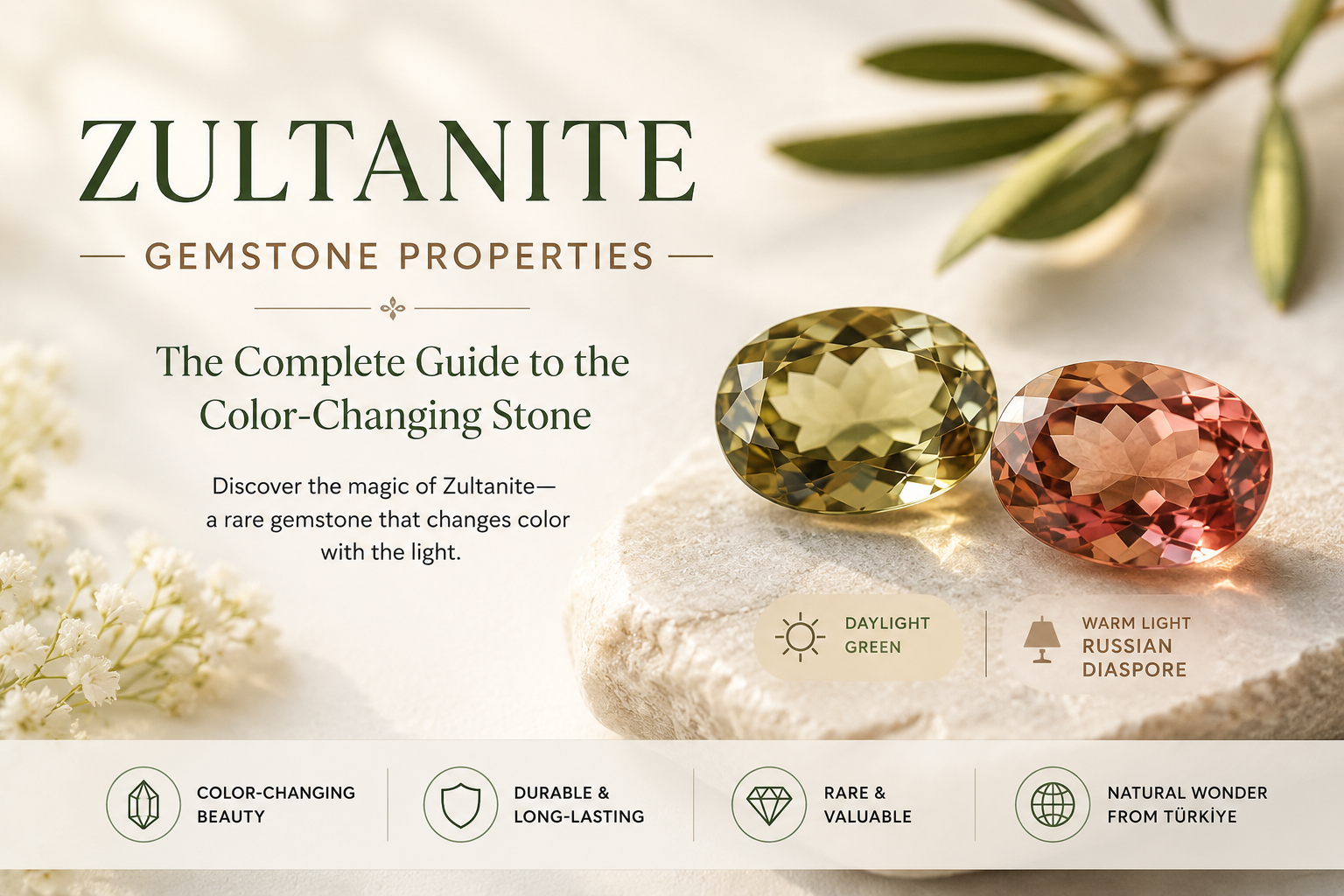
Zultanite Gemstone Properties: The Complete Guide to the Color-Changing Stone
Imagine a single stone that looks kiwi-green in the morning sun, mellows to a soft champagne under your living-room lamp, and warms into a raspberry blush by candlelight all without anyone touching it. That stone is zultanite, one of the rarest and most quietly theatrical gemstones on Earth. It comes from a single mountain range in Turkey, it is never heated or treated, and it shifts personality with the light around it.
If you have been researching zultanite gemstone properties what it is made of, how hard it is, why it changes color, what it is worth, and whether the one you are eyeing is genuine this guide pulls all of it together in one place. We will move from the science (crystal structure, hardness, refractive index) to the practical (price, care, spotting fakes) to the symbolic (meaning and metaphysical beliefs), so that by the end you can talk about zultanite with confidence and shop for it without getting burned.
Let’s start with the short version, then go deep.
What Is Zultanite? A Quick Answer
Zultanite is the trade name for gem-quality, color-changing diaspore a rare mineral (aluminum oxide hydroxide, AlO(OH)) mined exclusively in the İlbir Mountains of southwestern Turkey. Its defining feature is a natural, repeatable color change: green in daylight, champagne-gold in indoor light, and pink-to-raspberry in candlelight. It is completely untreated, registers 6.5–7 on the Mohs hardness scale, and is considered rarer and more single-sourced than almost any other commercial gem.
In other words, “zultanite” is a marketing name (a registered trademark), while “diaspore” is the underlying mineral species. Not all diaspore is zultanite only the transparent, facet-grade, color-shifting material from that one Turkish deposit earns the name. You will also see the same family of stones sold as Csarite, Ottomanite, Turkizite, or simply Turkish diaspore, a naming tangle we’ll untangle later.
Now, the properties in detail.
Zultanite Gemstone Properties at a Glance
Here is the full gemological profile of zultanite, useful whether you are a collector, a jeweler, or a curious buyer. Bookmark this table it is the heart of the stone’s identity.
| Property | Detail |
| Gem type / variety | Color-change variety of the mineral diaspore |
| Trade names | Zultanite®, Csarite®, Ottomanite, Turkizite, Turkish diaspore |
| Chemical formula | AlO(OH) aluminum oxide hydroxide |
| Mineral class | Hydroxide (oxide-hydroxide) |
| Crystal system | Orthorhombic |
| Mohs hardness | 6.5 – 7 |
| Toughness | Fair (limited by perfect cleavage) |
| Cleavage | Perfect in one direction ({010}); a second, weaker direction |
| Fracture | Conchoidal |
| Specific gravity | ~3.30 – 3.39 (typically 3.39) |
| Refractive index | ~1.70 – 1.75 (range often cited 1.682–1.752) |
| Birefringence | ~0.048 |
| Optic character | Biaxial positive |
| Dispersion (fire) | Weak |
| Luster | Vitreous; pearly on cleavage surfaces |
| Transparency | Transparent (gem grade) to translucent |
| Pleochroism | Strong different hues from different viewing angles |
| Color change | Green (daylight) → champagne/gold (indoor) → pink/raspberry (candlelight) |
| Cause of color | Trace iron, chromium, manganese, vanadium and titanium |
| Clarity type (GIA) | Type II (usually eye-clean, minor inclusions allowed) |
| Treatments | None enhancement code “N” (not enhanced) |
| Source | İlbir Mountains, Muğla Province, southwest Turkey |
| Notable trait | Heat-sensitive; avoid steam and ultrasonic cleaning |
If you only remember three numbers, make them these: hardness 6.5–7, specific gravity 3.39, refractive index ~1.75.Together with the color change, they are how gemologists separate real zultanite from imitations.
Let’s unpack the properties that matter most, starting with the one everyone talks about.
The Star Property: Zultanite’s Color Change
The reason zultanite commands attention and a premium price is its color change, a genuinely rare optical phenomenon that only a handful of gem species display.
What colors does zultanite actually show?
A fine zultanite is a chameleon. Under different light sources, the same stone can present a surprisingly wide range:
- In daylight or cool fluorescent light: kiwi green, sage green, or a soft yellow-green, sometimes with a flash of canary yellow.
- In indoor incandescent or warm LED light: champagne, golden-beige, honey, or “ginger-ale” tones.
- In candlelight or very warm, low light: raspberry pink, rose, cognac, or a muted purplish-red.
Top-grade material makes the leap all the way from green to pink the most dramatic and most valuable shift. Lower-grade stones may only warm slightly without a true hue change, which is an important distinction we’ll return to in the buyer’s guide.
Color change vs. pleochroism they’re not the same thing
People often blur two separate effects, so here’s the clean distinction:
- Color change happens when you swap the light source (sunlight vs. lamplight). The wavelengths hitting the stone change, so the color you perceive changes.
- Pleochroism happens when you change the viewing angle under the same light. Because zultanite is doubly refractive and biaxial, light splits and travels differently along different crystal axes, so tilting the stone reveals different hues.
Zultanite is unusual because it shows both strongly. That double effect is part of why no two zultanites and no two viewings of the same stone look exactly alike, and it’s also why the gem is famously difficult to photograph accurately.
Why does zultanite change color? The science
The color change comes down to trace elements trapped inside the crystal lattice during formation. Pure diaspore would be colorless or grayish; zultanite contains tiny amounts of iron, chromium, manganese, vanadium, and titanium. These impurities selectively absorb certain wavelengths of light and let others pass through.
Because daylight is rich in blue-green wavelengths while incandescent light is rich in red-orange wavelengths, the same selective absorption produces a green appearance in one and a pink appearance in the other. Manganese, chromium, and iron are most often credited with driving the shift, and spectroscopic studies point to iron and chromium absorption features in particular. This is the same broad mechanism known as the “alexandrite effect” that gives alexandrite its celebrated green-to-red transformation, even though the host minerals are completely different.
Crucially, the color change is 100% natural and infinitely repeatable. It is not a coating, not a treatment, and it never fades. Move the stone between rooms a thousand times and it will keep performing.
Physical and Optical Properties Explained
The data table above is a snapshot; here’s what those numbers mean in real life especially if you plan to wear zultanite rather than just admire it.
Hardness and toughness: a critical distinction
Zultanite sits at 6.5 to 7 on the Mohs scale, roughly the same as quartz, peridot, or tanzanite. That’s hard enough to resist everyday scratching reasonably well, but it is softer than sapphire (9) or diamond (10), so airborne dust (which often contains quartz) can dull it over decades.
Here’s the part many buyers miss: hardness and toughness are different things. Hardness measures scratch resistance; toughness measures resistance to chipping and breaking. Zultanite’s toughness is only fair, and the reason is its perfect cleavage.
Cleavage and why zultanite is so hard to cut
Zultanite has perfect cleavage in one direction (along the {010} crystal plane), plus a second, weaker cleavage direction. Cleavage is a built-in plane of structural weakness: a sharp knock in exactly the wrong direction can split the stone cleanly, the way a diamond can be cleaved despite being the hardest natural material.
This makes zultanite one of the most challenging gems in the world to cut. A lapidary must read the rough crystal and orient every facet to avoid the cleavage plane, or the stone can shatter on the wheel. Combine that with the fact that most rough must be discarded to find clean, color-rich sections, and you understand why finished zultanites are scarce and why skilled cutting adds so much to the price. Popular cuts oval, cushion, emerald, and pear are chosen specifically to maximize the color change and brilliance while respecting the cleavage.
For wearers, the practical takeaway is simple: protect the stone. Bezel and halo settings shield the girdle and edges; rings take more abuse than pendants and earrings, so daily-wear rings benefit most from protective mountings.
Refractive index, luster, and brilliance
Zultanite’s refractive index of roughly 1.70–1.75 is relatively high sitting between tanzanite and spinel, and not far below diamond. A higher RI means more light bends and bounces inside the stone, producing a lively vitreous (glassy) luster and good brilliance when well cut. Its dispersion (the splitting of light into spectral “fire”) is weak, so zultanite reads as soft and glowing rather than flashy and rainbow-like part of its understated, sophisticated appeal.
Specific gravity
At a specific gravity around 3.39, zultanite is noticeably denser than quartz (2.65) and tourmaline (3.06), similar to peridot or jadeite, and a touch lighter than topaz. For gemologists, density is a quick, non-destructive way to help confirm identity a stone marketed as zultanite that floats far off 3.39 raises a red flag.
Clarity: the Type II standard
GIA classifies zultanite as a Type II colored stone, meaning it typically grows with minor inclusions that may be visible under 10x magnification but is usually eye-clean to the naked eye from a normal viewing distance. Rough zultanite is often heavily included; the industry standard for faceted zultanite is that no inclusions should be visible at arm’s length to someone with normal vision. Visibly included faceted material is considered substandard. The cleaner the stone, the better it transmits light and the more vividly its color change reads.
Where Zultanite Comes From: Geology and Source
Part of what makes zultanite gemstone properties so distinctive is the stone’s almost impossibly narrow origin story.
A single source on the entire planet
Gem-quality, color-change zultanite is found in just one place: the İlbir (Ilbir) Mountains of Muğla Province in southwestern Turkey, at an altitude of more than 4,000 feet (about 1,200 meters). While the mineral diaspore occurs in many countries, facet-grade material with this color change is, for all practical purposes, unique to this Turkish deposit. That single-source rarity is the backbone of zultanite’s value and its marketing as “rarer than diamond.”
[IMAGE: Rugged mountain mining landscape in southwestern Turkey alt text: “İlbir Mountains of Turkey, the single global source of zultanite gemstone”]
How zultanite forms
Zultanite crystallizes inside bauxite, the same aluminum-rich rock that the world mines for aluminum metal. Bauxite forms when aluminum-bearing rocks weather intensely over long periods in warm, wet climates. Within these deposits, pockets undergo hydrothermal alteration heat and pressure driving the slow crystallization of aluminum oxide hydroxide into diaspore. Where conditions allowed crystals to grow large, transparent, and trace-element-rich, gem-quality zultanite was born over millions of years.
A nice piece of geological trivia: because gem diaspore signals high-grade bauxite, its presence can actually help geologists map regions with aluminum-mining potential.
Mining is brutally inefficient
Extracting zultanite is hard, low-yield work. The crystals hide in small veins deep in remote, high-altitude terrain, and they must be removed without fracturing along that troublesome cleavage. The numbers tell the story: by many industry accounts, miners move on the order of two tons of bauxite to recover a single carat of cut-grade material. That extraction difficulty, layered on top of the single-source geography, is a major reason top zultanite stays expensive and large stones stay rare.
Zultanite, Csarite, and Diaspore: Sorting Out the Names
If you have been confused by the parade of names attached to this gem, you are not alone. Here’s the clear version.
- Diaspore is the mineral species the scientific name, valid since 1801.
- Zultanite is a trademarked trade name for the gem-quality color-change diaspore from Turkey.
- Csarite is another trademarked trade name for essentially the same material.
- Ottomanite, Turkizite, and Turkish diaspore are additional names you’ll encounter.
Why so many brands for one stone? A Turkish entrepreneur named Murat Akgün coined “Zultanite” in the mid-2000s to distinguish premium, facet-grade crystals from ordinary industrial diaspore, registering the name through Zultanite Gems LLC. A period of legal and ownership disputes followed, after which Akgün parted with the Zultanite name and inventory and introduced Csarite as a fresh trade name (around 2012), while the mine’s ownership marketed material under that and other labels. The upshot for buyers: Zultanite and Csarite are competing brand names for the same species of Turkish color-change diaspore. Quality, not the label alone, is what should drive your decision though authentic Zultanite® does come with its own authenticity guarantee documentation.
To sidestep the branding entirely, many gemologists and dealers simply call the stone “color-change diaspore” or “Turkish diaspore.”
A Short History of Zultanite
Zultanite is, by gemstone standards, astonishingly young yet its mineral roots run two centuries deep.
The mineral diaspore was first described in 1801 by the French mineralogist René Just Haüy, based on a specimen from the Ural Mountains of Russia. He named it from the Greek diaspeírō, “to scatter,” because the mineral decrepitates crackles and bursts into pearly white flakes when heated. (Tuck that fact away: it’s the same heat-sensitivity that means you must never steam-clean the gem.)
For most of the next 170 years, diaspore was a mineralogical curiosity, not a jewelry stone. That changed when gem-quality, color-change material was recognized in Turkey in the early 1970s. Jewelers acquired small stones through the 1990s, but larger, clean, vividly color-shifting crystals remained the stuff of collectors’ hoards. Commercial mining began in 2006, and a public supply of cut stones arrived around 2007 the true birth of zultanite as a gem you could actually buy.
The stone’s name honors the 36 sultans of the Ottoman Empire, which ruled from 1299 to 1923 a romantic nod to Turkish heritage, even though the gem itself wasn’t known in Ottoman times.
Zultanite’s coming-out party was glamorous. Around 2011, a master cutter faceted the largest known zultanite, a 96-carat showpiece nicknamed the “Sultan’s Shield.” British jewelry designer Stephen Webster later set it into a high-jewelry piece, and the resulting creation reportedly sold for around $1.5 million. Designers including Erica Courtney and Rhonda Faber Green championed the stone at the prestigious Couture show, cementing zultanite’s reputation as a connoisseur’s gem rather than a mass-market one.
Zultanite vs. Alexandrite: How They Compare
Because both stones change color, zultanite is constantly compared to alexandrite, the famed June birthstone. They share the “alexandrite effect,” but they are very different gems. Here’s the head-to-head.
| Feature | Zultanite (color-change diaspore) | Alexandrite (color-change chrysoberyl) |
| Mineral | Diaspore, AlO(OH) | Chrysoberyl, BeAl₂O₄ |
| Color change | Green → champagne → pink/raspberry (multiple hues) | Green/teal → red/purple (two main hues) |
| Mohs hardness | 6.5 – 7 | 8.5 |
| Toughness | Fair (perfect cleavage) | Excellent |
| Sources | One deposit, Turkey only | Several countries (Russia, Brazil, Sri Lanka, East Africa, etc.) |
| Treatments | None | Usually none |
| Relative price | More affordable | Generally far more expensive |
| Best for | Statement pieces, collectors, color-change lovers on a (relative) budget | Top-tier investment gems, June birthstone, maximum hardness |
The simplest way to frame it: alexandrite is harder, tougher, and pricier, with a punchier two-color flip; zultanite is softer and rarer at the source, with a gentler but more multi-hued transformation at roughly 5–20% of alexandrite’s cost. For many buyers, zultanite is a way to own a genuine, untreated color-change gem without the eye-watering alexandrite premium. It even works as a creative stand-in for a June birthstone.
Zultanite Value and Price: What You’ll Pay
Let’s talk money. Zultanite pricing is highly variable because so few stones reach the market and quality ranges widely. Use the table below as a realistic framework rather than a fixed quote, since dealers, stone quality, and settings move prices substantially.
| Stone profile | Approximate price range |
| Small loose stones, under ~5 carats | ~$100 – $600 per carat (calibrated commercial material can start lower) |
| Larger loose stones, ~5 carats and up | ~$700 – $2,000+ per carat |
| Exceptional 10-carat-plus, top color change & clarity | $3,000 – $10,000+ per carat |
| Finished zultanite jewelry (rings, pendants, etc.) | ~$1,000 – $50,000 depending on stone & metal |
A few notes that explain the spread:
- Settings add a lot. Mounting a loose stone in gold and finishing the piece can add anywhere from 50% to 200% over the bare stone cost.
- Sterling silver is the budget lever. Silver settings dramatically lower the entry price versus gold or platinum, without touching the gem’s beauty.
- “Created” zultanite is cheap for a reason. Many sub-$50 “zultanite” rings online are lab-made simulants (often glass), not natural Turkish diaspore. More on that next.
The 4Cs, applied to zultanite
What actually drives a natural zultanite’s value? The familiar 4Cs, with a color-change twist:
- Color & color change The single biggest factor. A strong, distinct shift from green to pink beats a stone that merely warms slightly. Saturated, clean hues at each lighting stage command the highest prices.
- Clarity Eye-clean is the expectation. Visible inclusions reduce both beauty and the clarity of the color change.
- Cut Because the stone is so hard to cut, expert faceting that maximizes the color flip and brilliance adds real value.
- Carat weight Size is where zultanite gets dramatic. Most stones are under 2 carats; anything over 5 carats is genuinely rare, and large, eye-clean stones with vivid change are top-1% material that price accordingly.
How to Tell If Zultanite Is Real or Fake?
This is the section to read twice especially if you’re shopping while traveling or browsing marketplace listings. Because zultanite is rare and pricey, imitations are common.
The single best test: genuine color change
Real zultanite shows a clear, repeatable hue change between daylight and incandescent light green/yellow-green shifting to champagne or pink. Many fakes (and some honest-but-misleading listings) feature pale yellow or yellow-green stones that look a little warmer indoors but never truly change color. A stone that doesn’t shift hue is not zultanite. Test it yourself: view it in sunlight, then under a warm indoor bulb, then if possible in candlelight.
Watch for synthetics and simulants
Lab-made “color-change diaspore” and glass simulants exist and can mimic the effect using elements like neodymium and praseodymium. Tell-tale signs of trouble include:
- A price that’s too good to be true. Natural zultanite rarely dips below roughly $50 per carat; sub-$50 “zultanite” jewelry is almost always synthetic or simulant.
- No proof of color change. Reputable sellers provide videos showing the shift under multiple light sources.
- Vague origin claims. Authentic material is tied to the Anatolian/İlbir source; genuine documentation specifies it.
- Suspiciously flawless, glassy stones at large sizes for tiny prices a classic simulant signature.
Demand documentation
For most buyers, the surest path is paperwork: authentic Zultanite® is sold with an authenticity guarantee card, and any fine stone should ideally come with or be verifiable by a report from a recognized gemological laboratory confirming it is diaspore and characterizing its color change. The deeper tests (measuring refractive index, examining inclusions, checking density against that ~3.39 benchmark) are best left to a qualified gemologist. If a seller can’t or won’t provide a color-change video, clear origin information, and authentication, walk away.
Zultanite Meaning and Metaphysical Properties
Beyond its physical traits, zultanite carries a body of symbolic meaning and metaphysical belief. A quick, honest note before we dive in: the properties below come from crystal-healing and folk traditions, not from science. They are part of the stone’s cultural appeal and can be meaningful as personal symbolism, but they are not medically or scientifically proven and should never replace professional medical or mental-health care. With that framing, here’s what enthusiasts associate with the stone.
The core meaning: embracing change
Fittingly for a gem that transforms with the light, zultanite’s central symbolic theme is change, transformation, and adaptability. Many people are drawn to it during life transitions a new chapter, a fresh start, a shift in identity as a reminder that change can be beautiful rather than frightening.
Emotional and chakra associations
Because zultanite presents several colors, crystal traditions link it to multiple chakras depending on the hue you focus on:
- Its green tones are tied to the heart chakra themes of compassion, self-love, acceptance, and emotional balance.
- Its golden/yellow tones are connected to the solar plexus confidence, willpower, and personal power.
- Some practitioners associate its cooler, bluish shifts with the throat chakra (communication and self-expression) and its higher spiritual symbolism with the crown chakra (purpose and clarity).
The common thread is emotional healing and clarity a sense of releasing stress, sharpening focus, and inviting positive change.
Claimed mental and physical benefits
In metaphysical circles, zultanite is said to support mental clarity, memory, focus, and creativity, and is sometimes carried by people in creative or expressive work. You’ll also find traditional claims about physical benefits supporting memory, metabolism, sleep, and more. Treat these as folklore, not medical advice. A beautiful stone can be a comforting personal talisman; it is not a treatment for any health condition, and anyone with genuine health concerns should see a qualified professional.
Zodiac and astrology
As a diaspore, zultanite is often associated with the zodiac signs Libra, Leo, and Pisces, and in some astrological traditions it’s connected to the planet Mercury (linked to intellect and communication). These associations are part of the stone’s lore and vary by source.
Zultanite Jewelry and How to Care for It
Zultanite’s soft, shifting palette makes it a stunning choice for fine jewelry rings, pendants, earrings, brooches, and bracelets all show it beautifully, and its color play makes it a natural conversation piece. But its cleavage and heat-sensitivity mean care matters.
Choosing the right jewelry
- Pendants and earrings are the safest everyday options, since they’re shielded from impact.
- Rings and bracelets take more knocks, so favor protective settings bezels, halos, or designs that guard the stone’s edges especially for daily wear.
- Metal choice is purely about budget and look: gold and platinum elevate the piece (and the price), while sterling silver keeps it accessible.
Cleaning and storage: the do’s and don’ts
Because diaspore decrepitates with heat and can split along its cleavage, follow these rules:
DO:
- Clean gently with mild soap and lukewarm water.
- Use a soft toothbrush behind the stone to lift away oils and dust.
- Rinse in lukewarm water and pat dry with a soft, lint-free cloth or chamois.
- Store separately in a soft pouch or lined box so harder gems can’t scratch it, and wrap pieces individually for travel.
DON’T:
- Never use steam cleaners or ultrasonic cleaners heat and vibration can damage or even shatter the stone.
- Avoid sudden temperature swings and prolonged harsh sunlight.
- Remove zultanite jewelry before high-impact or chemical activities: sports, gardening, cleaning, or washing dishes.
Treat it with this modest care and a zultanite will keep performing its color-changing magic for generations.
Is Zultanite Worth Buying?
For the right buyer, absolutely. Zultanite earns its place for three reasons: it’s one of the few completely untreated, natural color-change gems on the market; it comes from a single, finite source, giving it genuine rarity; and it offers that rarity at a fraction of alexandrite’s cost. As awareness grows and the deposit’s output stays limited, fine stones have real potential as long-term collectibles.
It’s not the gem for everyone. If you want a hard, knockabout stone for a ring you’ll never take off, sapphire or alexandrite handle abuse better. But if you’re drawn to a stone with a story a quiet, color-shifting rarity that looks different in every room zultanite is one of the most rewarding gems you can own. Just buy from a reputable source, insist on proof of natural color change and authenticity, and choose a setting that protects it.
Frequently Asked Questions About Zultanite
Is zultanite a real gemstone?
Yes. Zultanite is a 100% natural, untreated gemstone the color-change variety of the mineral diaspore. It is not a synthetic or a created stone, though lab-made simulants of it do exist and are sold separately.
What are the main properties of zultanite?
Zultanite is a diaspore (AlO(OH)) with an orthorhombic crystal structure, a Mohs hardness of 6.5–7, a specific gravity around 3.39, and a refractive index near 1.70–1.75. Its standout properties are a natural color change (green to champagne to pink) and strong pleochroism.
Why does zultanite change color?
Trace amounts of iron, chromium, manganese, vanadium, and titanium in the crystal absorb different wavelengths of light. Because daylight and indoor light contain different wavelengths, the stone appears green in one and pink or champagne in another. The effect is natural and permanent.
Is zultanite rarer than diamond?
It is often described that way because it comes from a single deposit in Turkey and is mined in very limited quantities, whereas diamonds are found in many countries. In terms of source and annual production, fine zultanite is far scarcer than commercial diamond.
How much does zultanite cost?
Loose stones under 5 carats typically run from about $100 to $600 per carat, larger stones from roughly $700 to $2,000+ per carat, and exceptional large, top-color stones can reach $3,000–$10,000+ per carat. Finished jewelry ranges from about $1,000 to $50,000.
Zultanite vs. alexandrite which is better?
Neither is universally “better.” Alexandrite is harder (Mohs 8.5), tougher, and pricier, with a green-to-red change. Zultanite is softer, rarer at the source, more affordable, and shows a more multi-hued green-to-champagne-to-pink change. Your choice depends on budget, durability needs, and which color shift you prefer.
Is zultanite the same as csarite?
Essentially yes. Zultanite are competing trademarked trade names for the same gem-quality color-change diaspore from Turkey. Other names include Ottomanite, Turkizite, and Turkish diaspore.
How can I tell if my zultanite is real?
The best quick check is genuine color change: a real stone clearly shifts hue between daylight and incandescent light. Be wary of very cheap stones, missing color-change videos, and vague origin claims. For certainty, get a report from a recognized gemological lab and look for authenticity documentation.
Can zultanite be worn every day?
It can, with care. Its perfect cleavage makes it vulnerable to hard impacts, so daily-wear pieces especially rings should use protective settings like bezels or halos. Pendants and earrings are the most worry-free everyday options.
How do I clean zultanite jewelry?
Use only mild soap and lukewarm water with a soft brush, then rinse and pat dry. Never use ultrasonic or steam cleaners, and avoid sudden temperature changes, because diaspore is heat-sensitive.
What is the meaning of zultanite?
Symbolically, zultanite represents change, transformation, and adaptability, reflecting its color-shifting nature. In crystal-healing traditions it’s linked to emotional balance, mental clarity, and the heart and solar-plexus chakras beliefs that are cultural rather than scientifically proven.