


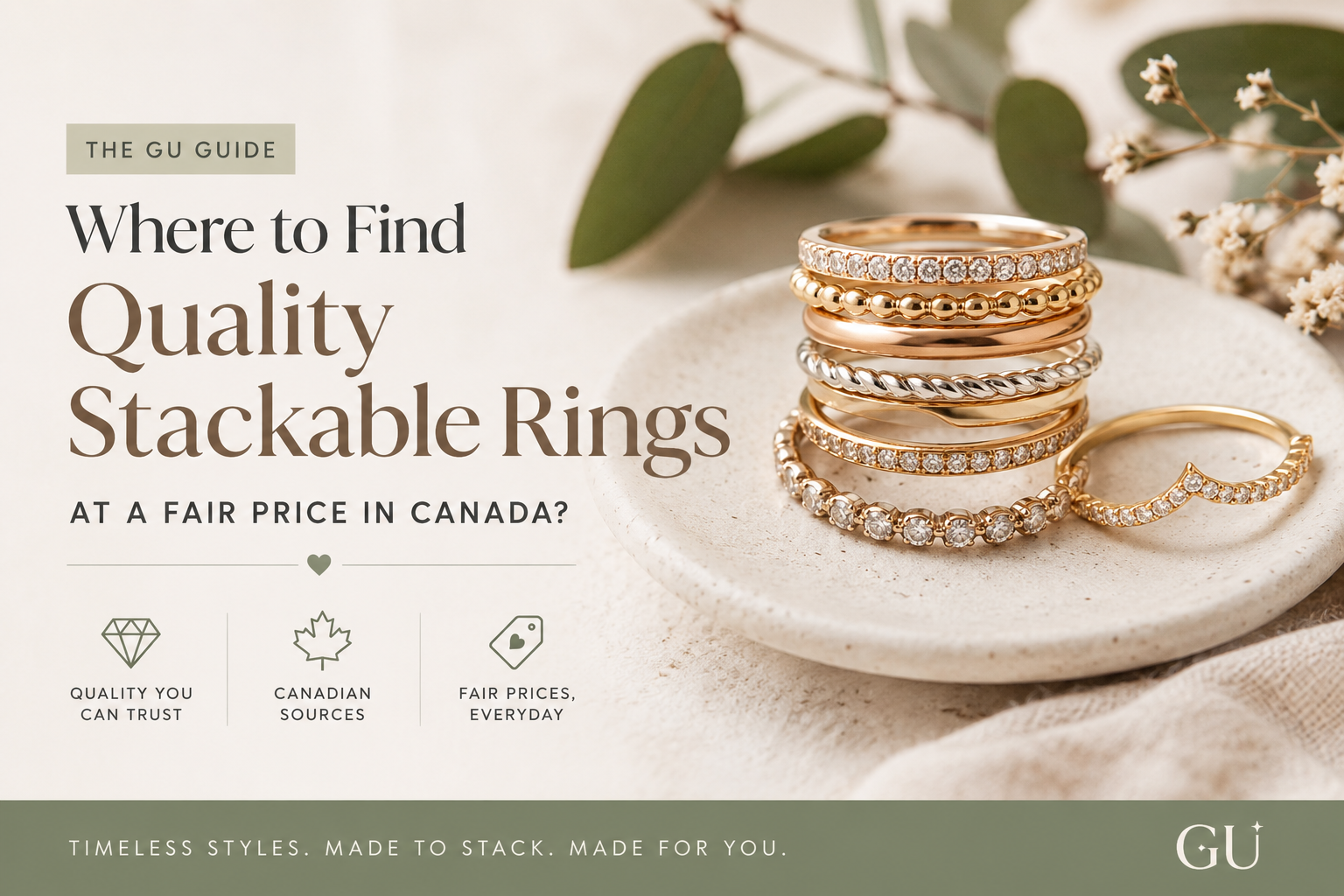
Where to Find Quality Stackable Rings at a Fair Price in Canada?
Stackable rings have quietly become one of the most worn and most over-bought categories in Canadian jewellery. They look effortless on the hand, they let you build a collection one piece at a time, and they suit everything from a Tuesday at the office to a wedding. But “effortless” hides a real problem for shoppers: the gap between a thirty-dollar ring that turns your finger green by summer and a two-thousand-dollar ring that lasts a lifetime is enormous, and the marketing on both ends looks almost identical.
So the question worth answering carefully is the one most Canadians are actually typing into Google: where do you find quality stackable rings at a fair price in Canada without overpaying for a name or underpaying for something that won’t last?
This guide answers that in full. You’ll learn what “quality” actually means for a stackable ring (it’s mostly the metal and the stone, not the brand), what a fair price looks like in Canadian dollars, where to buy across every channel from local ateliers to international specialists, how to vet any seller in five minutes, and the 2026 styling trends shaping what Canadians are stacking right now. We’ll also look at where gemstone stacking rings fit including specialists like GU, who craft stacks around natural, untreated, certified stones. By the end, you’ll be able to open any website or walk into any shop and tell quickly whether you’re looking at real value or a markup dressed up as luxury.
What “Quality” and “Fair Price” Actually Mean for a Stackable Ring?
Before you can find a good deal, you need a working definition of the thing you’re paying for. With stackable rings, quality and price come down to four levers, in roughly this order of importance.
1. The metal
This is the single biggest driver of both how long a ring lasts and what it costs. Solid gold, gold vermeil, gold-filled, plated, sterling silver, and platinum are radically different products even when they look the same in a photo, and most “bad value” purchases happen here a thinly plated base metal sold at a price that implies something far more durable.
2. The stone (if there is one)
A stacking ring with a gemstone or diamond adds a second, equally important quality axis: whether the stone is natural or lab-grown, whether it’s been treated, how it’s cut, and whether it’s certified. Two rings with the same carat weight can differ in price tenfold based entirely on the stone’s origin and treatment.
3. The craftsmanship
How securely the stone is set, how smooth the band is on the inside, whether the ring is cast hollow or solid, whether prongs are even, whether the finish is consistent. Poor craftsmanship is why a stone falls out at six months or a band bends out of round.
4. The brand and the buying experience
Certification, sizing help, returns, repairs, and warranty have real value. But a brand premium that buys you a logo and a beautiful box and nothing structurally better than a piece costing half as much is exactly where “fair price” breaks down.
A fair price, then, isn’t simply the lowest price. It’s the price that matches the metal, the stone, and the workmanship actually in your hand, with transparency about all three. A solid 14k gold band with a certified natural sapphire shouldcost meaningfully more than a gold-plated brass band with a synthetic stone and a seller who’s clear about which one they’re selling is already doing the most important thing.
What makes a ring “stackable” in the first place?
A stackable (or “stacking”) ring is simply one designed to be worn alongside others on the same finger or across the hand, layered to build a personalised look. In practice that means slimmer profiles, comfortable edges, and designs that pair rather than compete. The category spans plain bands, textured bands, eternity and half-eternity bands, thin solitaires, midi (above-the-knuckle) rings, and gemstone accent rings. The appeal and the reason this category keeps growing in Canada is that you can start with one well-made piece and add to the story over time, marking milestones as you go.
Metals: The Biggest Driver of Quality and Price
Solid gold (10k, 14k, 18k)
Solid gold is gold all the way through, alloyed with other metals for strength. The karat number tells you the purity: 24k is pure gold (too soft for daily wear), 18k is 75% gold, 14k is 58.3% gold, and 10k is 41.7% gold. For stacking rings that you’ll wear every day and bump against keyboards, car doors, and grocery bags, 14k is the sweet spot durable, genuinely precious, and it never needs re-plating because the colour goes all the way through. 10k is the most affordable solid option and the hardest; 18k is richer in colour and value but a touch softer. Solid gold is the only gold product that is, in the truest sense, a lasting investment and the most expensive up front.
Gold vermeil
Vermeil (pronounced “ver-MAY”) is a specific, regulated product: a base of sterling silver coated with a layer of gold that is at least 10k and at least 2.5 microns thick. The sterling base is what separates it from cheaper plating you’re not paying for brass under the gold. Vermeil is an excellent middle path for stacking: it gives you a warm gold look and a precious-metal core at a fraction of solid-gold cost. The trade-off is that the gold layer can wear over years of heavy daily use and may eventually need re-plating, especially on a ring (rings take more abrasion than necklaces or earrings).
Gold-filled
Gold-filled is a thick layer of real gold mechanically bonded to a brass core, where the gold makes up at least 5% of the item’s total weight. It’s more durable than standard plating and holds up well for everyday wear a strong value choice for stacking bands. It sits, roughly, between vermeil and plated in both price and longevity.
Gold-plated (and why to read the fine print)
Standard gold plating is a very thin layer of gold over a base metal, often brass. The layer is measured in fractions of a micron and wears off comparatively quickly months to a couple of years with daily wear. Plated jewellery isn’t “bad” it’s a legitimate way to wear a trend cheaply but it should be priced like the disposable-fashion piece it is. The classic over-payment is a plated ring sold at a price that implies vermeil or solid gold. If a listing just says “gold” or “18k gold finish” without specifying solid, vermeil, gold-filled, or the plating thickness, assume it’s plated and price it accordingly.
Sterling silver (925)
Sterling silver is 92.5% pure silver (hence the “925” stamp), alloyed for strength. It’s an outstanding everyday metal for stacking: genuinely precious, hypoallergenic for most people, beautifully cool-toned, and very affordable. It tarnishes over time when exposed to air and skin oils, but tarnish wipes away easily with a polishing cloth and isn’t permanent damage. Many of the best-value Canadian stacking rings are solid sterling silver.
Platinum
Platinum is the premium white metal denser and more durable than gold, naturally white (so it never needs rhodium re-plating the way white gold does), and hypoallergenic. It’s the priciest option and is usually reserved for heirloom or engagement-adjacent pieces rather than casual stacks. Worth knowing about; rarely the budget choice.
Metal comparison at a glance
| Metal | What it actually is | Everyday durability | Typical CAD for one stacking band | Best for |
| Solid 14k gold | Gold throughout (58.3%) | Excellent | ~$200–$700+ | A forever piece; the anchor of a stack |
| Gold vermeil | Sterling silver + ≥2.5µm gold (≥10k) | Good (may need re-plating over years) | ~$70–$180 | Gold look with a precious core, mid-budget |
| Gold-filled | Thick bonded gold (≥5% weight) over brass | Good | ~$50–$140 | Durable everyday gold look, value-focused |
| Gold-plated | Thin gold over base metal | Limited (months–years) | ~$20–$60 | Trying a trend cheaply |
| Sterling silver (925) | 92.5% silver | Good (tarnish wipes off) | ~$30–$120 | Best-value precious everyday stacking |
| Platinum | Naturally white, dense precious metal | Excellent | ~$500–$1,500+ | Heirloom / premium pieces |
Prices are approximate Canadian ranges for a single plain or lightly detailed stacking band and will vary with weight, brand, design, and gold price. Gemstones add cost on top.
Gemstones in Stackable Rings: Where Quality and Value Really Show
Plenty of stacking rings are plain metal a perfectly good way to build a stack. But the moment you add a gemstone or diamond, a second quality story begins, and it’s the area where Canadian shoppers most often either overpay or get something misrepresented. It’s also where a true specialist earns their keep.
Natural vs lab-grown vs simulated
There are three very different things sold under the umbrella of “gemstone,” and the price gap is huge:
- Natural gemstones are mined from the earth and formed over millions of years. They carry rarity, individuality, and lasting resale relevance and they cost the most. A fine natural ruby, sapphire, or emerald is genuinely scarce.
- Lab-grown gemstones are chemically and physically identical to natural stones but created in a lab in weeks. They’re real gemstones (not fakes), they’re more affordable, more consistent, and increasingly popular for ethical and budget reasons. The catch: they should be clearly disclosed and priced as lab-grown never sold at natural-stone prices.
- Simulated stones (cubic zirconia, glass, synthetic spinel, “CZ”) merely imitate the look of a gemstone. They’re inexpensive and fine for fashion pieces, but they are not the same material and should never command precious prices.
None of these is “wrong” but paying a natural price for a lab-grown or simulated stone is the most common way to lose money on gemstone jewellery. Transparency is everything.
Treated vs untreated the quiet quality issue
Here’s something most casual buyers never hear: a large share of coloured gemstones on the market have been treated to improve their appearance most commonly heat treatment to deepen colour or improve clarity, but also fracture-filling, dyeing, irradiation, and more. Treatment isn’t illegal or always bad, but it dramatically affects value and durability, and it must be disclosed. An untreated, all-natural stone is rarer and more valuable than a treated one of the same size and colour.
This is precisely the niche that specialist gemstone houses occupy. GU, for example, built its reputation on natural, untreated, unheated gemstones rubies, sapphires, emeralds, and more certified and graded on cut, clarity, colour, carat and the fact that they’ve undergone no enhancement. For a buyer who wants a meaningful gemstone in a stack a birthstone, an anniversary stone, an heirloom-grade piece knowing the stone is genuinely natural and untreated is a real, payable form of quality, not marketing fluff.
The 4 Cs, adapted for stacking
The familiar diamond grading framework cut, colour, clarity, carat applies to coloured gemstones too, with colour usually mattering most. For small accent stones in a stacking ring you don’t need an investment-grade stone, but you do want even colour, a clean-enough appearance to the eye, and a cut that actually sparkles rather than looking flat. For a hero gemstone you intend to keep, the 4 Cs and certification matter a great deal more.
Certification: the simplest fair-price safeguard
A certificate or grading report from a recognised gemmological lab is the closest thing to a receipt for honesty. It states the stone’s identity, whether it’s natural or lab-grown, and whether it’s been treated. For any meaningful gemstone purchase, ask for certification and be wary of a seller who can’t or won’t provide it. Reputable specialists certify as standard. Certification is also what lets you compare two stones fairly across two different sellers; without it, you’re trusting adjectives.
Durability: will the stone survive daily stacking?
Because stacking rings rub against each other and against everything you touch, hardness matters. The Mohs scale (1–10) measures scratch resistance. Softer stones can still be stacked beautifully they just want more protective settings (bezels) and gentler wear.
| Gemstone | Mohs hardness | Everyday-stacking suitability |
| Diamond | 10 | Excellent wears with anything |
| Sapphire / Ruby (corundum) | 9 | Excellent ideal hero stones for stacks |
| Topaz | 8 | Very good |
| Emerald (beryl) | 7.5–8 | Good, but often included/brittle treat gently |
| Garnet | 6.5–7.5 | Good |
| Amethyst / Citrine (quartz) | 7 | Good |
| Morganite (beryl) | 7.5–8 | Good a 2026 favourite |
| Opal | 5.5–6.5 | Delicate bezel-set, occasional wear |
| Pearl | 2.5–4 | Delicate keep away from abrasion |
The practical rule: a sapphire or ruby band can live on your hand permanently; an opal or pearl stack is better for going out than for gardening.
Meaning, birthstones, and the Vedic angle
A big part of why gemstone stacking is booming in 2026 is meaning. Buyers increasingly want stones tied to a person, a month, or a milestone rather than mass-produced sameness. Birthstone stacks (one ring per family member, for instance) are a perennial favourite. There’s also a long tradition central to GU’s specialty in Vedic/Jyotish gemmology of associating specific gemstones with planets and personal significance. Whatever your view of the symbolism, the practical takeaway is the same: a stone chosen for meaning still has to be a good stone, judged on the same quality and value criteria as any other.
How Much Should Stackable Rings Cost in Canada? Realistic CAD Price Ranges
“Fair” is easier to judge once you know the going rates. These are realistic Canadian retail ranges in 2026 use them as guardrails: prices far below the low end usually signal a cheaper metal or stone than advertised, and prices far above the high end usually signal a brand premium you should be able to justify.
| Ring type | Typical CAD range | Notes |
| Sterling silver plain/textured band | $30–$120 | Excellent everyday value |
| Gold-plated fashion band | $20–$60 | Trend piece; replace as it wears |
| Gold vermeil band | $70–$180 | Precious core, gold look |
| Gold-filled band | $50–$140 | Durable everyday gold tone |
| Solid 10k gold thin band | $150–$400 | Entry to “forever” gold |
| Solid 14k gold band (plain) | $200–$700 | The classic anchor piece |
| Sterling silver + small natural gemstone | $80–$250 | Great meaning-to-cost ratio |
| Gold vermeil + lab-grown stone | $120–$300 | Affordable colour + sparkle |
| Solid 14k gold + small natural gemstone | $400–$1,500 | Heirloom-leaning |
| Fine natural gemstone in solid gold (hero piece) | $1,000–$5,000+ | Driven by the stone’s quality, carat, rarity, and certification |
A few honest caveats: gold prices move, so solid-gold ranges drift with the market; custom and bespoke work costs more than ready-made because you’re paying for design time and craftsmanship; and a fine natural, untreated, certifiedcoloured gemstone can easily exceed these ranges, because at that level you’re buying rarity, not just material which is exactly why certification matters so much at the top end.
Red flags in both directions
- Too cheap: “18k gold” rings for $15, “real sapphire” for $20, no metal stamp mentioned, no stone certification, hundreds of identical “handmade” listings. These are almost always plated base metal and simulated stones.
- Over-priced: A heavy brand premium on a plated or hollow-cast piece; “luxury” pricing with vague metal descriptions; a gemstone sold without disclosure of treatment or origin; pressure tactics and perpetual “today only” discounts.
The middle clearly described metal, disclosed and ideally certified stones, pricing that lines up with the table above is where fair value lives.
Where to Find Quality Stackable Rings at a Fair Price in Canada?
Now the central question. There’s no single “best” source the right channel depends on whether you want a trend piece, an everyday workhorse, or a meaningful heirloom. Here’s an honest tour of every route, with the trade-offs.
Canadian fine jewellers and direct-to-consumer brands
Canada has a strong field of homegrown and Canada-serving brands that build their reputation on transparent materials and stacking-friendly designs. Direct-to-consumer labels like Mejuri popularised accessible solid gold and vermeil stacks with clear material descriptions and a polished buying experience. Ecksand crafts stackable rings in Montreal from recycled gold with a sustainability focus. Blue Ruby (Vancouver) curates solid gold, vermeil, gold-plated, and sterling silver stacks across price points. So Pretty Cara Cotter offers gold and sterling silver stacking rings designed and made in Canada. Heritage houses like Maison Birks and chains like Michael Hill carry broad ranges with the reassurance of established service and repairs. Jewlr offers personalised, made-in-Canada stackable pieces with customisation.
- Pros: Clear materials, Canadian shipping and returns, sizing help, repairs, no surprise duties, and pieces designed specifically to layer.
- Cons: You’ll usually pay a brand premium versus an independent maker, and selection of fine natural coloured gemstones (versus diamonds and trend stones) can be limited.
- Best for: Everyday gold and silver stacks, design-led pieces, and shoppers who value a frictionless Canadian buying experience.
Online marketplaces (Etsy, Amazon)
Marketplaces like Etsy and Amazon.ca offer enormous selection and the lowest entry prices, and Etsy in particular connects you with genuine independent makers some excellent, some not.
- Pros: Huge variety, customisation from small makers, very accessible prices, real reviews.
- Cons: Wildly inconsistent quality and accuracy. “Gold” often means plated; “gemstone” often means simulated; certification is rare. You have to vet each seller individually.
- Best for: Affordable trend pieces and supporting independent artisans if you read the materials carefully and treat vague listings with suspicion.
International gemstone specialists that ship to Canada
For gemstone stacking rings specifically especially natural, untreated, certified coloured stones the deepest expertise often sits with dedicated gemstone houses rather than general fashion-jewellery brands. GU is one such specialist: it focuses entirely on natural, untreated, unheated, certified gemstones and crafts them into rings (including pieces that work beautifully in a stack), shipping worldwide including to Canada.
- Pros: Genuine gemstone expertise, certification as standard, natural untreated stones, and custom crafting around a specific stone or intention.
- Cons: As an international purchase, factor in shipping time, Canadian duties and taxes, and a clear understanding of the return/exchange policy before you buy. Always confirm these in writing.
- Best for: Meaningful, gemstone-led, or heirloom-grade additions to a stack a certified natural birthstone, an anniversary sapphire, a Vedic/astrological stone where stone quality is the whole point. (More on when this route makes sense in the next section.)
Local artisans, goldsmiths, and craft markets
Independent Canadian goldsmiths and jewellery artists found at craft markets, design studios, and via local makers’ directories can offer outstanding value and one-of-a-kind work, because you’re paying for skill and materials rather than a marketing budget.
- Pros: Fair material-to-price ratio, unique designs, the ability to talk directly to the maker, easy custom sizing, and supporting local.
- Cons: Variable availability, and you’ll need to assess each maker’s quality yourself.
- Best for: Buyers who want something distinctive and personal, made by a real person, often at a genuinely fair price.
Whichever channel you choose, run every seller through the same quick test before paying the Smart Shopping Checklist near the end of this guide. In short: insist on an exact metal description and hallmark, disclosed stone origin and treatment, clear returns and (for cross-border orders) duties, and reviews that speak to durability over time, not just delivery speed. A seller who passes is almost certainly fair value; one who dodges the metal and stone questions is not.
GU: A Specialist Route for Quality Gemstone Stackable Rings
Because this guide is published by GU, it’s only fair to be precise about where the brand fits and where it doesn’t so you can make an honest decision.
GU positions itself as a specialist in natural, untreated, unheated, certified gemstones, with deep roots in Vedic/Jyotish gemmology the traditional Indian science of associating specific gemstones (rubies, sapphires, emeralds, red coral, yellow sapphire, and more) with planets and personal significance. Each stone is graded not only on the classic 4 Cs but on the strict requirement that it is genuinely natural and unenhanced, then crafted into rings, pendants, and talismans. The brand ships internationally, including to Canada.
When GU is the right fit:
- You want a meaningful gemstone at the centre of your stack a certified natural birthstone, an anniversary stone, or a stone chosen for Vedic/astrological significance.
- You specifically value a natural, untreated, certified stone over a treated or lab-grown one, and you want documentation to prove it.
- You want a piece crafted around a particular gemstone or intention, rather than picking from a fashion catalogue.
- You’re building a stack with heirloom-grade colour stones meant to last and hold meaning.
When a Canadian fashion-jewellery brand is the better call:
- You want plain metal trend bands, the latest organic/sculptural shapes, or budget plated pieces to refresh a look seasonally.
- You want same-country shipping, easy returns, and no duties as the priority.
- Your stack is about style and layering more than a single significant stone.
In other words: for the everyday architecture of a stack the plain gold and silver bands a Canadian direct-to-consumer brand or a local goldsmith is often the simplest, fairest route. For the meaningful gemstone that anchors the stack, a dedicated specialist that certifies natural, untreated stones is worth the extra steps of an international order. Just confirm shipping, duties, taxes, and the return policy in writing before any cross-border purchase.
How to Build and Style a Ring Stack (2026 Trends + Practical Tips)
A great stack is part shopping, part styling. Here’s how to assemble one that looks intentional rather than accidental and what’s actually trending in Canada this year.
The fundamentals
- The rule of three. A classic, foolproof starting point: three rings on one finger, with the boldest “hero” ring (a gemstone or wider band) in the middle, framed by two simpler bands.
- Vary the proportions. Mix at least one chunkier or textured band with thinner ones. All-identical bands read as a single ring; contrast is what makes a stack look curated.
- Use negative space. You don’t have to fill every finger a loaded index finger balanced by a single band elsewhere often looks more elegant than rings on every digit.
- Anchor, then add. Buy one excellent piece first typically solid gold or a certified gemstone band and build outward over time.
What’s trending for stacks in 2026
The current moment is unusually friendly to mixers and individualists:
- Mixed metals even within one piece. The old “never mix gold and silver” rule is gone; layering warm and cool tones is now the point, and designers are even combining metals in a single ring. For a stacker, your existing gold and silver bands finally belong together.
- Organic and sculptural shapes. Wave-form bands, “melted-metal” textures, and fluid, asymmetric silhouettes used as the standout piece in an otherwise simple stack.
- Asymmetry. Deliberately mismatched sizes and shapes a chunky band beside a dainty midi ring for a personal, of-the-moment look.
- Eternity and half-eternity bands. Timeless, subtly glamorous, and endlessly stackable; a perennial 2026 keeps front and centre.
- Meaningful colour. Natural coloured gemstones chosen for personal significance sapphire, ruby, emerald, morganite used as expressive accents.
- Sustainability. Recycled gold and responsibly sourced, traceable stones are increasingly part of the decision, and several Canadian makers lead here.
Sizing your stacking rings
Sizing is where comfort is won or lost:
- Stacked rings can feel tighter together than worn alone, because they press against each other. If you’ll always wear several on one finger, some people size up by a quarter to half size for the upper rings.
- Midi rings sit above the knuckle and run smaller than your base ring size measure the spot where they’ll actually sit.
- Comfort-fit bands (slightly domed on the inside) slide on more easily and feel better in a stack, especially for everyday wear.
- Fingers change size with temperature, time of day, and season measure when your hands are at a normal temperature, not cold.
- When buying online, use the retailer’s printable ring sizer or, better, get sized in person once and keep your measurement on hand.
Caring for Stackable Rings So They Last
Quality bought at a fair price still needs care and because stacked rings rub against one another, they need a little more of it than solo rings.
- Clean by metal. For solid gold and platinum, use warm water, a drop of mild dish soap, and a soft brush, then dry thoroughly. For sterling silver, a polishing cloth removes tarnish. For vermeil and plated pieces, be gentle avoid harsh chemicals, ultrasonic cleaners, and abrasive cloths, which strip the gold layer; simply wipe with a soft, dry cloth.
- Mind the gemstones. Hard stones (diamond, sapphire, ruby) tolerate gentle brushing; softer or porous stones (opal, pearl, emerald) want only a soft dry wipe, with no soaking or chemicals.
- Take rings off for the rough stuff cleaning with chemicals, swimming (chlorine is hard on gold alloys and some stones), the gym, gardening, and applying lotions, perfumes, and sunscreen. Chemicals and abrasion are the top causes of premature wear and lost stones.
- Store them so they don’t scratch each other in separate compartments or soft pouches; store silver with anti-tarnish strips in a closed box.
- Expect to re-plate vermeil and plated rings eventually with heavy daily wear it’s normal, not a defect and have prongs and settings on gemstone rings checked periodically by a jeweller. Catching a loose prong early is far cheaper than replacing a lost stone.
Treated well, a solid-gold or sterling stack will look beautiful for decades, and even vermeil pieces will last for years.
Frequently Asked Questions
Where can I find quality stackable rings at a fair price in Canada?
You’ll find the best value across three routes: Canadian direct-to-consumer brands and local goldsmiths for everyday gold and silver bands; online marketplaces for affordable trend pieces (with careful vetting of materials); and dedicated gemstone specialists for meaningful natural, certified gemstone rings. The key to a fair price is matching what you pay to the actual metal, stone, and craftsmanship and choosing sellers who disclose all three clearly.
Are stackable rings worth it?
Yes, for most people, because they let you build a collection gradually and restyle endlessly without buying a whole new piece each time. The “worth it” part depends entirely on quality-to-price: a well-chosen solid gold or sterling band, or a certified gemstone ring, holds its value and lasts; a thinly plated band sold at a precious-metal price does not.
How many rings should you stack?
There’s no rule comfort and personal style decide. Two to four rings on one finger is the most common and easiest to balance, with the boldest piece typically in the middle of three. Start with three and adjust.
Can you mix gold and silver in a ring stack?
Absolutely and in 2026 it’s actively on-trend. Mixing warm and cool metals reads as intentional and modern, and designers are even combining metals within single pieces. Layering different tones also makes your stack flexible enough to match more outfits.
What metal is best for everyday stacking?
For lasting everyday wear at a fair price, solid 14k gold (if budget allows) and sterling silver 925 (for value) are the standouts, because the colour and material run all the way through and never need re-plating. Gold-filled and gold vermeil are strong middle options for a gold look at lower cost, with the understanding that the gold layer can wear over years.
Are gemstone stackable rings durable enough for daily wear?
It depends on the stone. Diamonds, sapphires, and rubies (Mohs 9–10) handle daily stacking with ease. Quartz stones, topaz, garnet, and morganite are good with reasonable care. Softer or porous stones like opal and pearl are best in protective bezel settings and for going-out rather than gardening. Choose the stone to match your lifestyle, and have settings checked periodically.
How can I tell if a stackable ring is good quality?
Check four things: a clearly stated metal with a hallmark (14k, 18k, 925, etc.); disclosed stone origin and treatment, with certification for significant stones; even, secure craftsmanship (smooth interior, level prongs, consistent finish); and a price that fits the materials. A seller who’s transparent about all of this is the strongest quality signal of all.
What’s the difference between gold-plated, vermeil, gold-filled, and solid gold?
Gold-plated is a very thin gold layer over base metal (cheapest, wears fastest). Vermeil is a thicker gold layer (≥2.5 microns, ≥10k) over a sterling silver base (precious core, mid-price). Gold-filled is a thick bonded gold layer (≥5% by weight) over brass (durable, value-focused). Solid gold is gold throughout (most durable and valuable, never needs re-plating). They can look identical in photos, so always read the description.
Is lab-grown or natural better for stacking gemstone rings?
Neither is universally “better” it’s about priorities and honesty. Lab-grown stones are real, more affordable, and a popular ethical choice. Natural stones carry rarity and lasting value, and untreated natural stones are the most prized. The non-negotiable is disclosure: whichever you buy should be clearly labelled and priced accordingly. Never pay a natural price for a lab-grown or simulated stone.
Does GU ship to Canada?
GU ships its natural, untreated, certified gemstones and gemstone rings internationally, including to Canada. As with any cross-border purchase, confirm current shipping times, Canadian duties and taxes, and the return/exchange policy in writing before ordering, so the final landed cost and your options are clear up front.
How do I find my ring size for stacking rings?
Get sized in person at a jeweller once and keep the measurement, or use a retailer’s printable ring sizer at home. Remember that rings worn stacked can feel slightly tighter than worn alone, so some people size up a quarter to half size for upper rings; midi (above-the-knuckle) rings run smaller; and fingers change size with temperature and time of day, so measure when your hands are at a normal temperature.
The Bottom Line
Finding quality stackable rings at a fair price in Canada isn’t about hunting for a secret cheap source it’s about knowing what you’re paying for so you can recognise fair value anywhere you shop. Master the metals (solid gold and sterling silver for lasting everyday value; vermeil and gold-filled as smart middle options; plated only at plated prices). Understand the stones (natural vs lab-grown vs simulated, treated vs untreated, certification for anything meaningful). Then match the price to the realistic Canadian ranges, and vet every seller on transparency.
For the everyday bands that form a stack’s architecture, Canada’s direct-to-consumer brands and local goldsmiths offer excellent, honest value. For the meaningful gemstone that anchors a stack a certified natural birthstone, an anniversary stone, or a stone chosen for its significance a specialist like GU, focused on natural, untreated, certified gemstones, is worth the extra steps of an international order. Start with one piece you genuinely love, buy it from someone who tells you the truth about it, and build your stack and your story from there.