


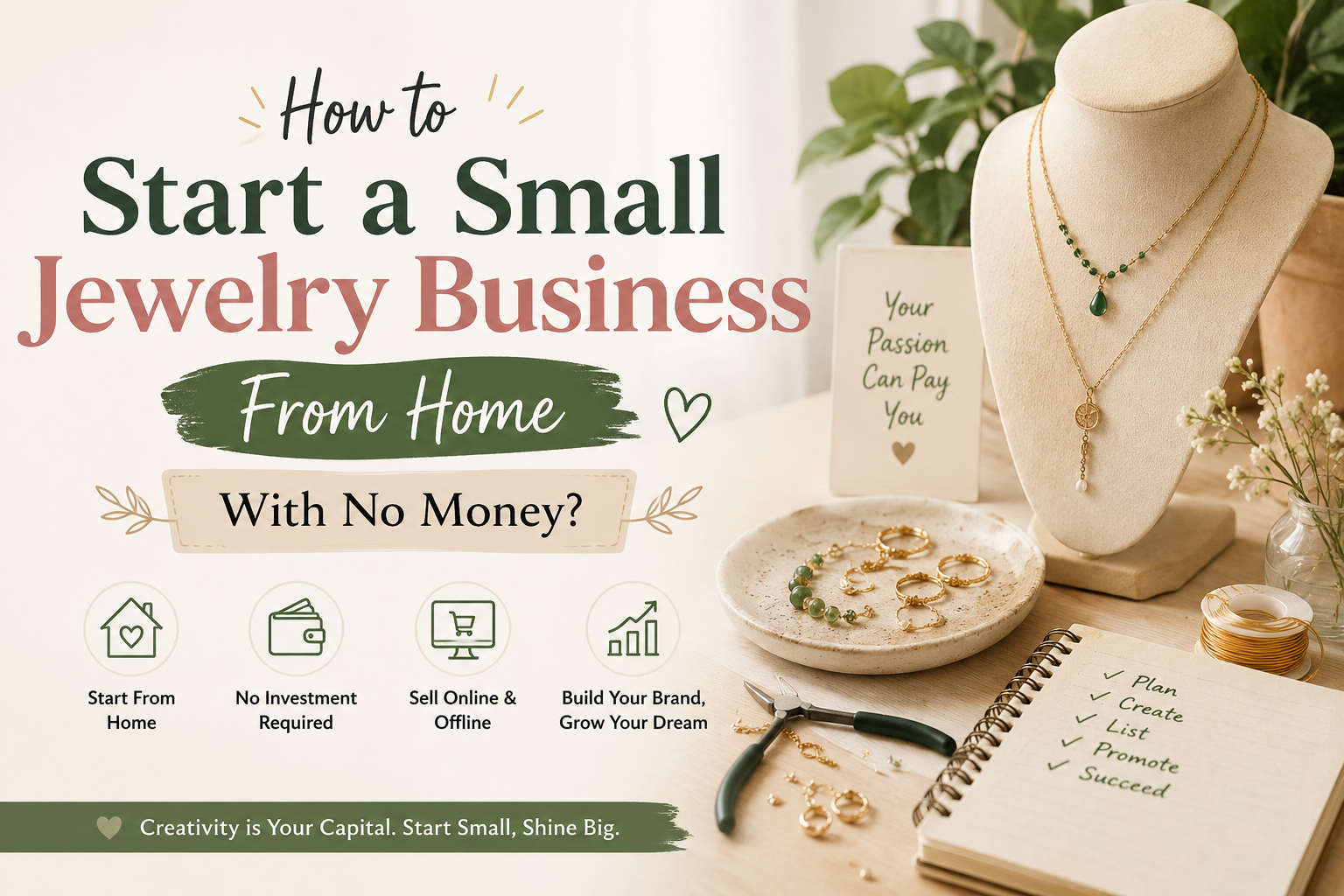
How to Start a Small Jewelry Business From Home With No Money?
Most guides on this topic quietly assume you have a few hundred dollars to “get started.” This one doesn’t. If your budget is genuinely close to zero, you can still launch a real jewelry business from your kitchen table but only if you choose the right model and do things in the right order.
This guide walks through exactly how to do that: the business models that need no inventory, the free tools that replace paid ones, how to price so you actually make money, and the legal basics you can’t skip in the United States. Everything here is built around one rule spend nothing until a customer has paid you first.
Step 1: Choose a Niche You Can Genuinely Own
A niche is simply the specific person and style you serve, and it’s the cheapest competitive advantage you have. “I sell jewelry” competes with millions of stores. “I make minimalist gold-fill necklaces for new moms” speaks directly to someone and that person is far easier (and cheaper) to reach.
Pick a lane based on three overlapping things: what you’re drawn to, what people are actively buying, and what you can realistically source or make. A few examples that work well for beginners:
- Minimalist everyday pieces dainty necklaces, stacking rings, simple hoops.
- Personalized jewelry initials, birthstones, names, coordinates, dates.
- Meaning-driven pieces birthstone and gemstone jewelry, healing crystals, zodiac themes.
- Statement or trend pieces bold earrings, beaded designs, color-led collections.
Resist the urge to be everything. A tight niche makes your marketing free-er (you know exactly who you’re talking to), your photos more consistent, and your brand more memorable.
Step 2: Pick a Business Model That Needs Zero Inventory
This is the most important decision in the whole process, so spend real time here. Your model determines whether you need money upfront or not. Five paths let you start with no inventory:
| Model | How it works | Upfront cost | Best for |
| Made-to-order / pre-order | Customer orders and pays first; you then make or source the piece | ~$0 | Handmade and fine/gemstone jewelry |
| Dropshipping | A supplier ships directly to your buyer; you only pay after a sale | ~$0 | Fashion/trend jewelry, fast launch |
| Print on demand (POD) | A supplier engraves/personalizes and ships per order | ~$0 | Personalized necklaces, charms, gifts |
| Consignment | A local shop displays your pieces and pays you only when they sell | ~$0 | Handmade makers near boutiques |
| Upcycle / thrift-sourced | You restyle pieces you already own or thrift cheaply, sell, reinvest | A few dollars | Vintage, one-of-a-kind, creative makers |
A few notes that save beginners from costly mistakes:
Made-to-order is the most underrated path.
Because the customer pays before you build anything, you carry no inventory and need no capital and unlike dropshipping, you can offer genuinely distinctive, higher-value pieces. This is the only model that lets you sell fine jewelry (real metals and genuine gemstones) without tying up cash, since you only buy the materials once an order is in hand.
Dropshipping and POD are the fastest to launch, but margins are thinner and thousands of stores sell the identical catalog. If you go this route, your brand, photography, and customer experience are what set you apart not the product.
Consignment costs nothing but a conversation.
Pitch a few local boutiques in person. Rejection is common; you only need one yes to get your pieces in front of paying customers.
You can also blend models for example, dropship a few trend pieces to bring in traffic while you build a made-to-order line of signature gemstone jewelry with healthier margins.
Step 3: Validate Demand Before Spending a Cent
Before you build a brand or list a single product, confirm people actually want what you’re planning to sell. This research is free and prevents you from wasting effort on designs nobody buys.
Spend an hour doing this:
- Search your niche on Etsy and sort by “Top customer reviews” or “Most recent” to see what’s selling, at what price, and how listings are described.
- Browse Pinterest and TikTok for your style keywords. Save what’s getting strong engagement these are visual signals of demand.
- Read the reviews on competing products. The complaints (“clasp broke,” “smaller than expected,” “wanted more colors”) are a free roadmap to doing it better.
- Check Google for your product terms to gauge how many people are searching and what the top results look like.
You’re looking for a sweet spot: enough demand that people are clearly buying, but enough gaps that you can offer something better or more specific. Write down three things you’ll do differently, and let that shape your first small collection.
Step 4: Build a Brand Using Only Free Tools
You don’t need a designer or a paid platform to look professional. A brand is mostly a clear name, a consistent look, and a reason to choose you.
- Name: Make it short, easy to spell, and easy to remember. Check that the matching social handles and a domain are available before you commit.
- Logo and visuals: Free tiers of design tools like Canva are more than enough to make a clean wordmark, choose two or three brand colors, and create matching social templates.
- Your USP (unique selling proposition): One sentence on why someone should buy from you ethically sourced, genuinely certified gemstones, made-to-order personalization, a specific aesthetic, or a story only you can tell. Put it everywhere: your bio, your listings, your packaging note.
Consistency matters more than polish. The same colors, fonts, and photo style across every touchpoint make a brand-new shop feel established.
Step 5: Source Products Without Buying Stock Upfront
How you get product depends on the model you chose in Step 2, and the goal is the same: don’t pay until you have to.
If you’re making pieces yourself, start with what you have and what’s cheap. You can improvise basic tools (a sturdy pair of household pliers and clippers will get you surprisingly far), buy only the components a current order requires, and add better tools later from profits not before.
If you’re curating or dropshipping, vet suppliers carefully. Order one sample only once you have your first sale or once you can afford a single piece to verify quality, photograph it, and confirm shipping times before promising anything to customers.
If you want to stand out with genuine gemstone jewelry, the made-to-order model is your friend. Instead of competing in the crowded race of identical mass-produced pieces, you can offer authentic, lab-certified natural gemstones set into rings or pendants only after a customer commits. This is exactly the kind of sourcing Gemstones Universe specializes in: natural, untreated, certified stones with delivery to the USA and in-house custom craftsmanship, so a new business can offer real fine-jewelry pieces without locking up cash in inventory. The customer’s deposit funds the stone; you carry no stock and no risk. (When you do sell genuine stones, always pass the certification through to your buyer it builds trust and protects you under US advertising rules, more on that below.)
The principle across all three: every dollar you spend on product should be triggered by a dollar a customer already gave you.
Step 6: Take Sales-Ready Photos With Your Phone
Online, your photos are your product customers can’t touch or try the piece, so the image does all the selling. The good news: a modern smartphone is genuinely enough.
- Use natural light. Shoot near a window during the day; skip harsh direct sun and indoor yellow bulbs.
- Keep the background clean. A sheet of white paper, a neutral fabric, or a simple wood surface keeps the focus on the jewelry.
- Show scale. Include at least one photo of the piece being worn (on you or a friend) so buyers understand the size.
- Shoot multiple angles and a close-up of any detail a gemstone, a clasp, an engraving.
Free phone editing tools handle the rest: straighten, brighten, and crop. Consistent lighting and background across every listing is what makes a shop look trustworthy.
Step 7: Open a Free (or Nearly Free) Storefront
You don’t need a custom website on day one. Start where the buyers already are and where setup is free or close to it:
- Etsy built-in audience of people specifically looking for handmade and unique jewelry. Listings carry a small per-item fee (cents), payable from sales, which fits a no-money start.
- Instagram and Facebook set up a free business profile and shop, post your collection, and sell through DMs and tagged products.
- Pinterest acts as a free, search-driven traffic source that sends shoppers to wherever you sell.
- Shopify or another store builder most offer a free trial, so you can build and even sell before committing to a paid plan once revenue is coming in.
A practical sequence: launch on a free marketplace and social platforms first, then graduate to your own branded store once consistent sales justify the small monthly cost.
Step 8: Price Your Jewelry for Real Profit
Underpricing is the fastest way to quit. Many beginners price to cover materials and nothing else, then wonder why the “business” feels like an expensive hobby. Price to cover everything and pay yourself.
A simple, reliable starting formula:
(Materials + Labor + Overhead) × 2 = Wholesale price Wholesale × 2 = Retail price
Here’s a worked example for a single made-to-order piece:
- Materials (chain, finding, a small stone): $12
- Labor (your time, e.g. 30 min at $20/hr): $10
- Overhead (packaging, listing fee, share of marketing): $3
- Base cost: $25 → Wholesale ($25 × 2) = $50 → Retail ($50 × 2) = $100
The exact multiplier varies by niche and what your audience will pay, but the lesson holds: always include your time and overhead, not just materials, and build in margin to reinvest. If a number feels uncomfortably high, that’s usually a sign you’ve been underpricing not that the price is wrong.
Step 9: Handle the Legal Basics (United States)
You can sell your first pieces while you sort this out, but don’t skip it. Getting the basics right makes you look professional, lets you buy wholesale and open business accounts, and keeps you out of trouble. Rules vary by state, so treat this as orientation rather than legal advice, and confirm specifics with your state and the U.S. Small Business Administration.
- Business structure. A sole proprietorship is the simplest and cheapest to start (often nothing upfront), but you’re personally liable for the business. An LLC costs a state filing fee but separates your personal assets from the business many sellers upgrade to one once sales are steady.
- DBA (“doing business as”). If you trade under a brand name that isn’t your legal name, most areas require you to register it.
- Seller’s permit / sales tax. Most states require a seller’s permit (sometimes called a sales tax permit) to collect and remit sales tax. If you sell on a marketplace like Etsy or Amazon, many states now have those platforms collect and remit sales tax for you but you still need to understand your own obligations.
- EIN. A free Employer Identification Number from the IRS lets you keep business finances separate and is often needed to open a business bank account.
- Truth-in-advertising and metal stamping. US rules require honest product descriptions. If you sell precious metals, karat/quality must be accurately marked, and you can’t misrepresent a material or a gemstone. This is where passing along genuine certification for any natural gemstone protects both your customer and you.
- Higher-volume rules. If you ever deal in precious metals or stones above certain annual thresholds, additional federal compliance can apply. That’s a “good problem” for later, but worth knowing exists.
Doing this early costs little and prevents expensive headaches as you grow.
Step 10: Market for $0
You don’t need an ad budget to get your first customers. Free, consistent marketing built around your niche does the heavy lifting.
- Show up on social media with content, not just product shots behind-the-scenes of a piece being made, the story behind a gemstone, styling ideas, customer unboxings.
- Encourage user-generated content. Ask early buyers to tag you; real photos from real customers are the most persuasive (and cheapest) marketing there is.
- Start an email list from day one with a free tier tool. Your subscribers are people you can reach for free, forever, without an algorithm in the way.
- Use word of mouth deliberately. Tell friends and family, ask them to share, and treat your first ten customers like VIPs their referrals are how small shops grow.
- Do basic SEO if you have a store or blog: write product descriptions and posts around the exact phrases your customers search, like “personalized birthstone necklace” or “certified natural gemstone ring.”
Pick two channels and be consistent rather than spreading thin across five. Momentum compounds.
Your First 90 Days: A Simple Roadmap
A plan beats motivation. Here’s a realistic, no-money sequence.
Days 1–30 Foundation.
Choose your niche and model. Validate demand for free. Build your brand with free tools. Set up a free storefront and at least one social profile. Photograph two or three sample pieces (or supplier samples once affordable). Make your first soft offer to friends, family, and your early audience.
Days 31–60 First sales.
Push consistently on your two chosen channels. Fulfill your first made-to-order or marketplace sales. Collect reviews and customer photos. Reinvest every early dollar into the next order, not into “stuff.” Begin your business registration and seller’s permit.
Days 61–90 Build momentum.
Expand your collection based on what actually sold. Start or grow your email list. Tighten your pricing using real numbers. Consider a branded store if marketplace sales are consistent. Pitch a local boutique for consignment if it fits your model.
Mistakes That Sink New Jewelry Businesses
- Buying inventory before you have buyers. The number one cash-killer. Let demand pull product, not the other way around.
- Competing only on price. If you sell the same dropshipped catalog as everyone else, you’re forced into a race to the bottom. Differentiate with brand, story, or genuinely better product.
- Underpricing your time. Materials are not your only cost. If you don’t pay yourself, you don’t have a business.
- Skipping the legal basics. It’s cheaper to set up correctly than to fix it later.
- Spreading too thin. Five half-built channels lose to two well-run ones.
- Inconsistent photos and branding. It’s free to be consistent, and consistency is what makes a new shop look credible.
Can You Really Start a Jewelry Business With No Money?
Yes with one honest caveat. “No money” rarely means zero dollars forever. It means you don’t lay out cash for inventory, equipment, or a website before you’ve made a sale. A handful of costs are effectively unavoidable (a domain or marketplace listing fee, or eventually a business registration), but those can be measured in single dollars and paid out of your first orders rather than your savings.
The trap that sinks most beginners is buying supplies, tools, and a big inventory hoping they’ll sell. Don’t. The smarter path is to flip the order: get the customer’s money first, then fulfill. That single shift is what makes a no-money launch realistic and it’s the backbone of every step below.
Frequently Asked Questions
Can I really start a jewelry business with no money?
Yes, if you use a zero-inventory model made-to-order, dropshipping, print on demand, or consignment so the customer pays before you spend. A few costs (a listing fee, a domain, eventually a business registration) are small enough to cover from your first sales rather than upfront savings.
What is the cheapest jewelry business model to start?
Made-to-order and consignment cost effectively nothing to begin, because you don’t buy product until you’ve made a sale (made-to-order) or until a shop sells your piece (consignment). Dropshipping and print on demand are also near-zero upfront and the fastest to launch.
Do I need a business license to sell jewelry in the USA?
In many cases yes. Requirements vary by state, but most sellers need to register their business and obtain a seller’s permit (sales tax permit) to collect sales tax. You can often make your first sales while you complete registration check your state’s rules and the U.S. Small Business Administration.
Can I sell jewelry on Etsy with no money?
Nearly. Etsy charges a small per-listing fee (cents) plus transaction fees on sales, which fit a no-money start because they come out of revenue rather than upfront capital. It also gives you an audience that’s already searching for jewelry.
How do I sell jewelry without holding inventory?
Use a made-to-order/pre-order model where customers pay first and you fulfill after, or partner with a dropshipping or print-on-demand supplier who ships directly to the buyer. For fine pieces, source certified gemstones only once an order is placed.
Is a home jewelry business actually profitable?
It can be, if you price correctly (covering materials, your time, and overhead with margin to spare) and keep costs lean by avoiding unsold inventory. Profit comes from consistent marketing and healthy margins, not from buying lots of stock.
How can I make my jewelry stand out from cheap online stores?
Offer something the dropshipped crowd can’t: a clear niche, a real brand story, strong photography, and genuinely distinctive product for example, made-to-order pieces with authentic, certified natural gemstones rather than mass-produced lookalikes.
The Bottom Line
You don’t need money to start a jewelry business from home you need the right model and the discipline to spend only after a customer has paid. Pick a tight niche, choose a zero-inventory path, validate demand for free, build a clean brand, and price so you actually profit. Do the legal basics early, market consistently on two channels, and reinvest every dollar into the next order.
When you’re ready to stand out with real fine jewelry instead of mass-produced pieces, made-to-order is the model that lets you do it with no inventory and no risk. Sourcing authentic, lab-certified natural gemstones the kind Gemstones Universe provides, with US delivery and custom craftsmanship means you can offer genuine, certified pieces from day one, funded by your customers rather than your savings. Start small, stay lean, and let demand grow your business one order at a time.